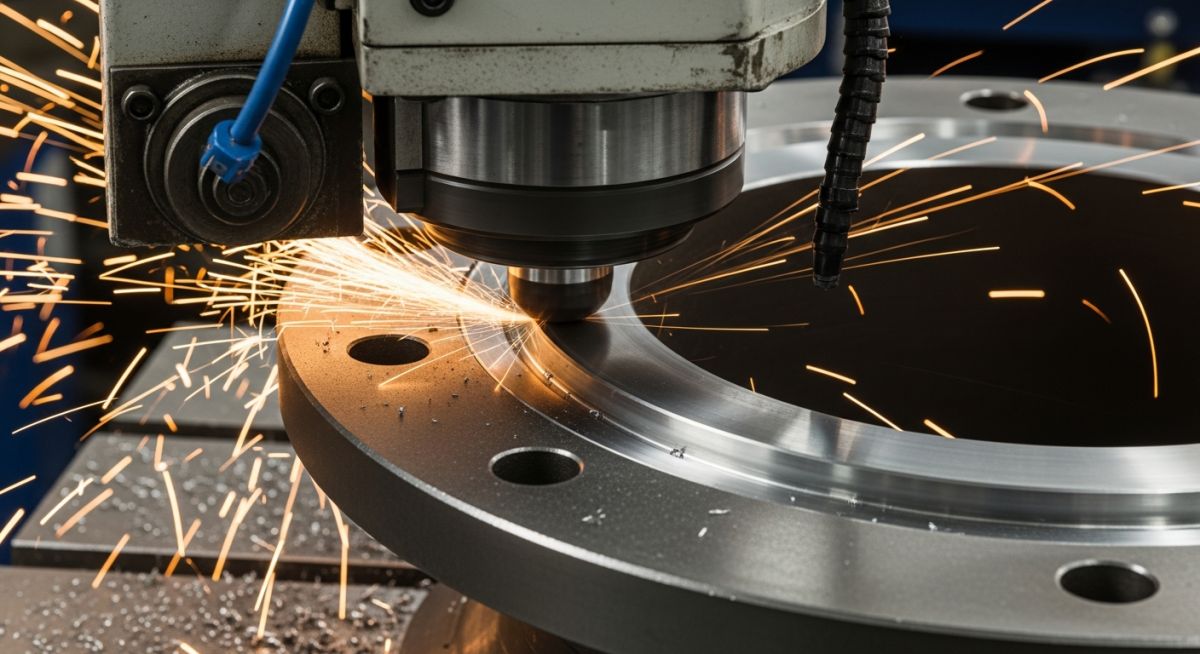
Engineering Verified Updated: February 2026 Professional Guide to the Flange Facing Machine: Engineering Standards & Types You are 48 hours into a critical refinery turnaround. A high-pressure steam line is pulled apart, only for the inspection team to find deep pitting and "wire-draw" erosion across the gasket seating surface. Without a precise Flange Facing Machine on-site, you are looking at a full spool replacement—adding days of unplanned downtime and hundreds of thousands in lost revenue. In the world of piping integrity, the seal is only as good as the surface it sits on. This guide breaks down how modern portable machining technology allows engineers to restore flange faces to ASME B16.5 or API 6A specifications in the field, ensuring a leak-free startup every time. Key Engineering Takeaways Surface Integrity: Understand how a Flange Facing Machine achieves the mandatory "phonographic" spiral serrated finish required for metallic gaskets. Mounting Versatility: Learn the critical differences between ID-mount and OD-mount machines for various spatial constraints. Standard Compliance: Ensure your machining tolerances align with ASME B16.5 and PCC-1 guidelines for bolted flange joint assembly. What is a Flange Facing Machine? A Flange Facing Machine is a portable tool used to machine and restore the seating surfaces of pipe flanges. It removes corrosion, nicks, and scratches to create a specific surface finish (usually serrated or smooth) that ensures a gas-tight seal when mated with a gasket and bolted. Founder’s Insight "In my 20 years of commissioning, I’ve seen many projects fail the initial hydro-test because they overlooked microscopic flange damage. A portable Flange Facing Machine isn't just a repair tool; it is an insurance policy for your plant's operational safety." — Atul Singla Table of Contents What is Flange Facing and Why Does It Matter? Critical Reasons Why a Flange Facing Machine is Required Industrial Applications of a Portable Flange Facing Machine Anatomy of a Modern Flange Facing Machine Step-by-Step: How a Flange Facing Machine Works Classifying the Types of Flange Facing Machines Engineering Criteria for Selection Frequently Asked Questions Engineering Check: Flange Facing Proficiency Question 1 of 5 Which ASME standard specifies the required surface finish for flange faces? ASME B31.3 ASME B16.5 ASME Section IX What is the primary benefit of an Internal Mount (ID) Flange Facing Machine? Simultaneous OD Machining Clears External Obstructions No Power Requirement Which gasket type typically requires a "Phonographic" serrated finish? Spiral Wound Gaskets Soft Rubber Gaskets PTFE Sheet Gaskets What does the term "Ra" refer to in flange machining? Rotational Acceleration Roughness Average Radial Alignment A Ring Type Joint (RTJ) flange requires what specific machining capability? Flat Face Grinding V-Groove Machining Thread Cutting Next Question What is Flange Facing and Why Does It Matter? In mechanical engineering, Flange Facing is a specialized machining process used to repair and restore the mating surfaces of a pipe flange. Over time, factors such as galvanic corrosion, chemical erosion, and mechanical impacts create imperfections on the seating area. If these surfaces are not perfectly flat or do not possess the required micro-texture, the gasket cannot achieve a sufficient seal, leading to hazardous leaks and environmental non-compliance. The process involves using a Flange Facing Machine to remove a thin layer of metal from the face, typically between 0.1mm and 0.5mm, depending on the severity of the damage. This restoration is governed by strict industry guidelines, most notably ASME B16.5, which mandates specific surface roughness values (Ra) to ensure the flange-gasket interface functions correctly under high pressure and temperature. Critical Reasons Why a Flange Facing Machine is Required for Leak Prevention A Flange Facing Machine is not merely a convenience; it is a critical safety tool. Manual sanding or grinding of a flange face is strictly forbidden in high-pressure piping because it creates an uneven surface that "wiggles" under bolt load. Here is why automated machining is mandatory: Restoration of Serrations: Standard raised-face flanges require a "phonographic" spiral groove. This groove helps "bite" into the gasket material, preventing it from blowing out under internal pressure. Only a precision machine tool can replicate this specific geometry. Achieving Parallelism: For a gasket to compress evenly, the two mating flanges must be perfectly parallel. A portable facing tool ensures the face is perpendicular to the pipe axis. Corrosion Removal: Pitting and crevice corrosion often occur in the area where the gasket meets the metal. A Flange Facing Machine cuts past the oxidized layer to reveal fresh, structurally sound metal. Emergency Repairs: During plant shutdowns, transporting a 500kg pipe spool to a machine shop is often impossible. Portable facing machines allow for "in-situ" (on-site) machining, saving days of logistical delays. Industrial Applications of a Portable Flange Facing Machine Modern Flange Facing Machines are utilized across heavy industries where fluid containment is paramount. In Refineries and Petrochemical Plants, they are used to resurface heat exchanger channels and nozzle faces. In the Power Generation sector, they maintain high-pressure steam line connections and turbine housings. Meanwhile, Offshore Oil & Gas operators rely on them to repair Ring Type Joint (RTJ) grooves that have been damaged by the harsh saline environment. Anatomy of a Modern Flange Facing Machine To achieve the precision required by ASME PCC-1 guidelines, a Flange Facing Machine is engineered with several high-rigidity components. The "Base Assembly" provides the stability, utilizing either independent or integrated leveling legs. The "Surfacing Arm" rotates around the center axis, carrying the "Tool Post" which holds the cutting bit. High-end models feature an "Automatic Feed" mechanism that synchronizes the radial movement of the tool with its rotation, ensuring a consistent spiral serration—often referred to as a phonographic finish. Step-by-Step: How a Flange Facing Machine Works The operation of a Flange Facing Machine is a clinical process that begins with "Centering and Leveling." The machine is mounted into the bore (ID) or onto the outer diameter (OD). Using dial indicators, the technician ensures the machine's axis of rotation is perfectly aligned with the flange's center. Once secured, the cutting tool is set to the desired depth. As the motor—usually pneumatic for spark-safety—spins the arm, the tool traverses the face, stripping away damaged metal to reveal a pristine surface. Classifying the Types of Flange Facing Machines Choosing the right equipment depends on the workspace and the specific flange geometry. Engineers typically categorize these machines based on their mounting system: Machine Type Mounting Style Best For... Key Advantage ID Mount Internal Bore Standard Pipes Maximum stability; clears external obstructions. OD Mount External Diameter Heat Exchangers Used when the bore is inaccessible or restricted. Orbital Milling Surface/Bolt Hole Large Diameters Higher metal removal rates on massive flanges. Engineering Criteria for the Selection of a Flange Facing Machine Selecting a Flange Facing Machine requires a deep dive into the technical specifications of the piping system. You must first determine the Facing Range—the minimum and maximum diameter the machine can reach. Secondly, consider the Power Source; in explosive environments like refineries, pneumatic motors are preferred over electric ones. Lastly, verify the machine's capability to produce the required Surface Finish (Ra). For example, API 6A standards for wellhead equipment may require much tighter tolerances and specific groove geometries compared to standard utility piping. Engineering Case Study: Zero-Leakage Turnaround Location Coastal LNG Terminal Equipment ID-Mount Flange Facing Machine Standard ASME B16.5 / PCC-1 The Challenge: Salt-Air Corrosion During a scheduled inspection at a coastal LNG terminal, maintenance engineers discovered severe crevice corrosion on thirty-two 24-inch Class 600 flanges. The saline environment had compromised the serrated finish, rendering the spiral wound gaskets ineffective. Traditional replacement would have required hot-work permits and weeks of welding and X-ray testing. The Solution: In-Situ Machining An engineering team deployed a portable Flange Facing Machine. By mounting the machine internally, they achieved a rigid setup despite the high-wind conditions. The team performed a "skin cut" of 0.3mm to remove the corrosion and then used the machine's automatic radial feed to re-cut the phonographic grooves to a specific 125-250 AARH finish. Technical Outcome: Accuracy: Achieved flatness within 0.05mm across the entire 24-inch diameter. Time Savings: Completed all 32 flanges in 4 days, compared to an estimated 20 days for spool replacement. Validation: 100% success rate during the subsequent 1.5x design pressure hydrostatic test. Don't miss this video related to Flange Facing Machine Summary: Master Piping Engineering with our complete 125+ hour Certification Course: ...... ✅ 2500+ VIDEOS View Playlists → JOIN EXCLUSIVE EDUCATION SUBSCRIBE Expert Insights: Lessons from 20 years in the field Thermal Expansion Management: When using a Flange Facing Machine on large-diameter stainless steel flanges, always account for work-hardening. Use a slower spindle speed and a deeper, consistent cut to stay "under" the hardened surface layer. Tooling Selection: Never settle for generic bits. For high-chrome alloys, utilize TiN-coated carbide inserts. The geometry of the tool nose radius directly dictates your peak-to-valley height, which is the "DNA" of your gasket's seal. The "Shadow" Test: After machining, use a flashlight held at a low angle across the flange face. Any deviation in the spiral serration (the phonographic finish) will cast a shadow, indicating a feed rate inconsistency or machine vibration that could cause a leak. Rigidity is King: 90% of machining chatter is caused by improper mounting. Always over-torque the leveling legs and verify with a dial indicator before the first pass. A vibrating tool creates "chatter marks" that act as leak paths for high-pressure gas. References & Standards For further technical validation, consult the following global authorities: ASME B16.5: Pipe Flanges and Flanged Fittings ASME PCC-1: Guidelines for Bolted Flange Joint Assembly API 6A: Specification for Wellhead and Tree Equipment ISO 7005-1: Pipe Flanges - Steel Flanges Expert FAQ: Mastering the Flange Facing Machine What is the standard surface finish for a Flange Facing Machine? ▼ According to ASME B16.5, the standard finish for raised face flanges is a serrated spiral or concentric finish with a roughness of 125 to 250 micro-inches (3.2 to 6.3 micrometers Ra). A Flange Facing Machine achieves this by controlling the feed rate and tool radius. Can I machine a flange while the pipe is under pressure? ▼ Absolutely not. This is a major safety violation. A Flange Facing Machine requires the system to be completely depressurized, drained, and blinded (LOTO). Machining removes wall thickness, and any internal pressure could cause a catastrophic rupture during the operation. How do I choose between an ID-mount and OD-mount machine? ▼ Choose an ID-mount Flange Facing Machine for standard open pipes as they are lighter and faster to center. Opt for an OD-mount machine when the bore is obstructed (e.g., by internal valves or heat exchanger tubes) or when you need to machine the flange OD simultaneously. Why is my Flange Facing Machine creating "chatter" marks? ▼ Chatter is usually caused by insufficient rigidity. Check if the mounting legs are loose or if the tool bit overhang is too long. Reducing the spindle speed or increasing the depth of cut can also stabilize the tool and ensure a clean, leak-proof finish. Does flange facing reduce the pressure rating of the pipe? ▼ Only if the material removal exceeds the Minimum Wall Thickness (T-min) specified in the design code. Engineers must calculate the remaining thickness after using a Flange Facing Machine to ensure it still meets ASME B31.3 or B16.5 safety factors. Can a portable machine handle Ring Type Joint (RTJ) grooves? ▼ Yes, modern Flange Facing Machines come with compound tool slides that can be angled at 23 degrees. This allows for precision machining of the V-groove geometry required for metallic ring gaskets in high-pressure oil and gas applications. 📚 Recommended Resources: Flange Facing Machine Read these Guides 📄 Flange Face Types & Finishes: The 2026 Engineering Guide to ASME B16.5 📄 The Root Cause of Persistent Leaks: How We Overcame Flange Face Damage Leakage in Process Piping 📄 Engineering Guide to Aluminum Pipes and Tubes | 2026 Industrial Specs 📄 What is a Progressive Cavity Pump? Working, Design, and 2026 Standards 🎥 Watch Tutorials What Are the Selection Criteria for Flange Connections as per ASME B31.3? How to Select the Right Flange in Piping Systems? 🔩 | Flange Rating, Facing, Standards Explained