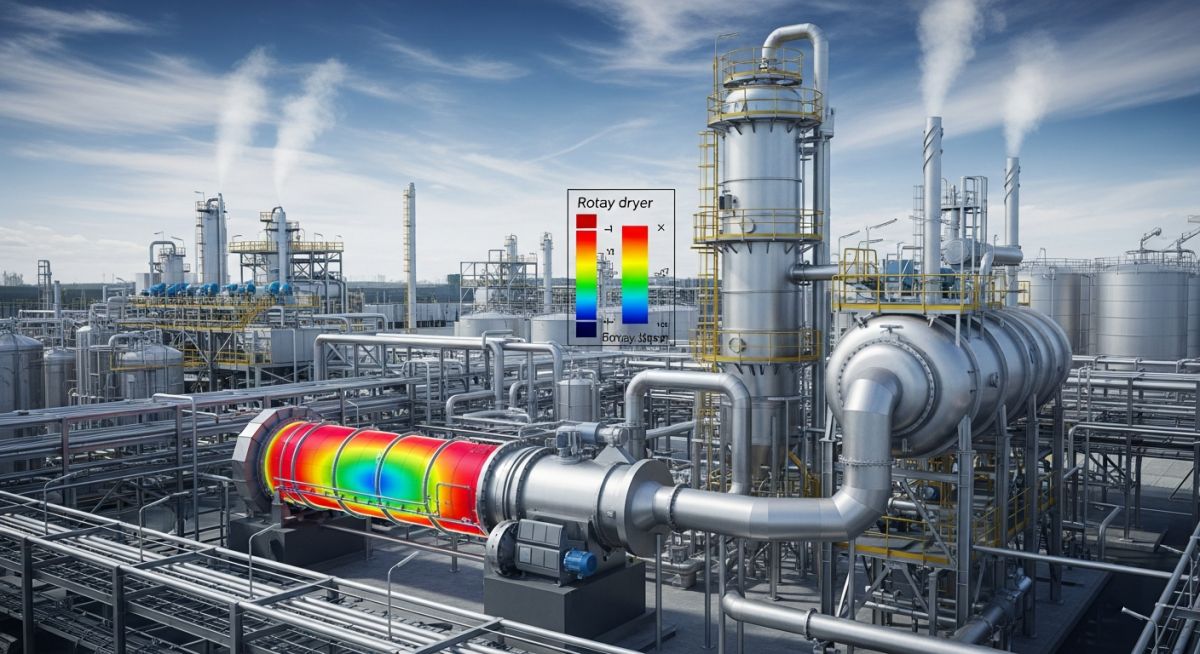
Certified Engineering Resource Updated for 2026 Types of Industrial Dryers and Their Selection Guide 2026 Imagine your production line grinding to a halt because a batch of pharmaceutical granules turned into a sticky, unusable paste, or your mineral ore is leaving the kiln with 15% more moisture than the downstream equipment can handle. These aren't just technical glitches; they are million-dollar bottlenecks caused by mismatched thermal processing. Choosing the wrong Industrial Dryers doesn't just waste energy—it compromises product integrity and operational safety. In this guide, we bridge the gap between theoretical heat transfer and practical field application to ensure your selection is optimized for maximum throughput and minimum utility cost. Key Takeaways Thermal Sensitivity: Matching dryer residence time with material heat tolerance is critical to preventing degradation. Moisture Mapping: Understanding the transition from constant rate to falling rate drying periods dictates equipment footprint. Efficiency Gains: Modern 2026 designs in Industrial Dryers prioritize closed-loop heat recovery to slash carbon footprints. What are the main types of Industrial Dryers? Industrial Dryers are classified by their operating mode (batch or continuous) and heat transfer method (direct or indirect). Primary types include Tray Dryers for small batches, Rotary Dryers for high-volume solids, Vacuum Dryers for heat-sensitive materials, and Fluidized-bed or Spray Dryers for rapid, uniform moisture removal in powders and liquids. "In my two decades of plant commissioning, I’ve seen more failures from incorrect moisture analysis than from mechanical breakdowns. You cannot select an industrial dryer based on capacity alone; you must respect the physics of the drying rate curve." — Atul Singla, Founder Table of Contents Fundamental Mechanisms of Industrial Dryers Analyzing Moisture Types The Drying Rate Curve Classification and Types Batch Processing (Tray Dryer) Continuous Rotary Dryers Vacuum Industrial Dryers Fluidized-bed Dryers Spray Industrial Dryers Critical Selection Criteria Expert Engineering Insights Frequently Asked Questions Engineering Knowledge Check: Industrial Dryers Test your technical proficiency in thermal processing and dryer selection. Question 1 of 5 Which drying period is characterized by the evaporation of surface moisture at a constant rate? A) Constant Rate Period B) Falling Rate Period C) Induction Period Question 2 of 5 Vacuum Industrial Dryers are primarily selected for which type of materials? A) High-volume bulk minerals B) Heat-sensitive pharmaceuticals C) Low-cost construction aggregates Question 3 of 5 What defines "Bound Moisture" in industrial drying kinetics? A) Moisture exerting full vapor pressure B) Moisture exerting less than pure water vapor pressure C) Surface water in a Tray Dryer Question 4 of 5 Which Industrial Dryer is best suited for producing uniform spherical particles from a slurry? A) Spray Dryer B) Rotary Dryer C) Tray Dryer Question 5 of 5 In a Fluidized-bed Industrial Dryer, what state must the particles achieve? A) Static bed state B) Suspended fluid-like state C) Molten state Previous Next Question Fundamental Mechanisms of Industrial Dryers The operation of Industrial Dryers is governed by simultaneous heat and mass transfer. Heat is transferred from the surrounding environment to the wet solid to evaporate the liquid, while mass transfer involves the migration of moisture from the interior of the solid to its surface and subsequently into the gas phase. In 2026, engineering standards emphasize the "Driving Force" of drying—the difference between the partial pressure of water vapor at the solid surface and its partial pressure in the drying medium. Understanding these kinetics is vital for meeting ASME standards for thermal vessel safety and performance. Analyzing Moisture Types for Industrial Dryers Not all moisture is removed with the same ease. In the design of Industrial Dryers, engineers categorize moisture into two primary types: Bound Moisture and Unbound Moisture. Bound moisture is liquid trapped within the cellular or crystalline structure of the material, exerting a vapor pressure lower than that of pure water at the same temperature. Conversely, unbound moisture refers to the liquid in excess of the equilibrium moisture content, exerting full vapor pressure and being relatively easy to remove. Furthermore, we define Free Moisture as the water that can be removed under specific temperature and humidity conditions. Successful selection of Industrial Dryers requires a precise moisture profile of the feed material to avoid over-engineering the thermal load or under-sizing the exhaust system. The Drying Rate Curve in Industrial Dryers The drying behavior of a material is best visualized through the Drying Rate Curve. This curve typically consists of three distinct phases: The Initial Period: A short phase where the material is heated to the drying temperature. Constant Rate Period: In this stage, the surface of the solid is entirely wet, and evaporation occurs at a constant rate. The temperature of the solid stays at the wet-bulb temperature of the drying gas. Falling Rate Period: This begins once the Critical Moisture Content is reached. The surface starts to dry out, and internal diffusion becomes the rate-limiting step. Industrial Dryers must be sized significantly larger for materials that spend the majority of their residence time in this phase. Classification and Types of Industrial Dryers Classification of Industrial Dryers is typically based on the method of heat transfer (Direct vs. Indirect) and the physical state of the feed. Direct dryers use hot gases in contact with the material, while indirect dryers transfer heat through a conduction wall. In 2026, the industry has seen a shift toward hybrid Industrial Dryers that combine convection and microwave energy to bypass the slow diffusion limits of the falling rate period. Batch Processing with the Tray Industrial Dryer Tray dryers remain the primary choice for small-scale batch operations, particularly in the pharmaceutical and specialty chemical sectors. Material is spread across specialized trays and subjected to cross-circulation of hot air. In 2026, the engineering focus has shifted toward Uniform Air Distribution to eliminate "dead zones" where moisture remains trapped. Engineering teams often specify stainless steel (SS316L) construction to comply with stringent hygiene standards and prevent corrosion. Advantages of Tray Dryer Systems: Low initial capital expenditure for multi-product facilities. Simplified cleaning and validation, crucial for preventing cross-contamination in batch changes. Minimal material loss during the drying of high-value powders. Continuous Operation in Rotary Industrial Dryers For high-volume throughput of mineral ores, fertilizers, and aggregates, the Rotary Industrial Dryer is the industry standard. These dryers consist of a rotating cylindrical shell slightly inclined to the horizontal. As the shell rotates, internal flights lift the material and shower it through the hot gas stream, maximizing the heat transfer area. Modern designs in 2026 incorporate advanced high-temperature seals to minimize air leakage, significantly boosting thermal efficiency and reducing fuel consumption. Strategic Applications of Rotary Dryers Rotary systems are ideal for materials that can withstand mechanical agitation without excessive attrition. When dealing with combustible dust or volatile solvents, engineers refer to ISO 10472-4 for safety requirements in industrial air drying systems to prevent explosion hazards and ensure operational compliance. Heat-Sensitive Material Handling in Vacuum Industrial Dryers Vacuum dryers operate at reduced pressures, which effectively lowers the boiling point of the solvent (usually water). This allows for rapid drying at low temperatures, making them indispensable for Heat-Sensitive biologicals, antibiotics, and food extracts. The design and fabrication of these vacuum vessels must strictly adhere to ASME Section VIII Division 1 to ensure the vessel can withstand external pressure without risk of implosion or mechanical failure. Dryer Type Heat Transfer Typical Material Operating Mode Tray Dryer Convection (Direct) Paste, Wet Cakes Batch Rotary Dryer Convection / Conduction Minerals, Fertilizers Continuous Vacuum Dryer Conduction (Indirect) Pharmaceuticals Batch / Continuous Spray Dryer Convection (Direct) Solutions, Slurries Continuous High-Efficiency Fluidized-bed Industrial Dryers Fluidized-bed dryers utilize a high-velocity gas stream to suspend solid particles in a fluid-like state. This "fluidization" ensures extraordinary heat and mass transfer rates because every particle is effectively surrounded by the drying medium. Performance testing for these systems, especially in grain and agricultural contexts, often follows ISO 11520-2 to determine evaporation rates and energy efficiency under steady-state conditions. Critical Selection Criteria for Industrial Dryers Selecting the optimal Industrial Dryers involves a multi-variable engineering matrix. Key considerations include: Physical Form of Feed: Determining if the feed is a liquid, slurry, paste, or free-flowing solid. Thermal Sensitivity: Assessing the degradation temperature and moisture sensitivity of the product. Scale of Production: Evaluating whether the annual tonnage justifies the capital expense of a continuous Rotary or Spray dryer. Sustainability Mandates: Integrating 2026 carbon-neutral protocols which may require closed-loop nitrogen systems for solvent recovery. Industrial Dryer: Moisture Removal Calculator Calculate the total water evaporation rate (kg/hr) required for your Industrial Dryers based on feed capacity and moisture delta. Initial Feed Rate (kg/hr) Initial Moisture Content (%) Final Desired Moisture (%) Calculate Load Evaporation Required: 0 kg/hr Final Product Output: 0 kg/hr Formula: Evaporation = FeedRate * ((Initial - Final) / (100 - Final)) Engineering Case Study: Optimizing Industrial Dryers in Pharmaceutical Production Efficiency Breakthrough 2026 Location: Pharmaceutical Facility, Barcelona The Challenge: Addressing Thermal Inertia in Batch Processing A high-capacity pharmaceutical unit operating legacy Industrial Dryers (specifically the Fielder Aeromatic MP 6/8 series) faced significant throughput bottlenecks. Human operators were relying on fixed, non-optimized preheating intervals, leading to nearly one hour of redundant energy consumption per batch. In an era of high utility costs, this manual approach compromised both the carbon footprint and the unit's competitive edge. Technical Intervention The engineering team deployed a Machine Learning (ML) optimization framework using the Catboost algorithm. By monitoring 56 critical data points—including inlet air humidity, exhaust temperature, and bed pressure drop—the system identified the precise moment of thermal saturation. This allowed the Industrial Dryers to transition from preheating to active drying automatically, eliminating human error. Verified Performance Gains ✓ 45-Minute Reduction in total batch cycle time. ✓ 2.8 MWh Annual Savings in facility electricity load. ✓ Zero Degradation of Active Product Ingredients (API). Technical Conclusion: This implementation demonstrates that Industrial Dryers can achieve modern 2026 efficiency targets through smart sensing and ML-driven control. For more on the sensor integration used in this project, refer to the MDPI Sensor Data Optimization Case Study. Expert Insights: Lessons from 20 years in the field After overseeing the commissioning of over 150 thermal systems, certain patterns in Industrial Dryers emerge that aren't found in textbooks. Success in 2026 is defined by how well an engineer manages the interface between mechanical hardware and digital monitoring. 1 Avoid "Over-Sizing" Safety Margins Engineers often add a 20% "safety factor" to thermal loads in Industrial Dryers. In practice, this leads to overheating the material during the falling-rate period, causing product brittleness or chemical degradation. Use precise pilot-scale data to size the burner, not guesswork. 2 Prioritize Exhaust Humidity Control The most efficient Industrial Dryers in 2026 utilize VFDs (Variable Frequency Drives) on exhaust fans tied to real-time humidity sensors. This maintains the maximum possible driving force without wasting energy on excessive airflow. 3 The "Hidden" Cost of Cleaning In multi-product facilities, the ROI of Industrial Dryers is often dictated by cleaning time (CIP/WIP). A Spray Dryer with 2026-spec polished internals can save 400 hours of downtime annually compared to a standard industrial finish. References & Standards The selection and design of Industrial Dryers must strictly follow these recognized international authorities: ➔ ASME BPVC Section VIII: Pressure Vessel Rules ➔ ISO 10472-4: Industrial Air Drying Safety ➔ ISO 11520-2: Drying Performance Testing ➔ NFPA 86: Standard for Ovens and Furnaces Frequently Asked Questions about Industrial Dryers What are the most common types of Industrial Dryers used in 2026? ▼ The most prevalent Industrial Dryers include Rotary Dryers for high-volume solids, Spray Dryers for liquid-to-powder conversion, Fluidized-bed Dryers for granular efficiency, and Vacuum Dryers for heat-sensitive pharmaceutical applications. 2026 trends show a significant rise in hybrid microwave-convection systems. How do I select the right Industrial Dryer for my product? ▼ Selection is based on the feed physical state (liquid vs. solid), material thermal sensitivity, required throughput, and the Drying Rate Curve. Continuous dryers (Rotary/Spray) are chosen for high capacity, while batch dryers (Tray/Vacuum) are preferred for smaller, high-value pharmaceutical batches. What is the difference between direct and indirect Industrial Dryers? ▼ Direct Industrial Dryers (convection) place the material in direct contact with hot gases, offering rapid heat transfer. Indirect dryers (conduction) transfer heat through a wall, preventing contamination between the heating medium and the product, which is vital for sterile processing. Why does my material stick to the walls of the Spray Industrial Dryer? ▼ Sticking usually occurs because the inlet air temperature is too close to the product's Glass Transition Temperature (Tg). In 2026, we solve this by using dehumidified "cold-wall" technology or by adjusting the atomization pressure to ensure particles dry before they impact the vessel walls. Can I convert an old batch Tray Dryer into a continuous system? ▼ While a physical conversion of the vessel is rarely cost-effective, you can achieve "pseudo-continuous" flow by implementing a Rotary Vacuum Band Dryer or a multi-stage Fluidized-bed system. For most 2026 plant upgrades, replacing the unit with a modular continuous dryer yields a better ROI through energy savings. How do 2026 ASME standards impact the safety of Vacuum Industrial Dryers? ▼ Modern ASME Section VIII guidelines now require more rigorous FEA (Finite Element Analysis) for vessels operating under cyclic vacuum loads. This prevents fatigue failure and ensures that Industrial Dryers can safely handle rapid depressurization cycles during high-speed batch processing.