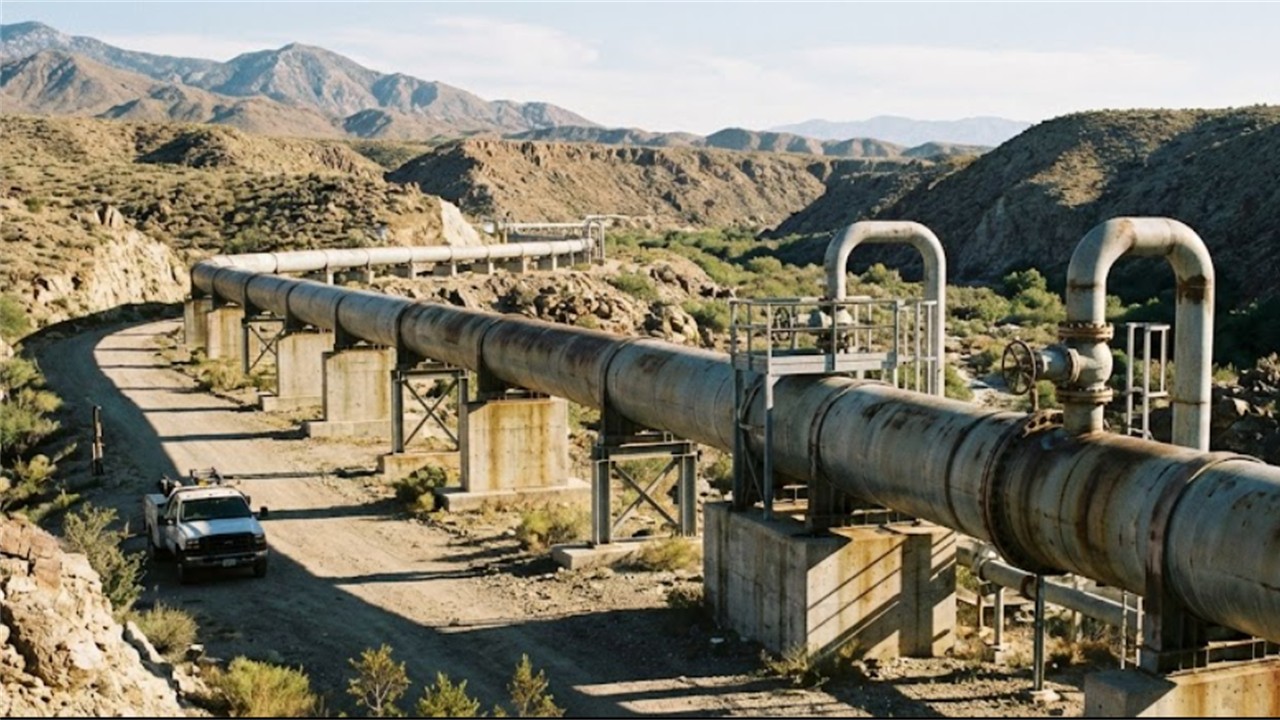
✅ Verified for 2026 by Epcland Engineering Team ASME B31.4: Pipeline Transportation Systems for Liquids and Slurries The ASME B31.4 code prescribes the primary requirements for the design, materials, construction, assembly, inspection, and testing of piping transporting liquids between production facilities and receiving terminals. Unlike process piping (B31.3), this code specifically governs cross-country pipelines carrying crude oil, condensate, liquid petroleum products, and even anhydrous ammonia. Definition: What is ASME B31.4? ASME B31.4 "Pipeline Transportation Systems for Liquids and Slurries" is the American Society of Mechanical Engineers standard for piping systems transporting liquids. It dictates the calculation of Minimum Wall Thickness ($t$) based on Hoop Stress limits and applies primarily to pipelines extending between facilities, rather than piping within a refinery or plant. Quiz: Test Your ASME B31.4 Knowledge Next Question Scope of ASME B31.4 Liquid Pipeline Systems The ASME B31.4 code is not just a suggestion; it is the regulatory backbone for liquid pipelines in the United States (referenced by 49 CFR 195) and many international jurisdictions. Its scope encompasses the piping transporting liquids from the outlet of the producer's metering facility to the inlet of the refinery or terminal. Engineers must understand that ASME B31.4 applies to: Primary Fluids: Crude oil, condensate, natural gasoline, natural gas liquids (NGL), and liquid petroleum products. Slurries: Non-hazardous aqueous slurries of coal, mineral ores, and concentrates. Anhydrous Ammonia: Liquid ammonia transport. Physical Limits: It covers the pipe, flanges, bolting, gaskets, valves, relief devices, fittings, and the pressure-containing parts of other piping components. ASME B31.4 Wall Thickness Calculation & Formulas The core of any pipeline design is determining the pipe wall thickness to contain the internal pressure without yielding. Under ASME B31.4, the design pressure of the pipe is governed by the Yield Strength of the material and the pipe geometry. Figure 1: Hoop Stress variables in liquid pipeline design. The formula for the required design pressure ($P_i$) or minimum nominal wall thickness ($t_n$) is derived from the Barlow Equation. Standard Design Formula (Paragraph 403.2.1) P = ( 2 × S × t ) / D × F × E Where: P = Internal Design Pressure (psig) t = Nominal Wall Thickness (inches) D = Outside Diameter of Pipe (inches) S = Specified Minimum Yield Strength (SMYS) (psi) F = Design Factor (0.72) E = Longitudinal Joint Factor (typically 1.0 for Seamless/ERW) Note: Unlike B31.3 which adds corrosion allowance ($c$) before stress calc, B31.4 typically verifies that the nominal thickness minus tolerances and corrosion allowance is sufficient for the pressure. Critical Differences: ASME B31.4 vs. ASME B31.8 A common error in EPC projects is confusing the liquid code (B31.4) with the gas code (B31.8). While they use similar physics, the safety factors and location classifications differ drastically. Feature ASME B31.4 (Liquid) ASME B31.8 (Gas) Primary Fluid Crude Oil, NGL, Water, Slurry Natural Gas, Methane Design Factor (F) 0.72 (Constant) 0.40 - 0.72 (Depends on Location Class) Hydrotest Pressure 1.25 × MOP (4 Hours) 1.25 × MOP (8 Hours typical) Surge Allowance Max 110% of MOP allowed temporarily Generally strictly limited by control valves Material Selection (API 5L) Most **ASME B31.4** pipelines utilize API 5L line pipe. The "Grade" refers to the SMYS. Higher grades allow for thinner walls, reducing steel tonnage but increasing welding complexity. Grade B: 35,000 psi (Low pressure, easy welding) X42: 42,000 psi X52: 52,000 psi (Common standard) X65 - X70: High strength, used for large diameter cross-country transmission lines. Case Study: ASME B31.4 Failure Analysis (Surge Event) Figure 2: Pipeline rupture caused by unmitigated hydraulic transient (water hammer). Project Specifications & Incident Data Asset: 24-inch Crude Oil Feeder Line Material: API 5L X52 (SMYS 52,000 psi) MOP (Max Operating Pressure): 980 psig ASME B31.4 Limit: 1,078 psig (110% of MOP) Peak Surge Recorded: 1,350 psig Failure Mode: Longitudinal ductile tear at weld seam The Incident: Hydraulic Transient Failure During a routine shutdown sequence at the receiving terminal, an Emergency Shutdown Valve (ESDV) closed faster than the design specification allowed (5 seconds instead of 15 seconds). This rapid closure created a pressure wave (hydraulic transient) that traveled upstream back toward the pump station. Under ASME B31.4 Paragraph 404.1.2, a pipeline is permitted to experience incidental overpressure allowances, but these must not exceed 110% of the Maximum Operating Pressure (MOP). In this specific case, the reflected pressure wave spiked to 1,350 psig—approximately 137% of the MOP—catastrophically exceeding the code's safety margin and the pipe's yield capability at the longitudinal seam. Root Cause Analysis (RCA): Code Violation: The system design failed to account for "surge pressure" limits mandated by ASME B31.4. Component Failure: The ESDV actuator was not calibrated to the correct closure speed curve. Lack of Relief: No surge relief valves or nitrogen accumulators were installed upstream of the terminal. Engineering Solution & Retrofit To bring the system back into compliance with ASME B31.4 and prevent recurrence, the EPC engineering team implemented a two-fold solution: Surge Relief Skid: A fast-acting nitrogen-loaded relief valve was installed immediately upstream of the ESDV. This valve is set to open at 105% of MOP, diverting excess crude into a holding tank, ensuring pressure never breaches the 110% ceiling. Actuator Retiming: The ESDV closure timing was mechanically restricted to a minimum of 20 seconds, significantly flattening the pressure wave curve. Result: Subsequent transient flow modeling (using Stoner or AFT Impulse software) confirmed that worst-case pressures now peak at 1,020 psig (104% of MOP), well within the safe operation limits of the pipeline code. Frequently Asked Questions about ASME B31.4 What is the main difference between ASME B31.3 and ASME B31.4? The primary difference lies in the scope and safety factors. ASME B31.3 (Process Piping) covers piping inside the boundaries of refineries, chemical plants, and terminals. ASME B31.4 (Pipeline Transportation Systems) covers the cross-country pipelines between these facilities. B31.4 typically uses a more liberal design factor (0.72) compared to B31.3 because cross-country lines are generally uniform and easier to inspect than complex plant piping. Does ASME B31.4 apply to natural gas pipelines? No. Natural gas and other gaseous media are covered by ASME B31.8. ASME B31.4 is strictly for liquids (crude oil, condensate, liquid petroleum products) and non-hazardous aqueous slurries. Using the wrong code can lead to critical safety violations regarding fracture control and location classification. What is the minimum hydrotest duration for B31.4 pipelines? ASME B31.4 requires a hydrostatic pressure test to be held continuously for at least 4 hours. This differs from B31.8 (gas), which typically requires 8 hours, and B31.3 (process), which often requires only enough time to inspect joints (often 10-30 minutes, though specifications vary). How do I calculate the Design Pressure under B31.4? Design Pressure is calculated using the Barlow formula modification: P = (2St/D) × F × E. Here, S is the Yield Strength, t is wall thickness, D is diameter, F is the design factor (0.72), and E is the joint factor (1.0 for seamless). Conclusion: Mastering Liquid Pipeline Safety Designing to ASME B31.4 standards is not optional for liquid pipeline engineers—it is the baseline for legal and physical safety. Whether you are transporting crude oil across a continent or moving mineral slurry short distances, understanding the nuances of the 0.72 design factor, the strict surge limitations (110% MOP), and the material requirements of API 5L is essential. As we move through 2026, keep a close watch on code updates regarding leak detection technologies and stricter integrity management programs for aging infrastructure.