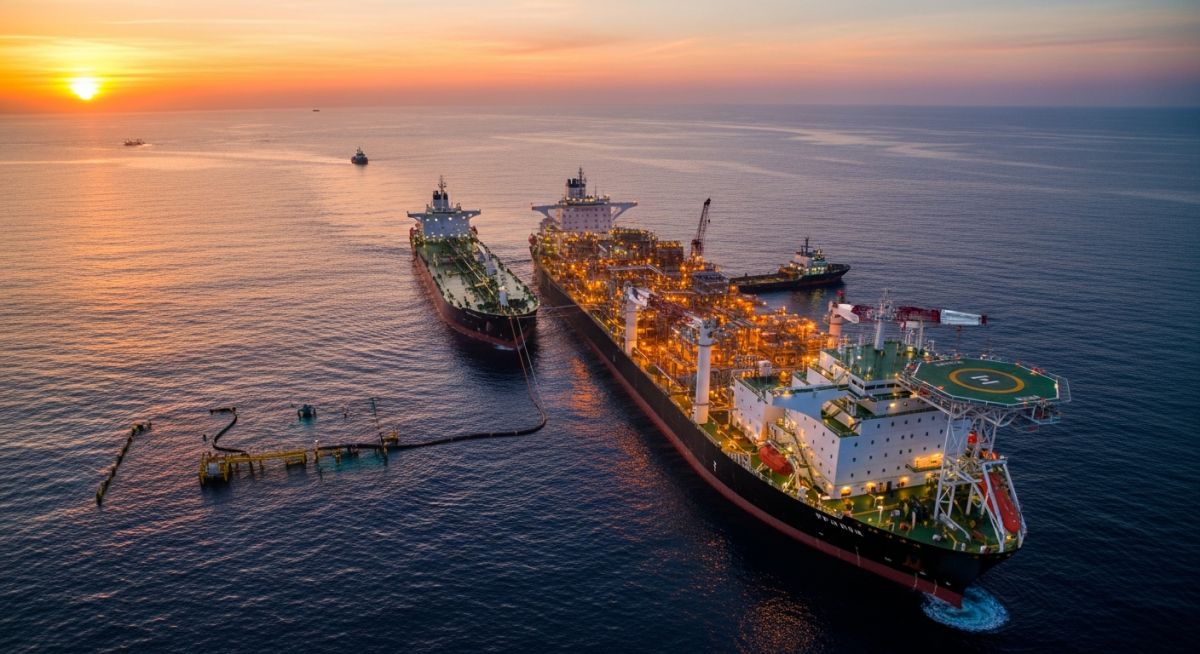
Verified Engineering Content Updated: 2026 What is an FPSO? Its Components, Working, and Advantages (2026) Imagine managing a multi-billion dollar offshore project where the oil field is too remote for pipelines and the water is too deep for fixed platforms. You are facing extreme weather, high pressure, and the logistical nightmare of transporting crude across oceans. For many offshore engineers, the FPSO Components and Working systems are the only viable solution to unlock these "stranded" reserves profitably and safely. Key Takeaways Understand the modular architecture of topside processing versus hull storage. Identify the critical role of turret and mooring systems in vessel stability. Evaluate why FPSOs dominate deepwater production over fixed alternatives. What is an FPSO? A Floating Production Storage and Offloading (FPSO) unit is a versatile offshore vessel used by the oil and gas industry to process and store hydrocarbons. Key FPSO Components and Working involve receiving fluids from subsea wells, separating oil, gas, and water on the topside, and storing crude in the hull until it is offloaded to tankers. Founder's Insight "The complexity of FPSO design isn't just in the processing; it's in the interface management between the static subsea world and the dynamic floating environment. Mastering FPSO Components and Working requires a deep understanding of hydrodynamics and process safety." — Atul Singla Table of Contents Core Advantages of FPSO Systems in Offshore Engineering Critical FPSO Components: From Hull to Turrets The FPSO Working Principle: Extraction to Offloading Comparing Assets: What is an FSU? Technical Difference: FSO vs FPSO Components and Working Operational Challenges and Disadvantages of FPSO Units Engineering FAQ: FPSO Components and Working Engineering Check: FPSO Systems Test your knowledge on FPSO Components and Working 1. Which component allows an FPSO to rotate freely to face prevailing weather? A) Turret System B) Spread Mooring C) Topside Module 2. What is the primary function of the FPSO "Hull"? A) Gas Dehydration B) Crude Oil Storage C) Water Injection 3. Why are FPSOs preferred for marginal fields? A) Reusability/Relocatability B) Lower initial CAPEX than Jack-ups C) Maintenance-free operation 4. In "FPSO Components and Working", what connects subsea wells to the vessel? A) Risers B) Mooring Lines C) Umbilicals 5. What does the "S" stand for in FPSO? A) Subsea B) Storage C) Stabilized Next Question → Core Advantages of FPSO Systems in Offshore Engineering The rapid global expansion of offshore exploration into deepwater and ultra-deepwater (depths exceeding 1,500 meters) has solidified the role of the FPSO Components and Working architecture as the industry standard. Unlike fixed platforms, which require massive steel jackets or concrete bases reaching the seabed, an FPSO is a floating all-rounder that circumvents the physical and economic limits of traditional infrastructure. According to the Offshore Magazine analysis, these units are expected to see a supercycle of investment through 2026, driven by their unique operational benefits. Rapid Deployment and Time-to-Market: A converted tanker can be transformed into an operational FPSO significantly faster than a newbuild fixed platform can be designed and installed. This "fast roll out" enables operators to achieve "first oil" and return on investment in months rather than years. Environmental Resilience and Mobility: One of the most critical FPSO Components and Working features is the ability to "weathervane" or even disconnect. In hurricane-prone regions like the Gulf of Mexico or cyclonic zones in the South China Sea, disconnectable turret systems allow the vessel to sail to safe harbor, protecting the multi-billion dollar asset from extreme environmental loads. Marginal Field Viability: For smaller oil fields with uncertain reserves or short lifespans, laying permanent subsea pipelines is economically unfeasible. FPSOs provide an integrated storage and offloading solution, and once the field is depleted, the entire unit can be redeployed to a new location. Reduced Abandonment Costs: Decommissioning a fixed platform is a massive engineering undertaking costing hundreds of millions. In contrast, an FPSO simply disconnects from its risers and sails away, leaving a significantly smaller environmental footprint and lower closure costs. Critical FPSO Components: From Hull to Turrets An FPSO is essentially a modular chemical plant built on top of a massive storage tank. To understand FPSO Components and Working, one must look at the vessel as two distinct engineering environments: the "marine" side (hull and mooring) and the "process" side (topsides). This dual-nature requires strict adherence to both maritime law and industrial process safety standards. Marine Hull & Storage Tanks The hull serves as the foundation for the entire facility. It provides the necessary buoyancy to support thousands of tons of processing equipment while housing the cargo tanks. Most hulls are either purpose-built or converted VLCCs (Very Large Crude Carriers). The internal structure includes dedicated ballast tanks to maintain stability during varying load conditions and inert gas systems to prevent the buildup of explosive vapors in the storage areas. Mooring System Engineering The mooring system is the "anchor" that keeps the vessel on station. There are two primary types: Spread Mooring, where the vessel is held in a fixed orientation by lines at the four corners, and Turret Mooring. Turret systems are more complex, allowing the hull to rotate 360 degrees around a fixed point to minimize the impact of wind and waves—a process known as weathervaning. Process Topside Modules This is the "refinery" of the ship. The topside consists of modular units designed to separate the raw well stream into its base components: oil, gas, and water. These modules include three-phase separators, gas compression units, and water treatment facilities. Because space is limited and the vessel is constantly moving, these modules must be designed to withstand dynamic forces as per ASME B31.3 standards for process piping and high-integrity pressure protection systems. Subsea Risers and Flowlines Risers are the umbilical cords of the FPSO. These flexible or rigid pipes transport the well fluids from the seabed to the vessel's turret. Because the FPSO is a dynamic floater, risers must be designed to accommodate significant vessel motion (heave, pitch, and roll) without fatiguing or rupturing, often utilizing "lazy-S" or "catenary" configurations to manage tension. The FPSO Working Principle: Extraction to Offloading The operational lifecycle of an FPSO Components and Working system begins thousands of meters below the mudline. Hydrocarbons—a complex mixture of crude oil, natural gas, water, and solids—are driven by reservoir pressure through subsea trees and manifold systems. These fluids ascend via flexible risers to the vessel’s turret interface. Once onboard, the "Separation Train" utilizes gravity and centrifugal force to stabilize the crude, reaching export-quality standards as per the API Standards for Oil and Gas Operations. 1. Primary Separation High-pressure (HP) and Low-pressure (LP) separators divide the stream. Gas rises to the top, oil sits in the middle, and produced water settles at the bottom. This stage is critical for preventing "slugging" in downstream equipment. 2. Gas Compression & Treatment Associated gas is dehydrated to remove water vapor (preventing hydrates) and compressed. It is then used for onboard power generation, reinjected for reservoir pressure support, or exported via pipeline. 3. Oil Stabilization & Storage The crude enters electrostatic treaters to remove remaining brine and sediments. Stabilized oil is then cooled and pumped into the hull's cargo tanks, adhering to ISO 13703 standards for offshore piping systems. 4. Offloading Operations Periodically, a shuttle tanker moors at the FPSO's stern (tandem offloading). Large-diameter flexible hoses transfer the stored crude, measured by high-precision fiscal metering skids. Technical Difference: FSO vs FPSO Components and Working Distinguishing between floating assets is vital for field architecture design. While they may look identical from a distance, their internal FPSO Components and Working capabilities vary significantly. An FSO (Floating Storage and Offloading) acts as a passive warehouse, whereas an FPSO is an active production hub. Engineers must also consult the ASME Boiler and Pressure Vessel Code (BPVC) when designing the high-pressure separators required for FPSO topsides. Feature FPSO (Production) FSO (Storage) FSU (Storage Unit) Processing Topside Full Separation & Treatment Minimal / None None Mooring Complexity High (Turret with Swivels) Medium (Spread or Turret) Simple Spread Mooring Typical CAPEX $800M - $3B+ $200M - $500M Under $150M Primary Market Remote Deepwater Fields Fields with fixed platforms Buffer storage for Refineries Operational Challenges and Disadvantages of FPSO Units Despite their versatility, FPSO Components and Working environments face unique hurdles. Space constraints on the deck lead to congested piping layouts, increasing the risk of fire and gas incidents. Furthermore, the dynamic motion of the vessel can negatively impact the efficiency of separation equipment, necessitating sophisticated internal baffles within pressure vessels. High opex (operational expenditure) due to specialized marine and process crews also remains a significant factor in long-term project planning. FPSO Storage & Offloading Estimator Calculate storage duration based on production rates and hull capacity. Hull Storage Capacity (Barrels) Daily Production Rate (BOPD) Days to Full Capacity: 20.0 Offloading Frequency: ~1.5 Times Per Month Update Calculations Note: This is a simplified estimation. Real-world FPSO Components and Working logic accounts for 10% ullage and weather-related downtime. Engineering Case Study Deepwater Resilience: The Turret Integration Challenge Project Location Santos Basin, Brazil Water Depth 2,200 Meters (Ultra-Deepwater) Technical Standard API RP 2FPS / ISO 19904-1 The Challenge: 100-Year Storm Stability In the high-energy environments of the South Atlantic, a leading operator required an FPSO Components and Working configuration capable of maintaining continuous production during 15-meter significant wave heights. The primary engineering bottleneck was the swivel stack—the heart of the internal turret—which had to transfer high-pressure gas reinjection (500 bar) while allowing the 300,000-ton vessel to weathervane freely. The Engineering Solution Engineers deployed a Large Diameter Internal Turret integrated into the forward hull. This system utilized a multi-path high-pressure swivel stack made of super-duplex stainless steel to resist chloride stress corrosion. By moving the pivot point forward, the vessel's natural hydrodynamic "mooring stiffness" was optimized, reducing the peak loads on the polyester mooring lines by 30%. Key Result: 99.8% Uptime The integration of advanced FPSO Components and Working logic allowed the vessel to remain connected during three major weather events in 2026, preventing an estimated $45 million in deferred production costs. Expert Insights: Lessons from 20 years in the field 1 Dynamic Interface Management: The most critical failure point in FPSO Components and Working systems isn't the equipment itself, but the "Steel-to-Flexible" interface. Ensure bend stiffeners at the turret-riser connection are inspected via ROV every 24 months to prevent catastrophic fatigue. 2 Weight Control is King: Every ton added to the topside processing modules during a brownfield modification exponentially increases the mooring tension requirements. Strict weight management protocols are non-negotiable for hull stability. 3 Swivel Stack Integrity: In high-sour (H2S) environments, the swivel seals are your primary defense. Utilizing modern elastomer-on-metal sealing technology significantly reduces the risk of gas migration into the turret void space. 4 Offloading Logistics: Never underestimate the "wait-on-weather" (WOW) costs. Modern FPSOs in 2026 are increasingly moving toward DP2-class shuttle tankers to allow offloading in sea states up to 4.5 meters Hs. References & Standards For deeper technical validation of FPSO Components and Working, consult these primary industry authorities: ➔ API RP 2FPS (FPSO Design) ➔ ASME B31.3 (Process Piping) ➔ ISO 19904-1 (Floating Structures) ➔ DNV-OS-E301 (Mooring Systems) ➔ OCIMF (Offloading Guidelines) ➔ ABS Guide for FPSOs Engineering FAQ: FPSO Components and Working What is the biggest FPSO in the world? The Egina FPSO, operated by TotalEnergies in Nigeria, is often cited as one of the largest by volume. It measures approximately 330 meters in length and has a storage capacity of 2.3 million barrels of oil. Understanding its FPSO Components and Working scale is vital for benchmarking ultra-deepwater projects. Is an FPSO considered a ship? While it has a hull and can often be propelled, an FPSO is technically a floating production facility. Unlike a standard ship, its primary purpose is staying stationary at a field for 20+ years. Its FPSO Components and Working systems are regulated by both maritime classification societies (like ABS/DNV) and oil and gas safety authorities. Does an FPSO perform drilling operations? No, a standard FPSO does not drill. Drilling is performed by a Mobile Offshore Drilling Unit (MODU) or a Drillship. The FPSO only receives the fluids once the wells are completed. A rare exception is the FDPSO (Floating Drilling, Production, Storage, and Offloading), which integrates a drilling derrick into the FPSO Components and Working design. How are FPSOs moored in extreme depths? In deepwater, FPSOs use taunt-leg mooring systems consisting of polyester ropes rather than heavy steel chains. This reduces the vertical load on the hull. The lines are anchored to the seabed using suction piles or torpedo anchors, which are critical FPSO Components and Working parts for subsea stability. What is the "swivel" in a turret system? The swivel is a precision-engineered mechanical joint that allows fluids, chemicals, and electricity to pass from the static geostationary turret (connected to the seabed) to the rotating hull. It is the most technically demanding of all FPSO Components and Working hardware, requiring high-pressure dynamic seals. Can an FPSO operate in icy or arctic conditions? Yes, but they require ice-strengthened hulls and disconnectable turret systems. If an iceberg approaches, the FPSO can disconnect its mooring and risers in minutes and sail away. This capability is a hallmark of advanced FPSO Components and Working engineering in regions like the Grand Banks of Canada. 📚 Recommended Resources: FPSO Read these Guides 📄 Pipe Fabrication Shops: Shop vs. Site Fabrication in Oil and Gas 📄 Commissioning in Oil and Gas: Process, Stages & Best Practices (2026) 📄 Comprehensive Guide to Feed Contracts for Oil and Gas Projects: Key Clauses Explained 🎥 Watch Tutorials 0.0 Introductory Video!! Piping Engineering!! Piping Layouts