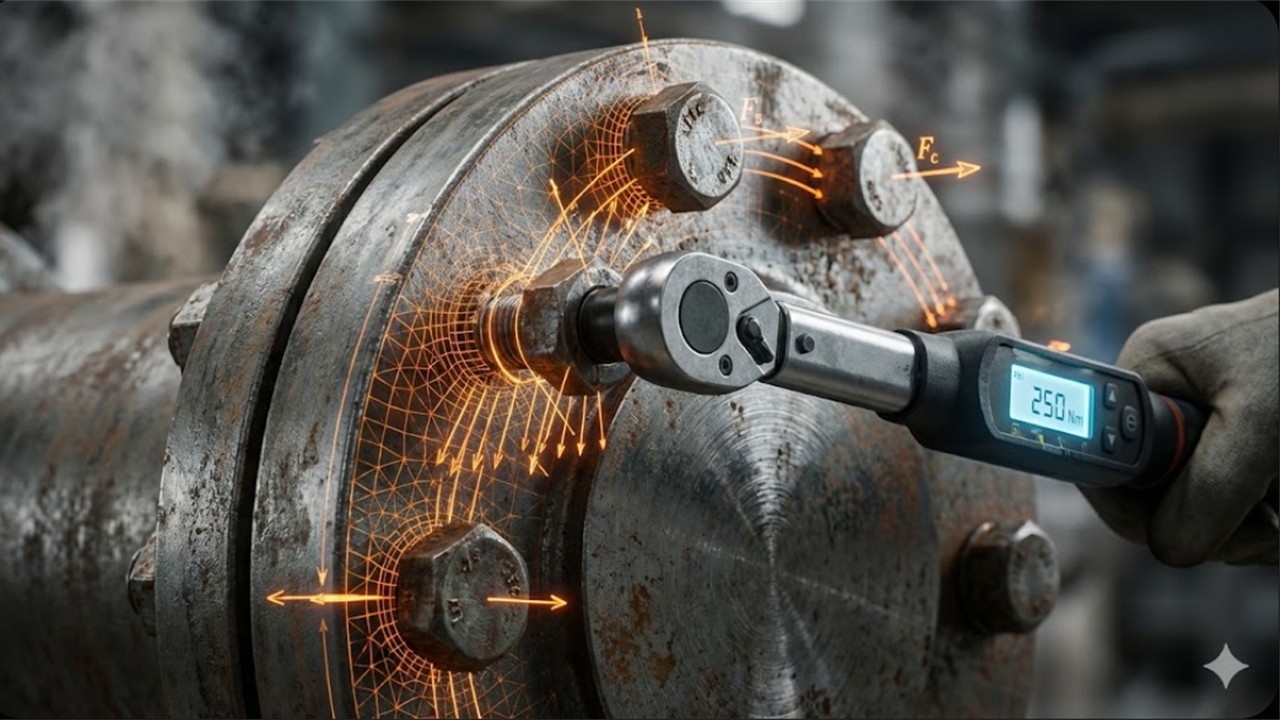
✅ Verified for 2026 by Epcland Engineering Team ASME PCC-1 Bolt Torque Calculation: The Ultimate Guide to Integrity It is a classic, yet expensive mistake: a maintenance crew believes that "tighter is better," so they maximize the torque wrench settings. The result? A buckled inner ring on a spiral wound gasket that protrudes into the flow path, creating turbulence and an inevitable leak path. To prevent this, a rigorous ASME PCC-1 Bolt Torque Calculation is mandatory for all critical service flanges. In 2026, relying solely on generic lookup tables (Appendix K) is no longer sufficient for high-pressure or high-temperature systems. Modern integrity management requires the use of Appendix O—a calculation method that determines the specific "Target Torque" required to seal the joint without crushing the gasket element. What is ASME PCC-1 Appendix O? Appendix O of ASME PCC-1 is the industry standard methodology for calculating the Target Bolt Stress (and subsequent torque) required to achieve a leak-free flange assembly. Unlike simple torque tables, Appendix O accounts for gasket maximum stress limits, bolt yield strength, and the friction factor (Nut Factor, K) to ensure the assembly preload is sufficient to hold pressure but low enough to prevent gasket crushing or flange rotation. Quiz: Test Your Flange Integrity Knowledge Question 1 of 5 Next Question The Physics of Sealing: Why "Hand-Tight" Fails In the world of ASME PCC-1 Bolt Torque Calculation, precision is the difference between a leak-free startup and a catastrophic blowout. The fundamental goal of torquing a flange is not just to "tighten" the bolts, but to act as a spring. The bolts must be stretched enough to maintain a compressive load on the gasket even when the internal system pressure tries to blow the flange faces apart. However, there is an upper limit. Every gasket—whether it is a Spiral Wound Gasket (SWG), Camprofile, or soft PTFE sheet—has a Maximum Permissible Gasket Stress ($S_{gmax}$). If the bolt load exceeds this limit, the gasket structure fails. In SWGs, this manifests as the inner metal ring buckling inward into the pipe bore, a phenomenon known as "Inward Buckling." "Torque is not the objective; Bolt Load is. Torque is simply the crude method we use to guess the Bolt Load. Without a calculated Target Torque based on Appendix O, you are essentially guessing the integrity of your joint." — Senior Piping Lead, Epcland Engineering The Appendix O Formula: Calculating Target Torque ASME PCC-1 Appendix O moves away from generic tables and forces the engineer to calculate the specific torque required for the specific joint conditions. The core relationship connects Torque ($T$) to the desired Bolt Load ($F$). Core Equation T = (K * D * F) / 12 T = Target Torque (ft-lbs) K = Nut Factor (Dimensionless friction coeff) D = Nominal Bolt Diameter (inches) F = Target Bolt Load (lbs) Deriving Bolt Load (F) F = S_bsel * A_root Where S_bsel is the Selected Assembly Bolt Stress (psi) and A_root is the bolt root area. The critical variable here is S_bsel (Selected Assembly Bolt Stress). Appendix O dictates that $S_{bsel}$ must be chosen such that: Condition 1: It is high enough to seat the gasket ($S_{gmin}$). Condition 2: It is high enough to offset hydrostatic end force. Condition 3: It is LOW enough to prevent gasket crushing ($S_{gmax}$). Visualizing the Failure: Gasket Crushing When an ASME PCC-1 Bolt Torque Calculation is ignored, and a technician applies "maximum torque," the compressive force on the gasket becomes excessive. For a Spiral Wound Gasket, the windings are compressed until they become a solid block. Once solid, any additional load forces the inner ring to buckle. Figure 1: Cross-section of a buckled inner ring due to excessive Bolt Stress ($S_{bsel}$). This buckling is catastrophic for two reasons. First, the buckled metal creates flow turbulence inside the pipe, which can cause erosion or vibration. Second, once the inner ring buckles, the radial support for the sealing element is lost, leading to an eventual blowout. The "K" Factor: The Silent Killer The Nut Factor ($K$) is an empirical value that summarizes the friction at the thread interface and the nut-to-flange face interface. It is the single biggest variable in torque accuracy. A small change in lubrication can double the bolt load for the same torque setting. Lubricant Condition Nut Factor (K) Impact on Bolt Load No Lubrication (Dry Steel) 0.30 - 0.40 Low Load (Torque wasted on friction) Machine Oil 0.20 - 0.25 Moderate Load Molybdenum Disulfide (Moly) 0.11 - 0.15 High Load (Standard for PCC-1) Nickel Anti-Seize 0.13 - 0.17 High Load (High Temp Apps) Table 1: Nut Factor (K) variations based on lubricant type. Note: PCC-1 recommends validating K via testing. The "Ghost" in the Flange: Bolt Cross-Talk Even with a perfect ASME PCC-1 Bolt Torque Calculation, a joint can fail due to a phenomenon known as "Elastic Interaction" or Bolt Cross-Talk. When you tighten the first bolt (Bolt #1), the flanges compress slightly. When you move to tighten Bolt #2, the flange compresses further. This additional compression relaxes the tension in Bolt #1. Real-World Case Study 24" Hydrocracker Feed Line (2024) The "Circular" Mistake A maintenance crew replaced a gasket on a 24" Class 600 flange. Instead of using a Star Pattern, they torqued the bolts in a circle (1, 2, 3, 4...) to save time. They applied the correct torque value (1,200 ft-lbs). The Result: Upon checking, the first 5 bolts they tightened had lost nearly 60% of their preload due to Cross-Talk. The joint leaked immediately during the low-pressure leak test. The crew had to depressurize and perform three full "Check Passes" to restore uniformity. The Star Pattern Strategy: Defeating Cross-Talk To mitigate Cross-Talk and prevent "pinching" the gasket on one side, ASME PCC-1 mandates a specific tightening sequence. For a 4-bolt flange, this is a simple crisscross. For a 24-bolt flange, it becomes a complex "Star Pattern." The 4-Step Legacy Method 1 Pass 1: Snug Tight (20-30%) Tighten in Star Pattern to ~30% of Target Torque. Check flange alignment. 2 Pass 2: Moderate Load (50-70%) Tighten in Star Pattern to ~60% of Target Torque. 3 Pass 3: Full Load (100%) Tighten in Star Pattern to 100% of Target Torque. 4 Pass 4: The Check Pass Apply 100% Torque in a Circular Pattern (clockwise) until nuts no longer turn. This fixes the Cross-Talk. Why the Star Pattern? Imagine the flange face as a clock. If you tighten 12 o'clock then 1 o'clock, the flange tilts. By tightening 12 o'clock, then 6 o'clock, then 3 o'clock, then 9 o'clock, you bring the flange faces together parallel to each other. Pro Tip: Number your bolts with a paint marker before starting. Following a sequence sheet is faster than guessing the "opposite" bolt on a 32-bolt flange. FAQ: ASME PCC-1 & Bolt Torque Strategies What is the difference between Appendix K and Appendix O in ASME PCC-1? ▼ Appendix K provides simplified, generic torque tables based on a fixed friction factor and bolt stress. It does not account for specific gasket stiffness or thermal expansion. Appendix O is the advanced method for 2026; it requires a rigorous calculation to determine the "Target Torque" based on specific gasket limits ($S_{gmax}$), bolt yield strength, and the actual Nut Factor ($K$) of the lubricant used. How do I determine the correct Nut Factor (K) for my calculation? ▼ The Nut Factor ($K$) is experimental. While manufacturers provide ranges (e.g., Moly paste is typically 0.11–0.15), ASME PCC-1 recommends validating $K$ through site-specific testing using a Skidmore-Wilhelm device. Relying on a "textbook" $K$ value without verification is the leading cause of torque calculation errors. Can I reuse bolts in critical flange service? ▼ Generally, no. ASME PCC-1 advises against reusing bolts in critical service because the thread friction profile changes after the first tightening. A reused bolt may require significantly higher torque to achieve the same preload due to thread galling or corrosion. If reuse is necessary, the threads must be re-machined or thoroughly cleaned and re-lubricated, and the Nut Factor ($K$) must be re-verified. What happens if I exceed the Maximum Gasket Stress? ▼ Exceeding the maximum stress leads to gasket crushing. For Spiral Wound Gaskets (SWG), this causes the inner winding layers to buckle inward into the pipe bore. This creates a flow restriction and eventually leads to a "blowout" failure because the gasket loses its radial recovery capability. Conclusion: Stop Guessing, Start Calculating In 2026, the era of "tightening it until it stops" is over. The cost of a flange leak—measured in environmental fines, downtime, and safety risks—far outweighs the time investment required to perform a proper ASME PCC-1 Bolt Torque Calculation. By utilizing Appendix O, respecting the Nut Factor ($K$), and verifying your Target Bolt Stress ($S_{bsel}$), you ensure that your flanges remain leak-free from hydrotest to shutdown. Remember: A bolt is a spring; treat it with the precision of a machine component, not just a fastener.