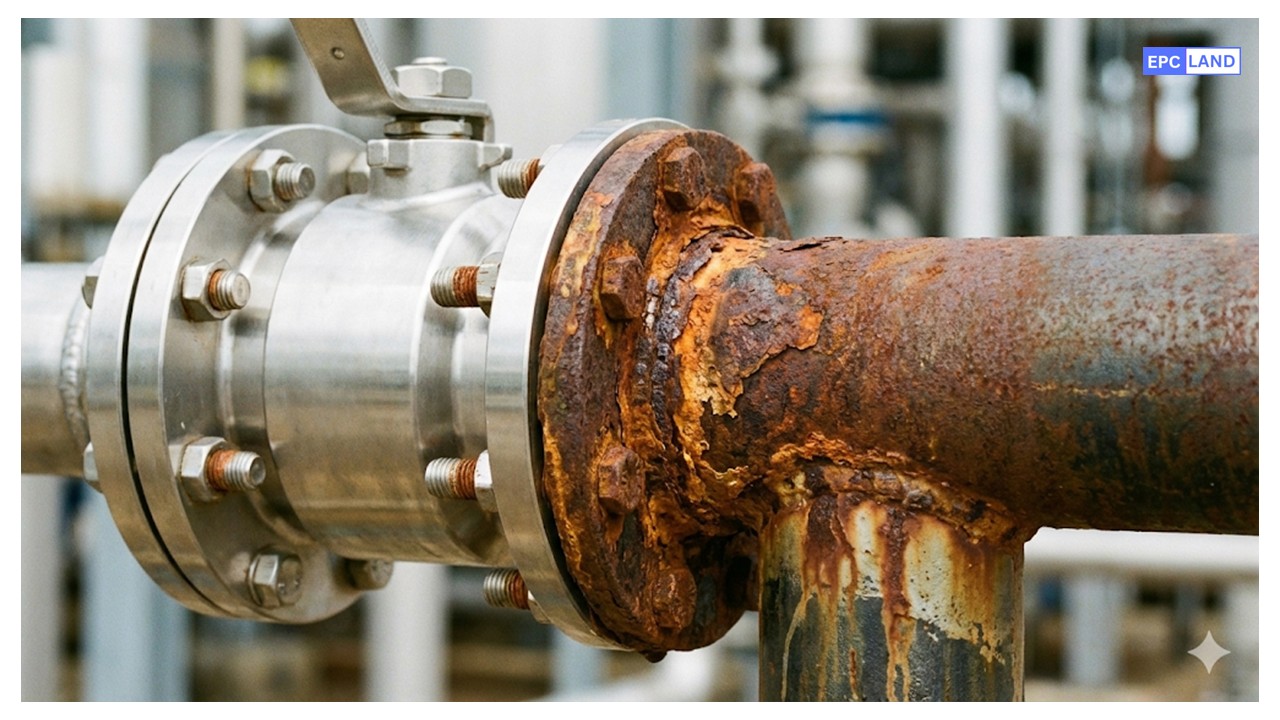
Verified for 2026 by Epcland Engineering Team Galvanic Corrosion: The "Battery Effect" in Industrial Piping Galvanic Corrosion (also known as dissimilar metal corrosion) occurs when two different metals are electrically connected in the presence of an electrolyte, effectively turning your piping system into a giant battery. It is one of the most common—yet preventable—design errors in engineering, often leading to rapid failure at flange connections, pump interfaces, and heat exchanger tube sheets. The 3 Requirements For this corrosion to occur, three conditions must exist simultaneously. If you remove any one of these, the reaction stops: Electrical Connection: Physical contact between dissimilar metals. Electrolyte: A conductive fluid (water, moisture, soil). Potential Difference: A significant voltage gap between the metals in the Galvanic Series. Quick Navigation 🔋 How It Works (Theory) 📊 The Galvanic Series ⚠️ The Area Ratio Effect 🛡️ Prevention & Isolation 📉 Real-World Case Study Test Your Compatibility Knowledge Question 1 of 5 Loading... 💡 Explanation: Next Question → The Physics: Electrochemical Potential Every metal has a specific internal energy level, known as its Electrochemical Potential. When you measure this potential against a standard reference electrode (like Silver/Silver Chloride) in seawater, you get a ranking. The driving force behind Galvanic Corrosion is the voltage difference ($\Delta$V) between two connected metals. The greater the difference, the faster the electron flow, and consequently, the faster the rate of corrosion on the "Active" (Anodic) metal. Figure 1: The "Galvanic Cell" circuit and the devastating impact of a small anode surface area. The Galvanic Series Chart (Seawater) Engineers use the Galvanic Series Chart to predict compatibility. The further apart two metals are on this list, the higher the risk of Dissimilar Metal Corrosion. Role Material Group Potential (Volts) Behavior ANODIC(Active) Magnesium Alloys -1.60 V Corrodes Rapidly (Sacrificial) Zinc -1.10 V Standard Galvanizing Material Aluminum Alloys -0.75 V Severe pitting if coupled to steel TRANSITION Carbon Steel / Cast Iron -0.60 V The most common structural metal Stainless Steel 304/316 -0.05 V Passive Condition Titanium +0.06 V Very Noble / Resistant CATHODIC(Noble) Graphite / Gold +0.20 V Protected (Causes others to corrode) The "Area Ratio" Rule (Critical) This is the most misunderstood concept. The rate of corrosion is determined not just by the voltage difference, but by the relative surface areas of the two metals. This is known as the Anode to Cathode Area Ratio. ⚡ The Danger Formula The current density on the corroding anode (Rate of Failure) is proportional to the area of the cathode. Corrosion Rate ≈ (Area of Cathode / Area of Anode) ❌ Scenario A: DISASTER Small Anode + Large Cathode Example: Carbon Steel bolts (Small Anode) on a Stainless Steel Flange (Large Cathode). Result: The bolts corrode 100x faster and snap. ✅ Scenario B: SAFE Large Anode + Small Cathode Example: Stainless Steel bolts (Small Cathode) on a Carbon Steel Flange (Large Anode). Result: The Steel flange corrodes slightly faster, but the mass is huge, so it lasts for years. Design Rule: Never paint the Anode without painting the Cathode. If the paint on the anode scratches (creating a small exposed area), the large unpainted cathode will drive rapid pitting at that scratch. Failure Analysis Report Case Study: Offshore Firewater System Leak Asset Location North Sea Offshore Platform Equipment Spec 10" Carbon Steel Ring Main (API 5L) Connected Component Nickel-Aluminum Bronze (NAB) Valve Electrolyte Seawater (High Conductivity) Figure 2: Severe "grooving" corrosion on the Carbon Steel flange face where it contacted the more noble Bronze valve. The Problem: Material Mismatch During a routine deluge test, operators observed significant leakage at the flanged connection between the main distribution header and the deluge valve. Disassembly revealed that the Carbon Steel flange face was severely corroded, exhibiting deep gouges up to 3mm deep across the sealing surface. The investigation confirmed a classic case of Galvanic Corrosion. The system designer had specified Nickel-Aluminum Bronze (NAB) valves for their excellent seawater resistance. However, NAB is significantly more "noble" (cathodic) than Carbon Steel on the Galvanic Series. With seawater acting as a highly conductive electrolyte, and no electrical isolation provided, the Carbon Steel flange became the anode and sacrificed itself to protect the valve. Key Observation: The corrosion was most severe near the gasket seating area. The original gasket was a graphite-filled spiral wound type. Graphite is extremely noble (+0.25V), effectively accelerating the attack on the steel flange even further. The Solution: Electrical Isolation To repair the system and ensure a 20-year design life, the engineering team implemented a robust isolation strategy: Flange Repair: The damaged flange faces were machined (faced) and built back up using weld overlay to restore the seal dimension. Isolation Upgrade: The connection was reassembled using Dielectric Isolation Kits. This included a high-strength G10 epoxy-glass gasket (which is non-conductive), Mylar bolt sleeves, and G10 washers. This physical barrier broke the electrical continuity between the Steel and the Bronze. Bolt Replacement: The B7 bolts were replaced with PTFE-coated bolts to further reduce the risk of electrical bridging. 💰 Project ROI & Impact The cost of the Dielectric Isolation Kits was approximately $150 per flange. Compare this to the cost of an emergency shutdown on an offshore platform (estimated at $250,000 per day). The retrofit prevented further degradation, and subsequent inspections after 2 years showed zero measurable wall loss at the interface. Frequently Asked Questions Is Galvanic Corrosion ever beneficial? Yes. This is the exact principle behind a Sacrificial Anode. By intentionally connecting a highly active metal (like Zinc or Magnesium) to a steel structure, we force the Zinc to corrode (sacrifice itself) to protect the steel. This is the foundation of Cathodic Protection (CP) systems used on ships and pipelines. How far does the corrosion extend from the connection point? It depends on the conductivity of the electrolyte. In low-conductivity fluids (fresh water), the attack is localized to within a few inches of the junction. In high-conductivity fluids like seawater, the Dissimilar Metal Corrosion can extend several feet along the pipe, although the severity usually decreases with distance. Should I paint the anode or the cathode? Never paint the anode only! If the coating on the anode (e.g., carbon steel) gets scratched, you create a massive Cathode-to-Anode area ratio, leading to rapid pitting at the scratch. The best practice is to paint both metals or paint the Cathode (noble metal) to reduce the driving current. Can I use Stainless Steel bolts on Carbon Steel flanges? Generally, yes, but with caution. Because the bolts (Cathode) have a small surface area compared to the large flange (Anode), the galvanic current is spread out, resulting in a low corrosion rate on the flange. However, in severe offshore environments, coating the bolts or using isolation washers is still recommended. Final Thoughts: Designing for Compatibility Galvanic Corrosion is a predictable and preventable failure mode. By consulting the Galvanic Series during the design phase and strictly adhering to the "Area Ratio" rule, engineers can avoid costly leaks. Whether you choose to isolate dissimilar metals with dielectric kits or embrace the concept for cathodic protection, the key is managing the electrical path. As we move through 2026, material compatibility remains the bedrock of safe piping systems. Download Compatibility Checklist