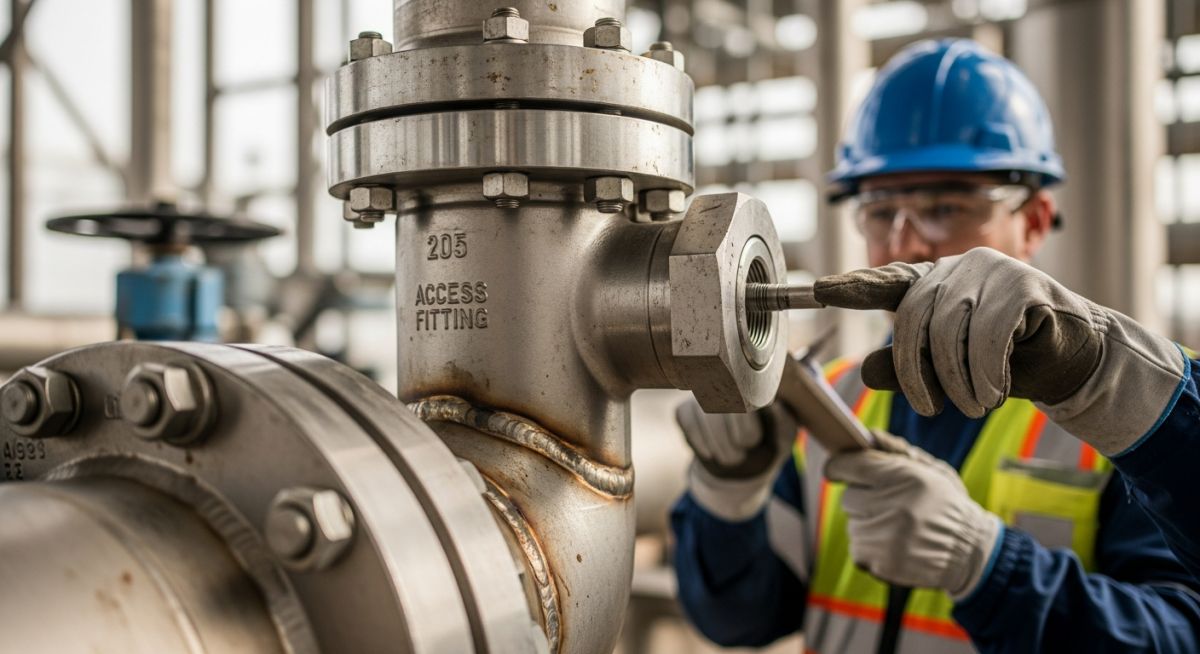
Engineering Standards 2026 What is an Access Fitting? Applications, Types, and Components An Access Fitting is a specialized high-pressure connection point used in piping and vessel systems to allow the insertion and retrieval of monitoring or injection equipment without shutting down the process. Quick Definition: Access Fitting An Access Fitting is a standardized high-pressure port (typically rated up to 6,000 PSI) that enables the safe insertion and retrieval of corrosion coupons, probes, or chemical injection quills. It utilizes a Plug Assembly and a specialized retrieval tool to maintain system pressure during maintenance, ensuring zero downtime. "In high-pressure environments, the integrity of the Access Fitting is your first line of defense against hazardous leaks during monitoring. Never compromise on the seal material selection for the plug assembly." — Atul Singla, Founder, Epcland Test Your Knowledge: Access Fitting Basics Next Question Restart Quiz Table of Contents What are Access Fittings in Piping Systems? Industrial Applications of the Access Fitting High Pressure Access Fitting Styles and Designs Major Components of an Access Fitting Assembly Solid vs Hollow Plug Assembly for Access Fittings Access Fitting Configuration for Chemical Injection Integrating Corrosion Coupons with Access Fittings What are Access Fittings in Piping Systems? In the complex world of midstream and downstream engineering, the Access Fitting serves as the fundamental interface between the internal process fluid and external monitoring equipment. These high-integrity components are permanently attached to the pipeline or vessel, providing a secure, threaded port that can withstand extreme operational pressures. Unlike standard flanged connections, an Access Fitting is specifically designed to work in tandem with a retrieval tool and service valve, allowing engineers to extract data without the need for a costly system depressurization or shutdown. The design of a modern Access Fitting is governed by rigorous mechanical standards, ensuring that the structural integrity of the pressure boundary is never compromised. By utilizing a specialized internal thread profile (often 2-inch ACME threads), the fitting ensures that the Plug Assembly remains locked in place even under cyclic loading and vibration. This makes the Access Fitting an indispensable asset for facilities aiming for high availability and 24/7 operational continuity in 2026. Figure 1: Cross-sectional view of a standard Access Fitting assembly showing internal thread engagement. Industrial Applications of the Access Fitting The versatility of the Access Fitting allows it to be utilized across various critical functions in oil, gas, and chemical processing. Primarily, it is the cornerstone of Corrosion Monitoring programs. By installing an Access Fitting at strategic locations—such as low-lying areas where water settles or high-velocity bends—operators can insert weight-loss coupons to measure the real-time degradation of the metal. Chemical Injection: Using the Access Fitting to deliver corrosion inhibitors, biocides, or demulsifiers directly into the flow stream via an injection quill. Microbiological Sampling: Retrieving bio-probes to check for Sulfate-Reducing Bacteria (SRB) that cause localized pitting. Sand Monitoring: Installing erosion probes through a High Pressure Access Fitting to detect particulate matter in high-velocity gas streams. Pressure/Temperature Sensing: Providing a temporary port for high-accuracy electronic transducers during commissioning or troubleshooting phases. High Pressure Access Fitting Styles and Designs Selecting the correct Access Fitting style is crucial for both weld integrity and long-term maintenance. The most common design is the Flareweld Access Fitting, which features a flared base that facilitates a high-strength fillet weld to the pipe surface. For applications involving thicker wall vessels or when welding is not preferred, engineers may opt for Flange-mounted or NPT-threaded variations. Each High Pressure Access Fitting is manufactured to meet specific metallurgy requirements. In sour service environments, the body is typically forged from A105 carbon steel or F316 stainless steel and must be compliant with NACE MR0175 to prevent Sulfide Stress Cracking (SSC). The external profile often includes a protective cover (pipe plug or heavy-duty plastic cap) to shield the external ACME threads from environmental debris and mechanical damage. Major Components of an Access Fitting Assembly A standard Access Fitting is not a single piece of hardware but a sophisticated assembly of precision-engineered parts. The primary component is the Fitting Body, which acts as the pressure-containing shell. Inside this body, the Plug Assembly serves as the primary seal, holding the monitoring equipment in place. To ensure zero leakage at 6,000 PSI, high-performance O-rings and primary packing seals are utilized, typically made from Viton or Teflon depending on the chemical compatibility of the process fluid. Component Material Selection Critical Function Fitting Body A105, F316L, Duplex Maintains pressure boundary and weld interface. Plug Assembly 316 SS / Hastelloy Holds coupons/probes and provides internal seal. Primary Packing Viton / PTFE Prevents process fluid bypass into the fitting threads. Protective Cap Heavy Duty Plastic/Steel Protects external threads from environment. Solid vs Hollow Plug Assembly for Access Fittings The choice between a solid and hollow Plug Assembly depends entirely on the application. A Solid Plug Assembly is the industry standard for weight-loss Corrosion Coupons. It provides a robust mechanical connection and is easier to maintain in high-pressure environments. Conversely, a Hollow Plug Assembly is required for electronic probes or chemical injection, as it allows for a passage (bore) through the center of the plug for cables or fluid flow. From a Service Valve perspective, the hollow plug requires additional sealing considerations to prevent internal leaks through the bore. Engineers must ensure that the internal bore is rated for the same design pressure as the Access Fitting body, typically following ASME B31.3 piping codes for wall thickness calculations. Access Fitting Configuration for Chemical Injection When an Access Fitting is repurposed for chemical injection, it utilizes an injection quill attached to a hollow plug. The placement is critical: the quill should ideally terminate in the center one-third of the pipe diameter to ensure maximum dispersion of the inhibitor. Engineering Math: Stress on the Access Fitting The longitudinal stress (Sl) on the fitting wall under internal pressure (P) is calculated using the simplified formula: Sl = (P × Di) / (4 × t) Where: P = Internal Design Pressure (PSI) Di = Internal Diameter of the Fitting (inches) t = Minimum Wall Thickness (inches) Integrating Corrosion Coupons with Access Fittings The integration of Corrosion Coupons into an Access Fitting allows for the empirical measurement of metal loss over time (mpy - mils per year). This data is vital for validating the effectiveness of chemical inhibitors. The coupon holder is threaded into the Plug Assembly, ensuring the coupon is oriented parallel to the flow to avoid artificial turbulence which could skew the data. Access Fitting Corrosion Rate Calculator Calculate the corrosion rate in Mils Per Year (MPY) based on weight-loss coupons retrieved from your Access Fitting. This tool follows the standard NACE calculation method. Weight Loss (grams) Coupon Area (sq. inches) Exposure Time (days) Metal Density (g/cm3) Default: Carbon Steel (7.85) Calculate Rate Reset Units Calculated Corrosion Rate: 0.00 MPY (Mils Per Year) Access Fitting Failure Case Study: High-Pressure Seal Leak Project Data Facility: Offshore Gas Processing Platform System Pressure: 4,200 PSI Equipment: Flareweld Access Fitting Service: Sour Gas (H2S present) Failure Analysis During a routine inspection, a minor gas weep was detected at the protective cap of a High Pressure Access Fitting. Upon removal of the cap, it was discovered that the primary O-ring seal on the Plug Assembly had suffered from Explosive Decompression (ED). Engineering Fix & Resolution The engineering team utilized a specialized Retrieval Tool and Service Valve to extract the damaged plug while the system remained at full operating pressure. The standard Nitrile O-rings were replaced with Rapid Gas Decompression (RGD) resistant Viton 90 shore seals. Additionally, the internal seating area of the Access Fitting was cleaned using a wire brush tool to ensure a metal-to-metal backup seal. Lessons Learned Always specify RGD-resistant elastomers for Access Fitting plugs in high-pressure gas service. Implement a 5-year replacement cycle for all internal Plug Assembly seals regardless of visual condition. Ensure the Access Fitting threads are lubricated with NACE-compliant anti-seize to prevent galling during high-pressure retrieval. Access Fitting: Frequently Asked Questions How do you perform a Retrieval Tool operation on an Access Fitting? ▼ Retrieving a Plug Assembly from an Access Fitting under pressure requires a specialized double-acting Retrieval Tool and a Service Valve. The tool equalizes the pressure between the pipeline and the tool's barrel, allowing the plug to be unscrewed and drawn back through the valve. Once the valve is closed, the pressure in the tool is bled off, and the components can be safely removed for inspection. What are the maintenance requirements for a High Pressure Access Fitting? ▼ Maintenance for a High Pressure Access Fitting involves regular inspection of the external ACME threads and the condition of the protective cap. During coupon replacement, the internal seating area must be cleaned of debris, and the Plug Assembly seals should be replaced. It is critical to use NACE-compliant lubricants on threads to prevent galling in 2026 operations. Can an Access Fitting be used for Chemical Injection and Corrosion Monitoring simultaneously? ▼ Typically, a single Access Fitting is dedicated to one function. However, specialized dual-purpose Plug Assembly designs exist that allow for limited chemical injection while supporting a corrosion probe. For high-accuracy monitoring, it is industry best practice to use separate fittings—one for the Chemical Injection quill and another downstream for the Corrosion Coupons. What materials are best for Access Fittings in sour service (H2S)? ▼ For sour service, the Access Fitting body must comply with NACE MR0175/ISO 15156. Common materials include forged 316L Stainless Steel or Super Duplex. The Plug Assembly and coupon holders are often made from Hastelloy C276 to prevent Hydrogen-Induced Cracking (HIC) and ensure long-term mechanical reliability. Conclusion The Access Fitting is a critical engineering component that bridges the gap between high-pressure process integrity and essential data acquisition. By understanding the nuances of the Plug Assembly, seal material selection, and proper installation styles, engineers can ensure a robust corrosion monitoring and chemical injection program. As systems move toward higher pressures and more corrosive environments in 2026, the reliance on high-quality High Pressure Access Fitting hardware remains a non-negotiable standard for pipeline safety and longevity. © 2026 Epcland Engineering Resources. All Rights Reserved. Back to Top ↑ 📚 Recommended Resources: Access Fitting Read these Guides 📄 What is a Pipe Union Fitting? Parts, Types, and vs Couplings 📄 Pipe End Cap Fittings: The Ultimate Guide to Pipe Caps vs Plugs 📄 MSS Standards in Piping: Complete List & Engineering Guide 2026 📄 What is TEMA? Comprehensive Guide to TEMA Heat Exchangers (2026) 🎓 Advanced Training 🏆 SMPV Rules 2016 & Latest Amendments (PESO Compliant) 🏆 Piping Design Basis: Piping Engineering 🎥 Watch Tutorials MR & TBE for Fittings Piping Engineering Courses II Certificate II Life time Access