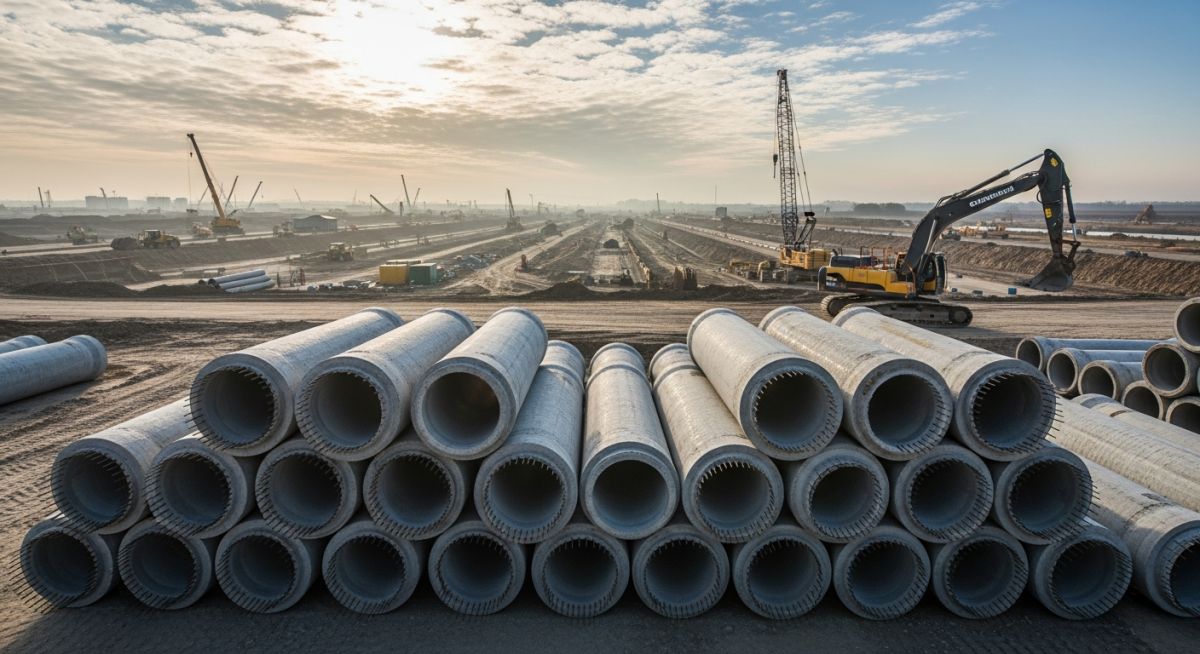
Verified Engineering Content Updated: January 2026 What is a Concrete Pipe? Engineering Guide to Types and Applications Imagine a city’s entire drainage network failing during a 100-year storm because a culvert couldn't handle the structural overburden. Why is your Concrete Pipe specification the difference between a century of service and a catastrophic collapse? In the 2026 engineering landscape, selecting the right Concrete Pipe—whether it is Reinforced (RCP) or Prestressed (PCCP)—is no longer just about diameter; it is about chemical resistance, load-bearing physics, and long-term sustainability. Key Engineering Takeaways • Structural Versatility: Unlike flexible pipes, a Concrete Pipe acts as both a conduit and a structural member, distributing loads directly into the bedding. • Standard Compliance: Understanding ASTM C76 (RCP) and AWWA C301/C304 (PCCP) is critical for pressure and non-pressure applications. • Longevity: With a design life exceeding 100 years, Concrete Pipe remains the gold standard for permanent 2026 infrastructure. What is a Concrete Pipe? A Concrete Pipe is a high-strength tubular structure manufactured from a mixture of Portland cement, water, and aggregates. It is engineered to transport water, sewage, or storm drainage. Available in reinforced (RCP), non-reinforced, and prestressed (PCCP) variants, it provides superior structural integrity, fire resistance, and a service life of 100+ years. "In my 20 years of field inspections, I've seen that the failure of a Concrete Pipe system rarely stems from the material itself, but from improper bedding or failing to account for 'T2' corrosion in sewage environments. Always match your pipe class to your burial depth." — Atul Singla, Founder of Epcland Table of Contents 1. What is a Concrete Pipe? 2. Primary Types of Concrete Pipe 3. Prestressed Concrete Pipe (PCCP) 4. Reinforced Concrete Pipe (RCP) 5. Noncylinder Design Factors 6. Pretensioned Concrete Pipe (C-303) 7. Engineering Advantages in 2026 8. Maintenance and Inspection Concrete Pipe Engineering Quiz Question 1 of 5 Next Question What is a Concrete Pipe? Defining Structural Integrity In the context of 2026 civil infrastructure, a Concrete Pipe is defined as a rigid conduit engineered to perform as a composite structure when integrated with its surrounding soil. Unlike flexible thermoplastic or metal pipes that rely almost entirely on side-fill support to resist deflection, a Concrete Pipe possesses inherent material strength. This means it can support vertical earth loads and live loads (such as HS-20 or HS-25 traffic loads) even with minimal lateral soil pressure. The manufacturing process involves a precise hydration reaction between Portland cement and water, binding aggregates into a rock-like mass. In modern engineering, this "rigid pipe" philosophy allows for shallower burial depths and more forgiving installation windows compared to flexible alternatives, provided the Concrete Pipe is selected according to the correct D-load or pressure rating. Primary Types of Concrete Pipe in Modern Infrastructure The classification of a Concrete Pipe is typically determined by its reinforcement method and its intended application (gravity flow vs. internal pressure). By 2026, the industry has standardized four primary categories that engineers must distinguish to ensure project longevity and safety. 1. Reinforced Concrete Pipe (RCP) The workhorse of municipal drainage. RCP is reinforced with steel cages (circular or elliptical) to handle tensile stresses that concrete alone cannot manage. It is governed by ASTM C76 and is categorized into five strength classes. 2. Prestressed Concrete Pipe (PCCP) Designed for high-pressure water transmission. PCCP involves a concrete core, a steel cylinder for water-tightness, and high-tensile wire wrapping that places the core in permanent compression, neutralizing internal bursting pressures. 3. Non-Reinforced Concrete Pipe Used primarily for smaller diameter storm drains (usually under 36 inches) where the compressive strength of the concrete alone is sufficient to manage the expected loads. Standardized under ASTM C14. Prestressed Concrete Pipe (PCCP) and High-Pressure Design Prestressed Concrete Pipe (PCCP) represents the pinnacle of concrete hydraulic engineering. In 2026, it remains the preferred choice for large-diameter water mains (up to 144 inches). The design relies on the principle of "prestressing," where high-strength steel wire is wound under high tension around a concrete core. This creates a state of compression that must be overcome by internal water pressure before the concrete ever experiences tension. There are two main sub-types of PCCP: Lined Cylinder Pipe (LCP): Features a steel cylinder lined with concrete, with wire wrapping applied directly to the cylinder. Embedded Cylinder Pipe (ECP): The steel cylinder is embedded within the concrete core, providing an extra layer of protection and structural rigidity before the wire wrapping is applied. Reinforced Concrete Pipe (RCP): The Standard for Culverts In 2026, Reinforced Concrete Pipe (RCP) remains the primary specification for storm water and sanitary sewer systems due to its unmatched "D-Load" capacity. Unlike flexible pipes that require high-modulus soil compaction for structural stability, RCP is a rigid structure that carries the majority of the load through its own pipe wall. The reinforcement cages within the Concrete Pipe are strategically placed in the "tension zones" (the crown and invert on the inside, and the springline on the outside). For high-performance 2026 projects, engineers specify RCP based on the ASTM C76 classification system, which dictates the minimum reinforcement area required to withstand specific crushing loads. Reinforced Concrete Pipe (Noncylinder) Design Factors Reinforced Concrete Noncylinder pipes are utilized in low-to-medium pressure applications where a continuous steel cylinder is not required for water-tightness. These Concrete Pipe designs rely on high-quality rubber gaskets and precision-engineered joints to maintain hydraulic integrity. In 2026, advancements in synthetic rubber compounds have significantly reduced joint leakage in these systems, making them viable for environmentally sensitive effluent transport. Pretensioned Concrete Pipe (C-303) vs. PCCP It is a common mistake in Concrete Pipe procurement to confuse Pretensioned (AWWA C303) with Prestressed (AWWA C301). Pretensioned Concrete Cylinder Pipe consists of a welded steel cylinder, a centrifugally cast concrete lining, and a high-strength steel rod wrapped around the cylinder. While PCCP (Prestressed) uses tensioned wire to compress the core, C-303 (Pretensioned) provides a semi-rigid structure that is particularly effective in soils where slight flexibility is required without sacrificing the corrosion protection of a mortar coating. 2026 Reference Table: Concrete Pipe Standards & Applications Pipe Type Governing Standard Primary Use Case Key Feature RCP (Reinforced) ASTM C76 / AASHTO M170 Storm Sewers & Culverts D-Load Strength Classes I-V PCCP (Prestressed) AWWA C301 / C304 High-Pressure Water Mains Wire-wrapped Compression Pretensioned AWWA C303 Water Transmission Steel Rod Reinforcement Non-Reinforced ASTM C14 / AASHTO M86 Low-load Drainage Cost-effective Small Dia. Engineering Advantages of Concrete Pipe for 2026 Projects Why does Concrete Pipe dominate the 2026 market despite competition from polymers? The answer lies in Environmental Stability and Structural Reliability. Concrete Pipe is non-flammable, making it the only safe choice for culverts in wildfire-prone regions. Additionally, its high mass prevents "pipe flotation" in high-groundwater areas, a common failure point for lightweight plastic alternatives. Concrete Pipe Weight & Load Estimator (2026) Estimate the approximate weight and required D-Load class for Reinforced Concrete Pipe (RCP) based on standard ASTM C76 parameters. Pipe Inner Diameter (Inches) Burial Depth (Feet) Estimated Weight ~265 lbs/ft Recommended RCP Class Class III Calculate Installation Specs *Disclaimer: This is a 2026 estimation tool. Always consult the Concrete Pipe Design Manual and a licensed structural engineer for final site-specific calculations. Concrete Pipe Failure Case Study: Forensic Analysis of PCCP Wire Snapping The Scenario In early 2026, a major municipal water district experienced a catastrophic blowout of a 72-inch Prestressed Concrete Cylinder Pipe (PCCP) main. The line, originally installed in the 1980s, was rated for 150 psi but failed under normal operating conditions. The Root Cause Forensic investigation revealed Hydrogen Embrittlement of the high-tensile prestressing wires. Micro-cracks in the outer mortar coating allowed chlorides to penetrate, leading to localized corrosion. As individual wires snapped, the Concrete Pipe core lost its compressive state, eventually leading to a structural "unzipping" under internal hydraulic pressure. 2026 Engineering Solutions 1 Electromagnetic Inspection: Use of "P-Wave" technology to detect broken wire coils without excavation. 2 Carbon Fiber Lining: Structural reinforcement using CFRP (Carbon Fiber Reinforced Polymer) on the pipe interior to restore pressure capacity. 3 Cathodic Protection: Implementation of sacrificial anodes to halt further wire degradation in the remaining Concrete Pipe segments. Expert Insights: Lessons from 20 years in the field ✓ The 0.01-inch Crack Myth: In 2026, we still see engineers panicking over hairline cracks in Concrete Pipe. Remember, ASTM C76 design allows for a 0.01-inch crack; the alkaline environment of the concrete actually "heals" these through autogenous healing. ✓ Bedding is 80% of the Battle: A Class IV Concrete Pipe can fail if placed on uncompacted point loads. Ensure the bedding "cradle" supports at least 120 degrees of the pipe's bottom haunch. ✓ Gasket Lubrication: Never skip the lube. 90% of joint failures in Concrete Pipe systems during 2026 hydro-testing are traced back to rolled or "fish-mouthed" gaskets caused by dry installation. Frequently Asked Questions (Concrete Pipe Engineering) How do I choose between Class III and Class IV RCP? ▾ The choice depends on the D-Load required by your fill height and traffic load. Generally, Class III is standard for depths up to 8-10 feet, while Class IV or V is mandatory for deeper burials or heavy railway/airport loads. Does a Concrete Pipe corrode in sewage? ▾ Yes, specifically via Microbial Induced Corrosion (MIC). In 2026, we mitigate this by using high-performance coatings, calcium aluminate cement, or PVC/HDPE linings inside the Concrete Pipe to resist sulfuric acid. What is the "Rigid Pipe" advantage over HDPE? ▾ A Concrete Pipe provides its own structural strength. HDPE is a flexible conduit that relies 100% on the surrounding soil for integrity. If your soil compaction isn't perfect, HDPE will deflect, while concrete remains stable. Why are my 2026 projects moving toward PCCP? ▾ For high-pressure water transmission, Prestressed Concrete Cylinder Pipe (PCCP) offers the highest safety factor against surge pressures and provides a much longer service life than ductile iron in corrosive soils. Is concrete pipe environmentally friendly? ▾ Yes, it has a lower carbon footprint over its 100-year lifecycle compared to plastic pipes, as it is made from local natural materials and is 100% recyclable into aggregates. How do joint gaskets handle movement? ▾ Modern Concrete Pipe joints use confined O-ring or profile gaskets that allow for minor differential settlement without leaking, maintaining a water-tight seal up to 13 psi in non-pressure applications. References & Standards ASTM C76 - Standard Specification for Reinforced Concrete Culvert, Storm Drain, and Sewer Pipe AWWA C301 - Prestressed Concrete Pressure Pipe, Steel-Cylinder Type American Concrete Pipe Association (ACPA) Design Manual 📚 Recommended Resources: Concrete Pipe Read these Guides 📄 Complete Guide to Epoxy Pipe Coating: Types, Applications, Pros and Cons 📄 What are Concrete Anchors? Their Applications, Materials, and Types (2026 Guide) 📄 Subsea Pipeline Design: 2026 Engineering Guide to Offshore Piping 📄 Thrust and Anchor Blocks in Pipelines: Design & Calculation Guide (2026) 🎥 Watch Tutorials Concrete Pipe II Types II Applications II #Epcland Underground Piping Design Course | Video 4: Pipe Burial Depth & Protection