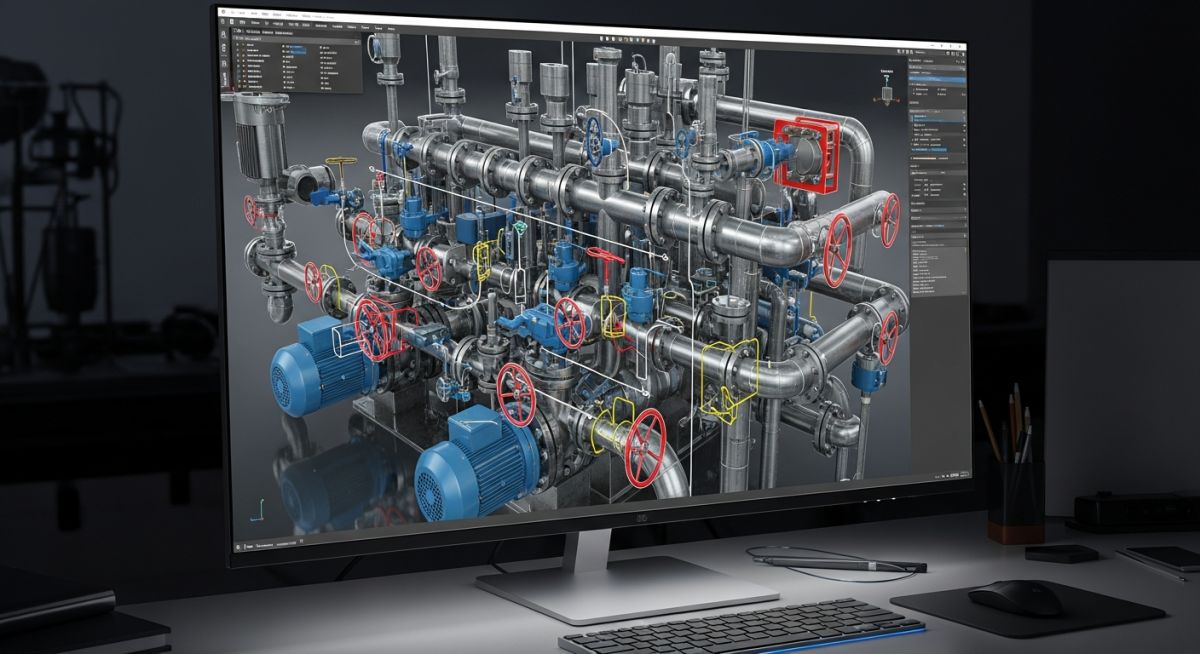
Industry Standard Updated: 2026 3D Model Review Guide: Mastering 30%, 60%, and 90% Design Stages Imagine standing at a construction site in the middle of a remote desert, watching a crane lift a multi-million dollar pressure vessel, only to realize the nozzle orientation is 15 degrees off because of a structural beam that "wasn't there" in the drawings. This nightmare is exactly what a rigorous 3D Model Review is designed to prevent. In the high-stakes world of EPC projects, these reviews are not just meetings; they are the final gatekeepers between a digital design and a multi-million dollar field error. This guide breaks down the strategic evolution of the design, ensuring your team captures every clash, accessibility issue, and maintenance requirement before a single bolt is tightened on-site. Key Takeaways ✔ Understand the specific deliverables required for 30%, 60%, and 90% milestones to avoid project delays. ✔ Identify the roles and responsibilities of the Piping Lead and Project Engineer during the review process. ✔ Utilize comprehensive checklists to ensure compliance with ASME and API standards. Quick Answer: What is a 3D Model Review? A 3D Model Review is a multidisciplinary engineering milestone where the 3D digital twin of a plant is audited at 30%, 60%, and 90% completion. It ensures design accuracy, identifies physical clashes, verifies maintenance access, and confirms that the layout aligns with P&IDs and safety standards before fabrication begins. "In my 20 years of engineering, I've seen that the most expensive mistakes aren't made in the field—they are born in skipped 3D Model Reviews. A 60% review isn't just about piping; it's about the conversation between the structural engineer and the operator who actually has to reach that valve." — Atul Singla, Founder Table of Contents What is a 3D Model Review in Modern Engineering? The Critical Stages of the 3D Model Review Process 30% 3D Model Review: Conceptual Foundation 60% 3D Model Review: Detailed Engineering Integrity 90% 3D Model Review: Final Production Readiness Professional 3D Model Review Responsibility Matrix Essential Documents for a Successful 3D Model Review Multidisciplinary Participants of Model Review The Ultimate 3D Model Review Checklist Knowledge Check: 3D Model Review Question 1 of 5 Which model review stage primarily focuses on the conceptual plot plan and major equipment locations? A) 30% Review B) 60% Review C) 90% Review At which stage is the "Frozen" P&ID usually required to validate the model? A) 30% Review B) 60% Review C) 90% Review What is the primary goal of checking "Egress Routes" during a model review? A) Reducing pipe length B) Personnel safety and emergency escape C) Managing cable tray density When should small-bore piping (typically 2" and below) be completely modeled and reviewed? A) 60% Review B) 90% Review C) Construction Phase Who is responsible for facilitating the 3D model review meeting and documenting clashes? A) The Client B) The Software Vendor C) The EPC Lead/Piping Coordinator Next Question What is a 3D Model Review in Modern Engineering? In the current digital engineering landscape, a 3D Model Review serves as the primary collaborative platform for multi-disciplinary design verification. It is a systematic, formal assessment of the plant’s three-dimensional digital twin, conducted at predefined stages of project maturity. Unlike traditional 2D drawing reviews, the 3D model allows stakeholders to walk through the plant virtually, identifying spatial constraints, maintenance access issues, and operational hazards that are often invisible on paper. The process is integrated within the ASME Standards framework to ensure that piping layouts, equipment orientations, and structural integrity align with international safety and performance benchmarks. By utilizing advanced software like Navisworks or S3D, the engineering team can perform automated clash detection, ensuring that "hard" clashes (physical intersections) and "soft" clashes (clearance violations) are resolved before the design is frozen for fabrication. The Critical Stages of the 3D Model Review Process The 3D Model Review process is typically structured into three distinct milestones: 30%, 60%, and 90% completion. Each stage represents a specific level of "Design Maturity." At the 30% stage, the focus is on the overall footprint and major equipment. By 60%, the primary piping and structural frameworks are audited. Finally, at 90%, the focus shifts to the granular details, including small-bore piping, instrumentation, and final accessibility for operations and maintenance. This phased approach prevents the "cascading error" effect, where a fundamental mistake in early layout leads to massive rework costs during the final stages of detailed engineering. 30% 3D Model Review: Conceptual Foundation The 30% 3D Model Review is arguably the most critical stage for the project’s financial health. At this point, the primary objective is to finalize the "Plot Plan" and the general arrangement of major equipment. The engineering team presents the conceptual layout to the client to ensure that the basic flow of the plant meets the operational intent. It is much easier (and cheaper) to move a 50-ton heat exchanger 5 meters to the left in the 30% model than it is after the underground piping and foundations have been designed. Objectives of 30% model review During this initial phase, the team focuses on macro-level engineering decisions: Validation of the overall Site Layout and Plot Plan. Confirmation of Major Equipment locations and orientations (Vessels, Tanks, Pumps). Identification of primary Pipe Rack locations and widths. Review of main access roads and entry points for construction equipment. Initial assessment of Safety Distances based on fire hazard zones and API 752/753 recommendations. 60% 3D Model Review: Detailed Engineering Integrity The 60% 3D Model Review marks the transition from conceptual layout to detailed design. At this milestone, all "critical" and "major" piping (typically 3" and above) must be modeled. This is the stage where the multidisciplinary nature of the review becomes evident, as structural supports, electrical cable trays, and HVAC ducts are integrated into the space. A primary focus here is Maintainability and Operability. Operators must be able to reach valves, pull heat exchanger bundles, and access instruments without obstruction. According to API Standards for plant layout, human factors engineering (HFE) must be applied to ensure that the physical environment supports safe and efficient work practices. Objectives of 60% model review Verification of Major Piping Routing (3" and larger) against frozen P&IDs. Review of Pipe Support locations, especially for high-temperature lines requiring spring hangers. Integration of Cable Trays and Ducting to identify spatial conflicts. Confirmation of Valve Accessibility and platform/ladder requirements. First pass of the "Maintenance Study," ensuring cranes and forklifts can access heavy components. 90% 3D Model Review: Final Production Readiness The 90% 3D Model Review is the final "pre-IFC" (Issued for Construction) checkpoint. At this stage, the design is essentially complete. All small-bore piping, instrumentation, electrical junction boxes, and secondary supports must be present in the model. This review is a granular audit where the team ensures that the design complies with the most minute requirements of ISO Quality Standards and site-specific safety regulations. The focus shifts from "where does this pipe go" to "how does the technician calibrate this instrument?" We verify that there are no "soft clashes"—where a pipe might not touch a beam, but it blocks the removal of a pump seal or the opening of a control panel door. This is the last chance to catch errors before they manifest as expensive Site Queries (SQs) or field rework. Objectives of 90% model review Verification of Small-Bore Piping (2" and below) and tubing. Final review of Instrumentation and Junction Box locations for ergonomic access. Confirmation of all Egress Routes and emergency lighting clearances. Final validation of Vendor Data—ensuring the "as-built" dimensions of purchased equipment match the model. Resolution of all remaining items from the 30% and 60% punch lists. Professional 3D Model Review Responsibility Matrix Role Primary Responsibility Key Deliverable Piping Lead Ensures routing logic, flexibility, and supportability. Model Clash Resolution Report Project Engineer Coordinates inter-disciplinary alignment and schedule. Consolidated Punch List Process Engineer Verifies model against P&IDs and PFDs. P&ID Consistency Check HSE Lead Audits safety distances, egress, and fire protection. Safety Access Audit The Ultimate 3D Model Review Checklist To ensure consistency across global projects, engineering firms use standardized checklists. These are often mapped to ASME B31.3 for process piping to ensure mechanical integrity is maintained alongside spatial efficiency. 30% Checklist • Equipment footprints accurate? • Major pipe rack corridors defined? • Maintenance roads clear? 60% Checklist • Primary piping (>3") modeled? • Valve handwheels accessible? • Cable tray paths resolved? 90% Checklist • All instrumentation present? • Small bore piping support? • Labels and tags visible? 3D Model Review Readiness Calculator Determine if your project is ready for the next milestone based on current design progress. Target Review Stage 30% Review (Conceptual) 60% Review (Detailed) 90% Review (Final) Piping Modeled (%) P&ID Status Preliminary / Issued for Design Frozen / Issued for Review Final / Issued for Construction Equipment Placed (%) Analyze Readiness Case Study The Clash Cost-Saver: Saving $200k at 30% Maturity The Challenge During a fast-track Brownfield expansion for a chemical processing unit, the initial 3D Model Review at the 30% stage revealed a critical spatial conflict. A primary 24-inch suction line was routed directly through a proposed concrete pile cap that had not yet been finalized in the civil drawings. The Solution By identifying this "Inter-disciplinary Clash" during the conceptual phase, the piping lead and structural engineer were able to shift the pump foundation by 1.2 meters. This adjustment was made digitally in less than two hours using Navisworks clash detection tools. Measured Impact Cost Avoidance: Estimated $200,000 in demolition and re-piling costs. Schedule Protection: Prevented a 3-week delay during the construction phase. Design Integrity: Zero piping stress failures reported after the re-routing. Don't miss this video related to 3D Model Review Summary: In 60% model review meeting there are many points to be included in terms of safety, Mechanical, Piping, Civil, Electrical, and ...... ✅ 2500+ VIDEOS View Playlists → JOIN EXCLUSIVE EDUCATION SUBSCRIBE Expert Insights: Lessons from 20 years in the field Prioritize "Soft Clashes" for Human Factors A model might be technically "clash-free" in the software, but if an operator cannot physically turn a handwheel or pull a transmitter, the design is a failure. Always include an avatar or "3D Man" in the 60% and 90% reviews to verify ergonomic accessibility. The 30% Review is a Commercial Milestone Never treat 30% as just a technical exercise. Major equipment locations dictate the bulk of your civil and structural costs. Finalizing the plot plan here "freezes" the largest cost drivers of the project. Small Bore is the 90% Killer The most common reason for 90% review failure is the lack of small-bore piping and secondary supports. If these aren't modeled, your clash detection is incomplete, leading to thousands of dollars in field "spooling" issues. References & Standards ASME B31.3: Process Piping Code API Standards for Layout and Human Factors (HFE) ISO 19650: BIM and Digital Twins Management Authority FAQ Section Why is the 30% 3D Model Review considered the "Financial Foundation" of a project? The 30% 3D model review is the first major milestone where the plant layout is roughly 30% complete. It is the "financial foundation" because it freezes the plot plan and major equipment locations. Establishing these footprints early allows for the release of civil foundation loads and underground piping design, preventing massive rework costs later in the project lifecycle. How do you handle missing deliverables during a formal review? Ideally, a 3D model review should not proceed until all required deliverables are modeled. However, if critical path schedules are at risk, a review may proceed only if the Project Manager and Client identify and approve specific mitigation strategies for the missing data. Industry guidelines from ScienceDirect Engineering emphasize that any gaps must be logged as "Action Items" with strict resolution deadlines. What specific "Human Factors" are audited during the 60% and 90% stages? Reviews focus on ergonomics and safety access. Key audits include valve handwheel heights (ideally between 250 mm and 1200 mm), maintenance clearances for pump seal removal, and emergency escape routes. As noted in the EPCLand Design Checklist, identifying these "soft clashes" ensures the plant is not just buildable, but safely operable for 20+ years. Who are the mandatory participants in a 3D model review session? A multidisciplinary team is required: The Piping Lead (facilitator), Project Engineer, Process Engineer (to verify P&IDs), and representatives from Civil, Structural, Electrical, and Instrumentation. Crucially, stakeholders from the Client’s Operations and Maintenance team must attend to provide practical feedback on equipment access and safety. What are the primary software tools used for these reviews in 2026? Autodesk Navisworks remains the primary tool for 3D walkthroughs and clash detection. However, integration with AVEVA E3D and Intergraph SmartPlant 3D (S3D) is standard for high-fidelity data extraction. Modern reviews also utilize VR (Virtual Reality) environments to simulate confined space entries and crane lifting studies. When is the P&ID officially "Frozen" for the 3D Model Review? The Piping and Instrumentation Diagrams (P&IDs) are typically frozen at the 60% review stage. This freeze ensures that the piping routing, line sizing, and instrumentation requirements are finalized before the team invests significant hours in modeling small-bore piping and electrical cable trays for the 90% milestone. 📚 Recommended Resources: 3D Model Review Read these Guides 📄 All About 3D Model Review: Piping Quiz 📄 What is Smart Plant Review (SPR)? Functions and Advantages (2026) 📄 All About 90% Model Review: Piping Quiz 📄 All About 60% Model Review: Piping Quiz 🎓 Advanced Training 🏆 Piping Deliverables & Non-Deliverables 🏆 Complete Course on Piping Engineering 🎥 Watch Tutorials 30% Model Review II 3D Model Review (Part-1 of 4) II Purpose II Check-Points #30%ModelReview 60% Model Review II 3D Model Review (Part-2 of 4) II Purpose II Check-Points #60%ModelReview 90% Model Review II 3D Model Review (Part-3 of 4) II Purpose II Check-Points #90%ModelReview