What is a Sideboom Pipelayer? The Engineering Guide to Heavy Lift Operations

Imagine you are standing on a rain-slicked ridge in the Appalachians. A 48-inch diameter steel pipe, weighing several tons per linear foot, is suspended just inches above a trench. Suddenly, the ground shifts. Does your operator know the exact tipping point of their Sideboom Pipelayer? Most field failures aren’t caused by mechanical breakdown, but by a fundamental misunderstanding of lateral stability physics. Whether you are a project manager or a field engineer, mastering the Sideboom Pipelayer is the difference between a successful “lower-in” and a multi-million dollar environmental disaster.
Executive Summary: Core Insights
- Stability Mechanics: Unlike standard cranes, a Sideboom Pipelayer utilizes a specialized track-oscillating system to maintain a low center of gravity.
- Regulatory Compliance: All 2026 operations must strictly adhere to ASME B30.14, governing design, inspection, and operation.
- Operational Precision: Modern units integrate Load Moment Indicators (LMI) to prevent static tipping during tandem lifts.
Definition: What is a Sideboom Pipelayer?
A Sideboom Pipelayer is a specialized heavy industrial machine, typically built on a track-type tractor chassis, designed specifically for lifting, handling, and installing large-diameter pipes. It features a side-mounted boom, hydraulic winches, and extendable counterweights to balance heavy lateral loads while traversing rugged pipeline right-of-ways.
Atul Singla’s Expert Perspective
“In my 20 years of EPC project management, I’ve seen that the Sideboom Pipelayer is often treated as just a ‘tractor with a crane.’ This is a dangerous mistake. In 2026, the complexity of tandem lifts in varying soil conditions requires engineers to treat these machines as dynamic lifting platforms, not static assets.”
— Atul Singla, Founder of Epcland
Complete Course on
Piping Engineering
Check Now
Key Features
- 125+ Hours Content
- 500+ Recorded Lectures
- 20+ Years Exp.
- Lifetime Access
Coverage
- Codes & Standards
- Layouts & Design
- Material Eng.
- Stress Analysis
Sideboom Pipelayer Competency Quiz
1. Which ASME standard specifically governs the design, inspection, and operation of a Sideboom Pipelayer?
Core Definition: What defines a Sideboom Pipelayer in 2026?
In the high-stakes world of midstream infrastructure, the Sideboom Pipelayer is the undisputed backbone of mainline construction. Unlike a conventional crane that rotates 360 degrees, a Sideboom Pipelayer is an integrated lifting platform engineered for linear stability. It is built upon a heavy-duty crawler tractor chassis, where the traditional dozer blade is replaced by a side-mounted lattice or box-section boom.
The engineering DNA of a Sideboom Pipelayer focuses on the Lateral Load Moment. By mounting the hoist mechanism on the side, the machine can straddle a trench while carrying massive sections of coated pipe. In 2026, the integration of electronically controlled hydraulic winches allows for “micro-creeping”—the ability to move the machine at millimeter precision while the load is suspended, a feat impossible for standard hydraulic excavators.
Critical Differences: Sideboom vs. Standard Pipelayer Configurations
Engineers often confuse the generic term “Pipelayer” with the specific “Sideboom” designation. A Sideboom Pipelayer is defined by its Fixed-Track Orientation. While some “pipelayer” attachments can be mounted to hydraulic excavators (often called “Excavator-Pipelayers”), they lack the wide track gauge and low center of gravity inherent in a purpose-built Sideboom Pipelayer.
| Feature | Sideboom Pipelayer | Excavator-Based Pipelayer |
|---|---|---|
| Stability Profile | High (Wide Gauge + Counterweights) | Moderate (Subject to Swing Centrifugal Force) |
| Lift Orientation | Lateral (Side-mounted) | 360-Degree Rotation |
| Trench Clearance | Optimized for Close-proximity Work | Limited by Boom Reach and Tail-swing |
How a Sideboom Pipelayer Works: The Physics of Lateral Lifting
The operational physics of a Sideboom Pipelayer rely on the Law of the Lever. As the boom extends laterally to position the pipe, the machine’s center of gravity shifts toward the tipping line (the outer edge of the track). To counteract this, the Sideboom Pipelayer employs hydraulically extendable counterweights on the opposite side.
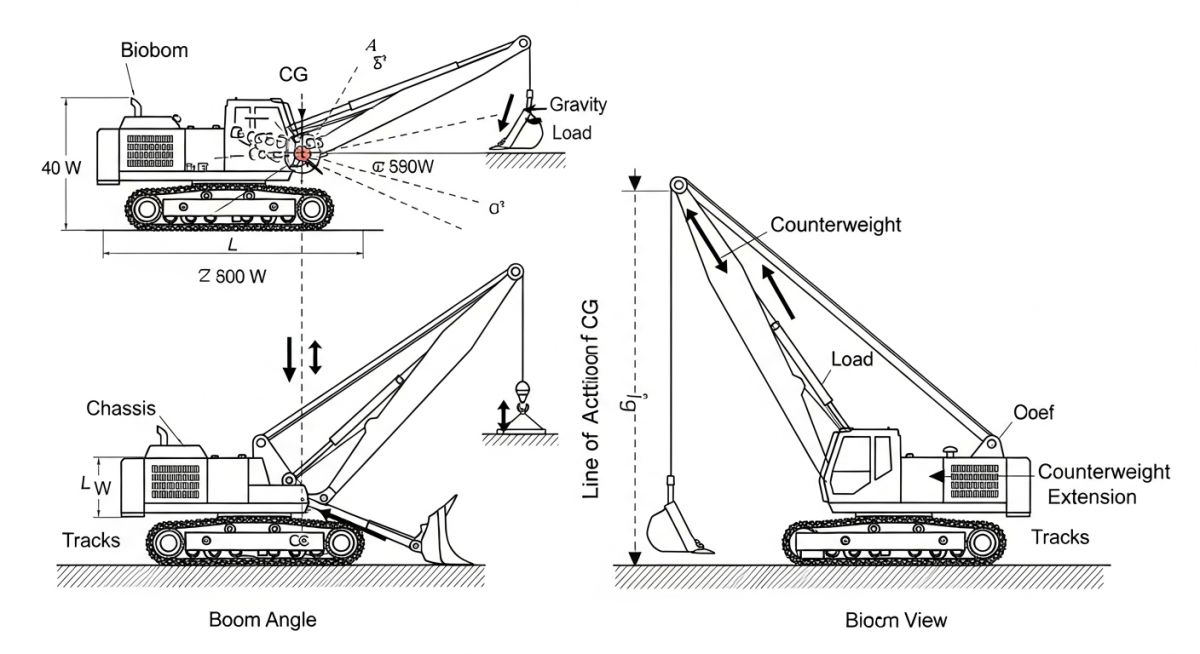
One of the most critical components in this workflow is the Drawworks Control. Modern 2026 models utilize dual-path hydrostatic transmissions. This allows the operator to control the hoist and the boom independently while simultaneously steering the tracks. In a “lower-in” operation, where five or more Sideboom Pipelayers work in tandem, this precision is what prevents the pipe from buckling or the coating from being damaged.
Sideboom Pipelayer: Stability & Load Estimator
Estimate the maximum safe working load based on ASME B30.14 tipping factors (75% to 85% rule).
Note: This is an estimate. Always consult the specific machine’s Load Chart before any lift.
Sideboom Pipelayer Failure Case Study: The “Soft-Shoulder” Tipping Incident
Project Overview
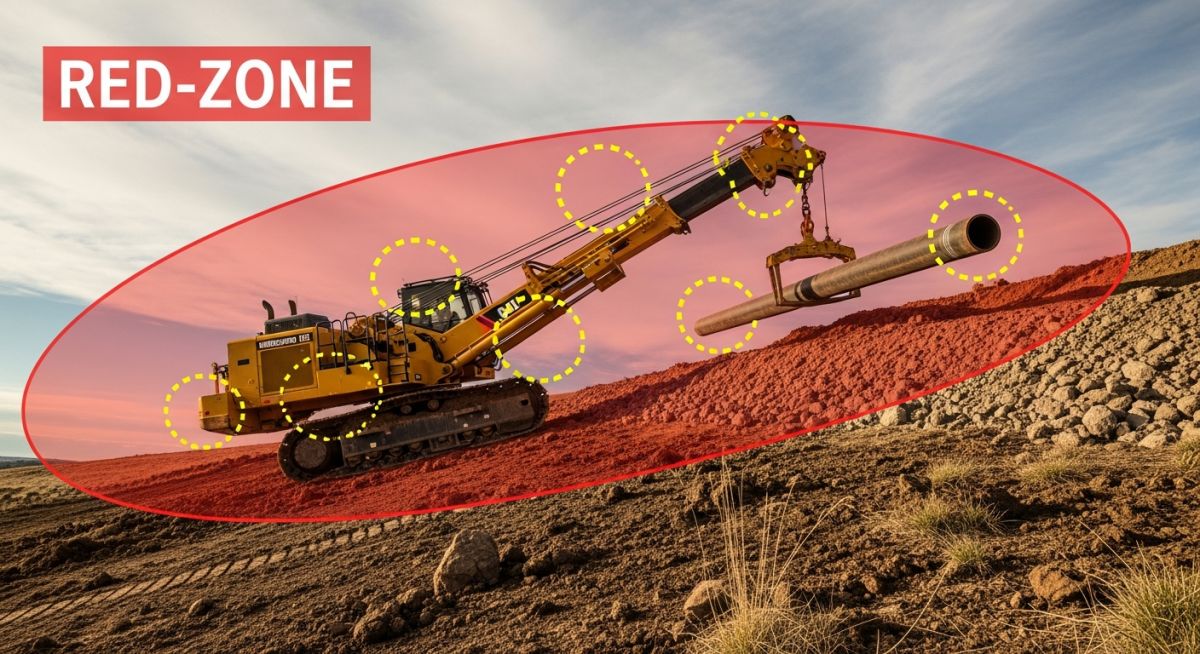
During a 42-inch natural gas pipeline installation in the Gulf Coast region (2025), a Sideboom Pipelayer (200,000 lb capacity class) experienced a near-total tipping event during a standard “lower-in” procedure. The operation involved five machines working in a synchronized spread.
The Root Cause
Post-incident engineering analysis revealed that while the Load Moment Indicator (LMI) was active, the operator had overridden the “out-of-gauge” alarm to accommodate a slight soil slope. The Sideboom Pipelayer was positioned on uncompacted backfill (soft shoulder), causing the track on the boom side to sink 12 inches, instantaneously shifting the center of gravity beyond the tipping line.
Engineering Lessons Learned
- 1. Dynamic Loading: A static load chart does not account for soil subsidence. Always subtract 25% from the Sideboom Pipelayer capacity when working on uncompacted fill.
- 2. Tandem Sync: In this case, the lead machine’s failure nearly caused a “zipper effect,” where the weight transfer almost pulled the adjacent four machines into the trench.
- 3. Standard Adherence: Strict ASME B30.14 protocols regarding ground stability checks could have prevented the incident.
Pro-Tip: Modern Sideboom Pipelayers in 2026 now feature “Ground Pressure Sensors” that integrate with the LMI to provide a real-time stability score based on track sinkage.
Don’t miss this video related to Piping Engineering

Summary: In this video, let’s explore the types & Scope of piping engineers. In general, Piping engineers can be categorized into the ……
Expert Insights: Lessons from 20 years in the field
Transitioning from theoretical engineering to field execution reveals nuances that standards manuals often overlook. Based on global pipeline spreads in 2026, here are the critical operational pillars:
- The 85% Trap: While ASME B30.14 allows lifting up to 85% of the static tipping load, veteran engineers cap “Lower-In” operations at 65% to account for dynamic wind loading and uneven track subsidence.
- Hydraulic Drift: In aging Sideboom Pipelayers, internal seal bypass in the boom cylinder can cause “creeping.” Always implement a secondary mechanical lock or pilot-operated check valves during static holds.
- Counterweight Sequencing: The most common operator error is extending counterweights after the load has reached a critical radius. Counterweights should be positioned as the primary setup step, not a reactive adjustment.
Authority FAQ: Mastering the Sideboom Pipelayer
How is the rated capacity of a Sideboom Pipelayer calculated?
The rated capacity is determined by the Static Tipping Load. Per ASME B30.14, the working load must not exceed 85% of the load required to tip the machine on a level, firm surface at any given boom radius.
Can a Sideboom Pipelayer be used as a standard crane?
Generally, no. A Sideboom Pipelayer is designed for linear pipe handling. They lack 360-degree rotation and are governed by specific standards that do not permit general construction lifting unless the machine meets ASME B30.5 requirements.
What are the certification requirements for an operator?
Operators must be qualified according to ISO 15513 or national equivalents like NCCCO in the US. This includes documented training on load charts, stability physics, and emergency shutdown procedures.
Why is the Drawworks design unique in a Sideboom?
The drawworks are engineered for high-torque, low-speed inching to prevent pipe coating damage. They often feature independent hydraulic circuits for the boom and hook to allow simultaneous control during complex lifts.
What is the “Anti-Two Block” system?
It is a safety device that prevents the hook block from coming into contact with the boom tip. Contact (two-blocking) can snap the wire rope instantly, dropping the load and potentially causing a machine tip-over.
How do engineers handle steep terrain with a Sideboom?
On slopes exceeding 10 degrees, engineers must utilize specialized winching tractors and derate the Sideboom Pipelayer capacity. The Load Moment Indicator (LMI) must be calibrated for the specific pitch and roll.
References & Standards
📚 Recommended Resources: Piping Engineering
Read these Guides
🎓 Advanced Training



Related posts:
![High-grade industrial Wing Nut Types and Applications for mechanical assemblies.]()
Wing Nut Types and Applications: The 2026 Engineering Guide
![Industrial Monorail Crane Systems installed in a modern manufacturing plant 2026.]()
Monorail Crane Systems: Design, Types & 2026 Standards Guide
![Lead engineer performing a Factory Acceptance Test FAT on an industrial skid system 2026]()
Factory Acceptance Test FAT: The 2026 Engineering Guide to Zero-Defect Delivery
![Professional engineering workspace showing a Basis of Design document layout for a 2026 project.]()
Basis of Design: How to Write a BOD for Engineering Projects in 2026
![Industrial Flare Knockout Drum Sizing and installation in a refinery relief system.]()
Flare Knockout Drum Sizing: Design & API 521 Standards (2026 Guide)
![Advanced Reboiler Control Systems in a modern petrochemical refinery 2026.]()
Reboiler Control Systems: Engineering Guide to Precision Control 2026