Critical Pipe Stress Engineering Challenges in ASME B31 and EN 13480 Standards
Navigating Pipe Stress Engineering Challenges requires a profound understanding of how evolving codes like ASME B31.3 and EN 13480 govern the mechanical integrity of pressure piping. From the nuanced calculations of axial force to the critical 2016 updates on branch section modulus, engineers must adapt to maintain safety and compliance in modern industrial environments.
What are the primary Pipe Stress Engineering Challenges?
The core challenges involve accurately calculating longitudinal stresses from internal pressure, managing the 2016 ASME B31.3 effective section modulus for tees, and ensuring bend wall thickness compensates for thinning during fabrication. Mastery of these factors ensures piping systems withstand sustained, thermal, and occasional loads without mechanical failure.

In This Technical Guide
Engineering Competency Check
Question 1 of 5
Complete Course on
Piping Engineering
Check Now
Key Features
- 125+ Hours Content
- 500+ Recorded Lectures
- 20+ Years Exp.
- Lifetime Access
Coverage
- Codes & Standards
- Layouts & Design
- Material Eng.
- Stress Analysis
Analyzing Pipe Stress Engineering Challenges with Axial Stress and Pressure Loads
One of the fundamental Pipe Stress Engineering Challenges involves the accurate calculation of longitudinal stresses derived from internal pressure. In a closed piping system, internal pressure does not only create hoop stress; it generates a significant longitudinal force that acts on end caps, blind flanges, and changes in direction such as elbows and reducers.
Longitudinal Force and the Bourdon Effect
The longitudinal pressure stress (SL) is a sustained load that must be combined with weight and other mechanical loads. According to ASME B31.3, this is calculated based on the internal pressure (P), the pipe outside diameter (D), and the thickness (t) minus allowances.
- Internal Pressure (P): The primary driver of axial tension.
- Cross-Sectional Area: The metal area resisting the longitudinal force.
- Code Compliance: Ensuring the sum of longitudinal stresses stays within the allowable stress (Sh).
Axial Stress Formula
Simplified representation of longitudinal pressure stress:
SL = (P × D) / (4 × t)
Note: Modern FEA and stress software account for the metal area (Am) more precisely using the internal diameter (d).

Calculating Axial Force and Torsion Moment in Complex Piping
When piping systems transition from 2D planes to 3D space, torsion moments become a critical component of Pipe Stress Engineering Challenges. Torsion creates shear stress (tau) which is often overlooked in simplified manual checks but is vital for the integrity of overhanging large-diameter valves or eccentric loads.
| Load Type | Code Reference | Primary Stress Result |
|---|---|---|
| Internal Pressure | ASME B31.3 Para. 302.3.5 | Longitudinal & Hoop Stress |
| Axial Force (Mechanical) | EN 13480-3 Clause 12 | Normal Tension/Compression |
| Torsion Moment | ASME B31.1 Appendix G | Shear Stress (tau) |
The ASME B31.3 Section Modulus Issue for Tee Branches
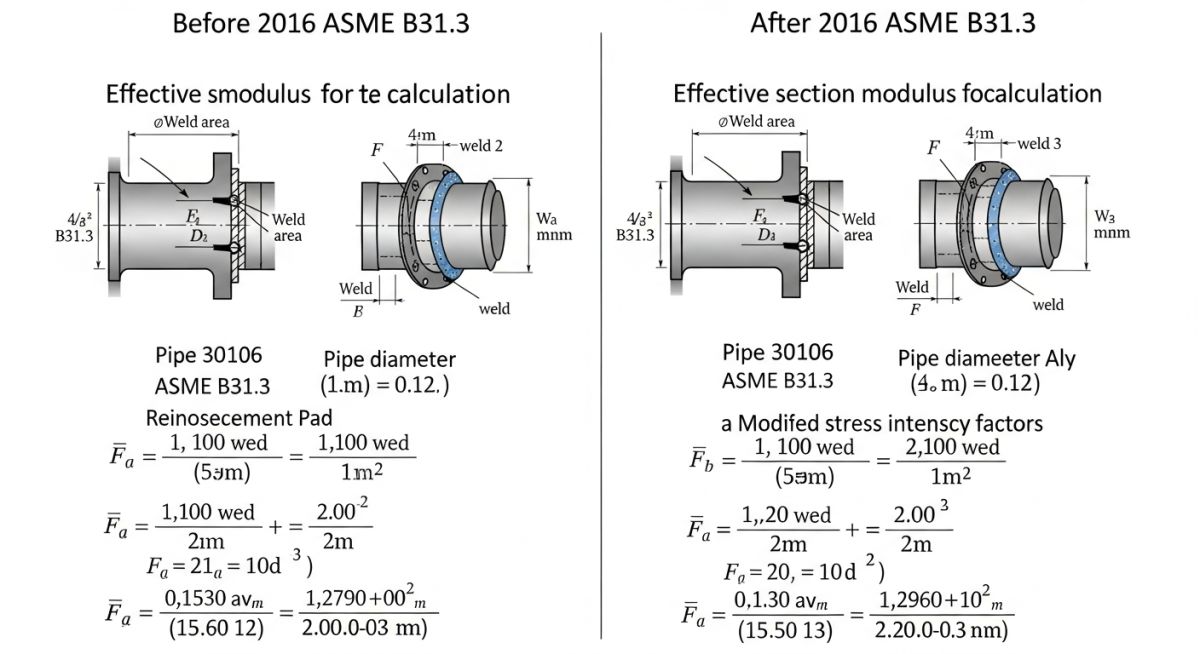
The 2016 update to the ASME B31.3 code introduced a significant shift in how engineers calculate the strength of branch connections. The transition to using an “Effective Section Modulus” (Ze) was designed to address inconsistencies between the branch pipe and the header pipe stress calculations, particularly for reinforced tees.
Impact of the 2016 Code Update on Branch Flexibility
Prior to 2016, many engineers used the standard section modulus of the branch pipe (Zb) for stress checks. The current code mandates the use of Ze = pi × r22 × ts, where ts is the effective thickness. This change often results in higher calculated stresses for the same physical design, forcing a re-evaluation of branch reinforcement and flexibility.
Managing Pipe Stress Engineering Challenges in Bend Wall Thickness Selection
A recurring issue in Pipe Stress Engineering Challenges is the discrepancy between the ordered wall thickness of a bend and the required thickness after the fabrication process. When a straight pipe is bent, the material at the extrados (outer radius) undergoes significant thinning, while the intrados (inner radius) thickens.
Why Real Bend Thickness Exceeds Matching Straight Pipe
Under ASME B31.3 Paragraph 304.2.1 and EN 13480-3 Clause 4.3, the minimum required thickness (tm) for a bend is higher than that of a straight pipe to compensate for this thinning.
Engineers must specify a starting “mother pipe” thickness that accounts for:
- Mill tolerance (usually 12.5 percent).
- Thinning allowance based on the bend radius (3D, 5D).
- Corrosion and erosion allowances.
Bend Thickness Factor (I)
Equation for the extrados factor:
I = (4(R/D) – 1) / (4(R/D) – 2)
Where R = Bend Radius and D = Outside Diameter.
Harmonizing EN 13480 and ASME B31 for Global Projects
One of the most complex Pipe Stress Engineering Challenges is managing projects that span multiple jurisdictions. While ASME B31.3 is the global benchmark, EN 13480 is mandatory for European projects falling under the Pressure Equipment Directive (PED).
| Feature | ASME B31.3 (Process Piping) | EN 13480 (Metallic Piping) |
|---|---|---|
| Safety Factor | Typically 3.0 on UTS | Typically 2.4 on Yield (Re/t) |
| Occasional Loads | 1.33 times allowable stress | Defined by specific k-factors |
| SIF Methodology | Based on Appendix D / ASME B31J | Based on Clause 12 formulas |
| Creep Range | Table A-1 check required | Detailed life-fraction analysis |
Pipe Stress Engineering Challenges Calculator
Use this tool to estimate the Longitudinal Pressure Stress and the Bend Thinning Factor (I) at the extrados, two critical parameters in piping integrity.
Don't miss this video related to Pipe Stress Engineering Challenges

Summary: Master Piping Engineering with our complete 125+ hour Certification Course: ......
Case Study: Solving Pipe Stress Engineering Challenges in a High-Pressure Steam Header
Project Data & Problem Identification
A power plant expansion project involving a 24-inch Steam Header (Design Pressure: 60 bar, Temp: 400C) encountered significant Pipe Stress Engineering Challenges during the final design review. Initial stress reports using pre-2016 ASME B31.3 methodologies suggested the reinforced tee branches were safe. However, a re-audit using the Effective Section Modulus (Ze) revealed that the branch stresses exceeded code allowables by 18 percent.
Failure Analysis:
The previous calculation underestimated the stress intensification at the intersection. Under thermal expansion, the branch connection was at risk of fatigue cracking due to the stiffness of the heavy-wall header.
Technical Specs
- Material: ASTM A335 P22
- Code: ASME B31.3-2016
- Sustained Load: 85 MPa
- Thermal Range: 20C to 400C
The Engineering Fix
To mitigate the risk without replacing the header, the team implemented a three-step solution:
- Weldolet Optimization: Swapped standard tees for heavy-duty forged integrally reinforced branch connections.
- Loop Expansion: Increased the length of the branch piping to 12 meters to improve flexibility.
- Support Re-alignment: Replaced rigid anchors with variable spring hangers to accommodate vertical thermal growth.
Lessons Learned
This case demonstrates that Pipe Stress Engineering Challenges cannot be solved by software alone. Engineers must manually verify that the software is applying the correct Effective Section Modulus logic per the latest code editions to prevent catastrophic fatigue failure in high-cycle thermal systems.
FAQ: Addressing Common Pipe Stress Engineering Challenges
How does EN 13480 address occasional loads like wind or seismic events differently from ASME B31.3?
Both codes permit increased stress allowables for occasional loads. ASME B31.3 typically allows an increase of 33 percent (to 1.33 times the basic allowable stress). EN 13480 uses specific load factors and combination rules (k-factors) within its analysis clauses, often aligned closely with Eurocode standards for structural design, which can sometimes result in more conservative requirements for certain seismic zones than the B31.3 general rule.
What are the main causes of axial force leading to Pipe Stress Engineering Challenges?
The main causes are internal pressure acting on closed ends or area changes, thermal expansion/contraction restricted by anchors, and external mechanical loads (e.g., connected equipment movement). The pressure-induced axial stress is a constant sustained load that must be carefully managed in long pipelines.
Does the effective section modulus in ASME B31.3 apply to welded-on branch plates?
The concept of effective section modulus is primarily for standard tee fittings and integrally reinforced fittings (like Weldolets). For fabricated branch connections with reinforcement pads (re-pads) or saddles, the engineer must rely on area replacement rules (ASME B31.3 Para. 304.3.3) and use general guidance for stress intensification factors, which often requires finite element analysis (FEA) for high-cycle fatigue applications.
How can I ensure my bend wall thickness calculations meet 2026 standards?
The key is to use the bend factor 'I' (or similar code-specific formulas) to calculate the required *original* straight pipe thickness before bending occurs. Always consult the material manufacturer's data on thinning percentages and apply the most stringent requirements from either ASME B31.3, EN 13480, or your client specifications.
Conclusion: Future-Proofing Against Pipe Stress Engineering Challenges
Mastering Pipe Stress Engineering Challenges requires continuous learning and adherence to the latest global standards. The nuanced interpretations of the ASME B31.3 section modulus, careful handling of axial loads, and harmonizing different codes like EN 13480 are essential skills for any competent engineer in 2026.
By applying these principles, leveraging modern calculation tools, and learning from historical case studies, engineers can ensure the robust integrity and safety of complex piping systems worldwide. The commitment to engineering excellence is what separates industry leaders from the rest.
📚 Recommended Resources: Pipe Stress Engineering Challenges
Read these Guides
🎓 Advanced Training




Related posts:
![High-grade industrial Wing Nut Types and Applications for mechanical assemblies.]()
Wing Nut Types and Applications: The 2026 Engineering Guide
![Industrial Monorail Crane Systems installed in a modern manufacturing plant 2026.]()
Monorail Crane Systems: Design, Types & 2026 Standards Guide
![Lead engineer performing a Factory Acceptance Test FAT on an industrial skid system 2026]()
Factory Acceptance Test FAT: The 2026 Engineering Guide to Zero-Defect Delivery
![Professional engineering workspace showing a Basis of Design document layout for a 2026 project.]()
Basis of Design: How to Write a BOD for Engineering Projects in 2026
![Industrial Flare Knockout Drum Sizing and installation in a refinery relief system.]()
Flare Knockout Drum Sizing: Design & API 521 Standards (2026 Guide)
![Advanced Reboiler Control Systems in a modern petrochemical refinery 2026.]()
Reboiler Control Systems: Engineering Guide to Precision Control 2026