Strategic Guide to FEED for Petrochemical Plant Projects [2026]

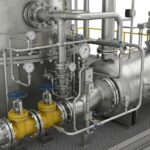
Figure 1: High-complexity distillation and furnace sections during the FEED phase of a modern Ethylene Cracker.
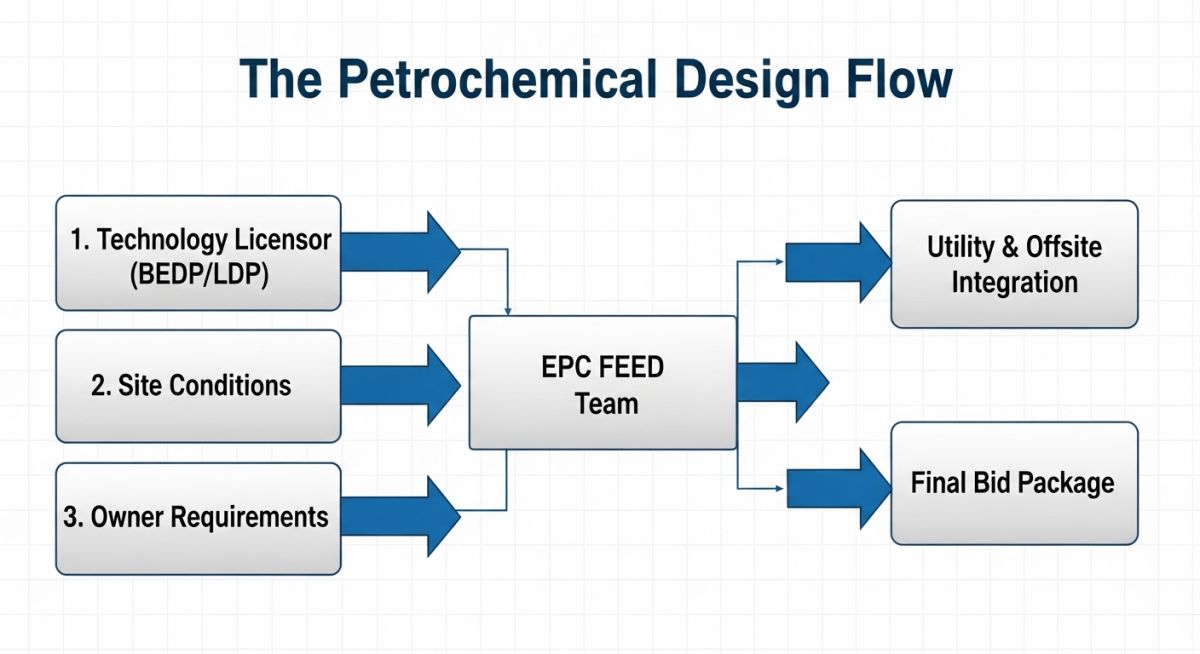
Executing a successful FEED for Petrochemical Plant project requires a sophisticated understanding of the interface between proprietary technology and detailed engineering. Unlike standard oil and gas facilities, petrochemical assets are defined by the presence of a Technology Licensor, whose “Basic Engineering” forms the nucleus of the entire design.
What is Petrochemical FEED?
FEED for Petrochemical Plant is the engineering phase that bridges the gap between a Licensor’s Basic Engineering Design Package (BEDP) and EPC execution. It involves integrating proprietary “Inside Battery Limits” (ISBL) technology with “Outside Battery Limits” (OSBL) utilities, performing site-specific safety studies (HAZOP/SIL), and defining the Total Installed Cost (TIC) to support the Final Investment Decision (FID).
In 2026, the focus has shifted toward deeper process integration and modularization. Managing the “Black Box” of licensor technology while ensuring the utility systems (Steam, Power, Water) are perfectly balanced is the primary challenge for the modern FEED team.
Table of Contents
Quiz: Petrochemical FEED Mastery
Complete Course on
Piping Engineering
Check Now
Key Features
- 125+ Hours Content
- 500+ Recorded Lectures
- 20+ Years Exp.
- Lifetime Access
Coverage
- Codes & Standards
- Layouts & Design
- Material Eng.
- Stress Analysis
1. What Makes Petrochemical FEED Unique?
In the energy sector, a FEED for Petrochemical Plant is widely considered the pinnacle of engineering complexity. Unlike upstream oil and gas projects that focus on physical separation, petrochemical units rely on complex chemical transformations—cracking, polymerization, and synthesis—governed by proprietary technology.
The defining characteristic of these projects is the presence of a Technology Licensor. The Licensor provides the chemical “recipe,” while the FEED contractor must design the industrial kitchen to cook it at scale. This creates a multi-layered design environment where proprietary data must be integrated with open-art utility systems.
In 2026, the industry has moved toward more aggressive Process Integration. Modern plants now recover waste heat from high-temperature furnaces to power downstream separation units, requiring the FEED team to perform sophisticated energy balance modeling that spans across multiple licensed and unlicensed units.
2. The Role of the Technology Licensor in FEED
The starting point for any petrochemical FEED is the Basic Engineering Design Package (BEDP), also known as the Licensor Design Package (LDP). This document acts as the technical “Bible” for the project.
Understanding the BEDP / LDP
The BEDP contains the proprietary process flow diagrams (PFDs), heat and material balances (HMB), and specific equipment data sheets for the Inside Battery Limits (ISBL) equipment. The FEED contractor’s job is to:
- Validate the Licensor’s data against site-specific environmental conditions (ambient temp, humidity).
- Design the Outside Battery Limits (OSBL) utilities—steam, cooling water, and power—to meet the Licensor’s consumption requirements.
- Translate the Licensor’s P&IDs into the project-specific format and standards.
The “Black Box” Problem
One of the most significant challenges in a FEED for Petrochemical Plant is dealing with “Black Box” equipment. Licensors often withhold internal design details of reactors or proprietary catalysts to protect their intellectual property.
The FEED contractor must design the interconnecting piping, foundations, and control systems for this equipment based solely on external connection points and performance guarantees. This requires a high degree of trust and strict Non-Disclosure Agreements (NDAs) between the owner, licensor, and engineer.
Expert Tip: Check the Tie-In Points Early
Experience shows that 70% of engineering rework in Petrochemical projects stems from nozzle orientation and tie-in mismatches at the ISBL/OSBL boundary. Ensure the 3D model interface is audited every 30 days during FEED.
3. Critical Technical Deliverables for Petrochemical Assets
A FEED for Petrochemical Plant produces a significantly higher volume of documentation than a standard refinery project. Because the margins in chemical production are driven by yield efficiency, the engineering deliverables must focus on precision and metallurgy.
| Deliverable Category | ISBL (Licensor Scope) | OSBL (FEED Contractor) |
|---|---|---|
| Process Design | Proprietary H&MB, PFDs, and Catalyst Specs. | Utility Energy Balance, Flare Model, Offsite Interconnects. |
| Equipment Data | Reactors, High-Speed Compressors, Extruders. | Pumps, Boilers, Cooling Towers, Storage Tanks. |
| Piping & Valves | Exotic Alloys (Hastelloy, Inconel) Specifications. | Main Piperack Layout, OSBL Valve Schedule. |
| Automation | Proprietary Control Logic (Advanced Control). | DCS/SIS Architecture, Field Bus Design. |
Special attention is given to Long Lead Equipment. In a Petrochemical FEED, items like the primary reactor or the cracked-gas compressor may have a lead time of 18-24 months. The FEED team must finalize these data sheets early to allow the owner to place “Commitment Orders” before the EPC contract is even awarded.
4. Safety Engineering: SIL and LOPA Studies
Petrochemical processes often involve highly exothermic (heat-releasing) reactions and toxic intermediates. Therefore, SIL and LOPA Studies are much more rigorous in these projects than in standard upstream facilities.
LOPA (Layer of Protection Analysis)
This is a semi-quantitative risk assessment performed during FEED to determine if existing safeguards (like relief valves) are sufficient. If the risk of a reactor runaway is too high, LOPA dictates the need for a Safety Instrumented Function (SIF).
SIL (Safety Integrity Level)
LOPA results define the SIL Rating (SIL 1, 2, or 3). SIL 3 represents the highest level of risk reduction, requiring redundant sensors and final elements. Determining these ratings correctly during FEED is vital for the TIC Cost Estimation, as SIL 3 hardware is significantly more expensive.
5. Modularization Strategy & Logistics
For 2026 petrochemical projects, Modularization is no longer optional; it is a strategic requirement. By moving labor from a congested project site to a controlled fabrication yard, owners can reduce construction risks.
The “Shipability” Calculation
During FEED, the logistics team must perform a “Route Survey.” The maximum module size is limited by the smallest bridge or tightest turn between the yard and the site.
Max Module Width (W) < Road Clearance (Cr) – 1.0m
Module Weight (Mw) < Crane Capacity (Kc) × 0.85

Petrochem Utility Load Estimator
Calculate total OSBL capacity requirements based on Licensor ISBL process demands and growth factors.
Required OSBL Capacity
HP/MP Steam Supply
180.0 T/Hr
Electrical Substation Load
54.0 MW
Cooling Tower Duty
10,200 m3/Hr
FEED Note: These estimates include the design margin. If existing site capacity is lower than these values, the Total Installed Cost (TIC) must include OSBL upgrades or a new utility island.
Don’t miss this video related to FEED for Petrochemical Plant

Summary: Master Piping Engineering with our complete 125+ hour Certification Course: ……
6. Petrochemical FEED Deliverables & Cost Estimation
In a FEED for Petrochemical Plant, the deliverables are split into two distinct universes: the Licensor Design Package (LDP) and the EPC FEED Package. The accuracy of the final AACE Class 3 estimate depends entirely on how well these two universes are integrated.
Maturity Matrix: Key FEED Deliverables
| Engineering Discipline | Core Deliverable | Target Maturity (%) | Estimation Use |
|---|---|---|---|
| Process | Final P&IDs (Frozen for Design) | 90% – 100% | Detailed Valve & Instrument counts. |
| Piping | 3D Model & Preliminary MTO | 30% – 40% | Bulk Material costs (Steel/Pipe). |
| Mechanical | Proprietary Equipment Data Sheets | 100% (Issued for Bid) | Firm Vendor Budget Quotes. |
| Project Controls | Execution Schedule (Level 3) | 100% | Escalation & Indirect Labor costs. |
Estimating “Black Box” & Licensor Fees
A unique aspect of Petrochemical Cost Estimation is the “Proprietary Premium.” Unlike buying a standard pump, purchasing a licensed reactor or extruder often involves:
Licensor Royalties & Fees
Typically paid in stages: 1. Disclosure Fee, 2. Engineering Fee (BEDP), and 3. Running Royalty (based on production). These can account for 3% to 7% of the Total Installed Cost (TIC).
First Fill Catalysts & Chemicals
In units like Ammonia or Ethylene synthesis, the initial load of proprietary catalyst is extremely expensive and must be included in the CAPEX, not the OPEX budget.

The “Interface Rework” Calculation
Project Managers use a “Complexity Factor” (Cf) to estimate the engineering hours required to manage the interface between the Licensor and the EPC team.
// FEED Engineering Hour Estimate
Hourstotal = (Base Hours) × Cf
Where Cf for Petrochem is typically 1.25 – 1.45 due to:
- Non-standard nozzle configurations
- Proprietary metallurgy reviews
- Complex SIL/LOPA safety loop integration
Case Study: Bridging the Licensor Interface Gap
Project Data: A major petrochemical producer initiated a brownfield expansion to add a 450 KTA (Kilo Tons per Annum) Polypropylene line. The technology was provided by a third-party Licensor (ISBL), while the FEED for Petrochemical Plant was executed by a separate EPC contractor responsible for the utilities and offsites (OSBL).
The Interface Failure
During the 60% 3D model review, it was discovered that the Licensor’s Basic Engineering Design Package (BEDP) used a legacy nozzle configuration that conflicted with the site’s standard maintenance access requirements.
- ✖ Nozzle Mismatch: 12 major reactor nozzles were oriented toward a structural column.
- ✖ Utility Deficit: The Licensor’s updated cooling water demand exceeded the existing site capacity by 15%.
Potential ROI Impact
Projected Rework Cost
$4.5 Million
If found during construction.
Schedule Risk
4 Months
Delay in Long Lead Equipment.
The Engineering Fix & Result
The FEED team implemented a Design Interface Matrix (DIM). This live document tracked every tie-in point, including coordinates, pressure, temperature, and nozzle orientation.
The Result: The nozzle orientations were corrected in the Licensor’s proprietary design before the reactor fabrication began. By identifying the cooling water deficit during FEED, the team redesigned the OSBL cooling tower during the same phase, preventing a commissioning failure. The Final Investment Decision (FID) was secured with a high confidence level, saving the project an estimated 8% in total execution costs.
Frequently Asked Questions (FAQ)
Why is the BEDP critical for a FEED for Petrochemical Plant?
The Basic Engineering Design Package (BEDP) provided by the Technology Licensor is the technical foundation. Without it, the FEED contractor cannot know the exact pressures, temperatures, or catalyst requirements of the proprietary process. The BEDP defines the “Inside Battery Limits” (ISBL) core, which dictates the size of the utilities and offsites (OSBL) designed during the FEED phase.
How does a Petrochemical FEED differ from a Refinery FEED?
While both are complex, a FEED for Petrochemical Plant is more “Licensor-heavy.” Refineries often use “Open Art” (non-proprietary) technology for many units like Crude Distillation. In contrast, almost every major unit in a Petrochemical plant (Ethylene, Polyethylene, Ammonia) is proprietary technology, making Interface Management between the Licensor and the EPC contractor the primary engineering challenge.
What is the importance of a SIL study during Petrochem FEED?
A Safety Integrity Level (SIL) study is critical because petrochemical processes often involve runaway reactions and toxic gases. Performing this during FEED ensures that high-integrity safety instrumented systems (SIS) are budgeted correctly. Discovering the need for a SIL 3 rated interlock during construction can lead to massive cost overruns and hardware delays.
Can I use modular construction for a Petrochemical plant?
Yes, and it is highly recommended for 2026 projects. Modularization is defined during the FEED phase to shift labor from congested project sites to controlled yards. For petrochemical assets, this often involves pre-assembling “Process Skids” or “Piperack Modules” to improve safety and reduce the overall construction schedule.
Conclusion: Precision in the Front-End
A FEED for Petrochemical Plant project is the most critical phase for risk mitigation. In 2026, the complexity of proprietary technology integration and the pressure for decarbonized chemical production leave no room for error.
By focusing on a robust Licensor BEDP interface, detailed SIL/LOPA safety studies, and a clear modularization strategy, owners can transition from FEED to EPC with a secured budget and a high-performance asset. Success starts with engineering the interface before you ever pour the concrete.

Related posts:
![High-grade industrial Wing Nut Types and Applications for mechanical assemblies.]()
Wing Nut Types and Applications: The 2026 Engineering Guide
![Industrial Monorail Crane Systems installed in a modern manufacturing plant 2026.]()
Monorail Crane Systems: Design, Types & 2026 Standards Guide
![Lead engineer performing a Factory Acceptance Test FAT on an industrial skid system 2026]()
Factory Acceptance Test FAT: The 2026 Engineering Guide to Zero-Defect Delivery
![Professional engineering workspace showing a Basis of Design document layout for a 2026 project.]()
Basis of Design: How to Write a BOD for Engineering Projects in 2026
![Industrial Flare Knockout Drum Sizing and installation in a refinery relief system.]()
Flare Knockout Drum Sizing: Design & API 521 Standards (2026 Guide)
![Advanced Reboiler Control Systems in a modern petrochemical refinery 2026.]()
Reboiler Control Systems: Engineering Guide to Precision Control 2026