What is Driving EPC Digital Transformation in 2026?

Key Takeaways
- Data Over Documents: The shift from static PDF deliverables to dynamic, machine-readable data is the backbone of modern project execution.
- Standardization as a Catalyst: Adoption of ISO 19650 and CFIHOS is no longer optional for Tier-1 international EPC contracts.
- ROI Realization: Digital maturity is directly correlated to a 10-15% reduction in total installed cost (TIC) through optimized construction sequencing.
Defining EPC Digital Transformation
EPC Digital Transformation is the strategic integration of data-centric workflows, cloud-based collaboration, and automation technologies across the Engineering, Procurement, and Construction lifecycle. It replaces traditional document-based handovers with Digital Twins and Unified Data Environments (UDE) to improve predictability, reduce rework, and ensure real-time project transparency in 2026.
Founder’s Insight
“In my two decades of project management, the biggest hurdle to EPC Digital Transformation hasn’t been the software—it has been the ‘siloed’ mindset. In 2026, we are finally seeing the wall between engineering and construction crumble as data becomes the single source of truth.”
— Atul Singla, Founder of Epcland
Complete Course on
Piping Engineering
Check Now
Key Features
- 125+ Hours Content
- 500+ Recorded Lectures
- 20+ Years Exp.
- Lifetime Access
Coverage
- Codes & Standards
- Layouts & Design
- Material Eng.
- Stress Analysis
Engineering Challenge: EPC Digital Maturity Check
Validate your knowledge on 2026 Digital Transformation standards.
1. Which standard is currently the global benchmark for managing information over the whole life cycle of a built asset using BIM?
The Catalyst: How COVID-19 Permanently Accelerated EPC Digital Transformation
Before the global disruptions of the early 2020s, EPC Digital Transformation was often viewed as a “luxury” or a pilot-phase initiative reserved for ultra-major capital projects. However, the forced shift to remote work and the collapse of traditional supply chains acted as a high-pressure catalyst. In 2026, we recognize that the pandemic didn’t just change where we work; it fundamentally altered how data must flow between engineering centers in Mumbai, fabrication yards in Korea, and project sites in the Gulf.
The primary shift was the abandonment of “Physical Document Dependency.” Engineering firms that relied on wet signatures and printed transmittals faced immediate stagnation. This led to the rapid adoption of Cloud-Based Engineering Environments. By 2026, the industry has standardized on real-time collaboration where 3D model reviews occur in virtual environments, allowing for instantaneous clash detection and interdisciplinary coordination without a single person being in the same room.
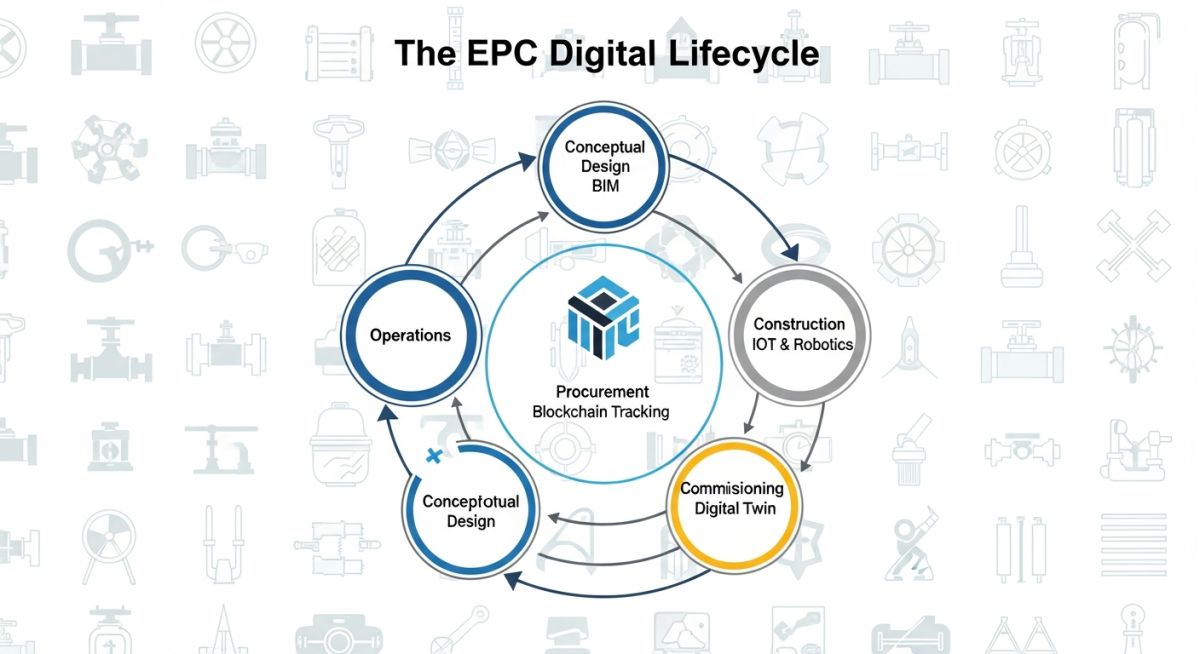
Market Volatility: Why EPC Digital Transformation is the Only Solution for Current Challenges
As we navigate the market landscape of 2026, EPC contractors are facing “The Triple Squeeze”: rising material costs, skilled labor shortages, and aggressive decarbonization mandates. Traditional project management methodologies are too slow to react to these volatile variables. EPC Digital Transformation provides the agility required to maintain margins. By leveraging Predictive Analytics and AI-driven Procurement, firms can now forecast price fluctuations in bulk commodities like structural steel and piping with 85% accuracy.
Furthermore, the “Opportunity” in this shift lies in Data-Centric Execution. In a data-centric model, the “deliverable” is no longer a set of ISO drawings; it is a validated database. This allows for the seamless transition to Advanced Work Packaging (AWP), where construction requirements drive engineering sequences. This “Construction-Led” approach ensures that the field never runs out of “Workable Backlog,” directly addressing the productivity gaps that have plagued the industry for decades.
Scaling Success: How Proven ROI Encourages Further EPC Digital Transformation
The momentum behind EPC Digital Transformation in 2026 is now driven by hard financial data rather than theoretical promises. Early adopters have reported a 10% to 15% reduction in Total Installed Cost (TIC). These savings are primarily found in the elimination of field rework. When a Digital Twin is utilized to simulate the heavy lift of a 500-ton pressure vessel before the crane even arrives on site, the risk of a multi-million dollar “clash” is virtually eliminated.
Success breeds further investment. We are seeing a “Digital Flywheel Effect” where the ROI from initial BIM Level 2 implementations is being reinvested into BIM Level 3 and Autonomous Construction Monitoring. In 2026, digital success is measured by “Data Fluidity”—the speed at which a design change in the engineering office is reflected in the automated cutting machines at the fabrication shop and the foreman’s tablet at the site.
EPCLand YouTube Channel
2,500+ Videos • Daily Updates
The Role of AWP and BIM in Driving EPC Digital Transformation
In 2026, the integration of Advanced Work Packaging (AWP) with high-maturity Building Information Modeling (BIM) has become the definitive engine for project success. While BIM provides the multi-dimensional data structure, AWP provides the execution framework. This synergy ensures that the engineering and procurement phases are strictly aligned with the construction sequence. By utilizing 4D (Schedule) and 5D (Cost) BIM, project managers can visualize the entire build sequence, identifying potential logistical bottlenecks months before they manifest on-site.
The shift toward BIM Level 3—characterized by a fully integrated, web-based collaborative model—has effectively neutralized the “Information Loss” typically seen during project handovers. In this ecosystem, EPC Digital Transformation manifests as a living data stream where every bolt, valve, and instrument carries its own digital pedigree, from the initial P&ID (Piping and Instrumentation Diagram) through to commissioning and final handover to the owner-operator.
Engineering Standards: ISO 19650 and the Future of EPC Digital Transformation
To achieve true interoperability, the global engineering community has rallied around rigorous international standards. In 2026, compliance with the ISO 19650 series is a mandatory requirement for nearly all large-scale infrastructure and energy projects. This standard defines the collaborative processes for effective information management, ensuring that data is consistently named, classified, and stored across the diverse software platforms used by various subcontractors.
Beyond ISO 19650, the adoption of CFIHOS (Capital Facilities Information Handover Specification) has revolutionized how EPCs deliver data to plant owners. By standardizing the “Data Dictionary,” EPC Digital Transformation ensures that the Digital Twin delivered at the end of construction is immediately operational, eliminating the traditional “Data Cleanup” phase that previously cost owners millions in delayed operational readiness.
Comparison: Traditional vs. Digital-Centric Execution (2026)
| Feature | Traditional EPC | Digital-Centric (EPC 4.0) |
|---|---|---|
| Primary Deliverable | Static PDF & Paper Drawings | Validated Digital Twin & UDE |
| Information Management | Siloed Folders / Emails | ISO 19650 Compliant UDE |
| Work Packaging | Manual/Ad-hoc Planning | Advanced Work Packaging (AWP) |
| Rework Rates | Avg. 5-12% of TIC | Under 2% through 3D Clash Detection |
EPC Digital Transformation ROI Estimator
Estimate the potential cost savings of shifting from Document-Centric to Data-Centric execution on your project.
*Results based on average 2026 EPC Digital Transformation benchmarks (12% TIC reduction and 60% rework mitigation).
Don’t miss this video related to EPC

Summary: Master Piping Engineering with our complete 125+ hour Certification Course: ……
EPC Digital Transformation Failure Case Study

The Scenario: $1.2B Offshore Platform Interface Conflict
In a major offshore brownfield expansion, a Tier-1 EPC firm initially bypassed EPC Digital Transformation protocols in favor of legacy 2D “checker” workflows for piping spool verification. During the module integration phase, it was discovered that a primary structural support beam clashed with the main steam header across 42 different locations.
The Failure Cost
- Manual Rework: 14,000 man-hours for field welding.
- Schedule Delay: 4-month slippage on first-oil date.
- Financial Impact: $22 Million in liquidated damages.
The Digital Intervention
- Laser Scanning: Rapid 3D point-cloud mapping of the as-built site.
- Automated Clash Detection: Identified 127 additional soft/hard clashes.
- Digital Twin Sync: Real-time updates to the construction work packages.
The Outcome
By pivoting to a full EPC Digital Transformation strategy mid-project, the team utilized a Unified Data Environment (UDE) to resolve the remaining 127 clashes virtually. This prevented an estimated additional $45M in rework costs. The lesson learned for 2026 is clear: Digital tools are no longer an “extra”—they are the primary insurance policy against catastrophic project failure.
Expert Insights: Lessons from 20 years in the field
- Data Governance is Paramount: EPC Digital Transformation fails not because of software, but because of poor data ownership. Establish a “Data Management Plan” (DMP) as early as the FEED phase.
- Interoperability Over Proprietary: Avoid “vendor lock-in.” Prioritize platforms that support OpenBIM and API-first architectures to ensure your 2026 data is still readable in 2036.
- The Human Element: Upskilling your construction superintendents is more valuable than buying 1,000 VR headsets. Transformation happens at the toolbelt level, not just the C-suite.
Frequently Asked Questions
What is the first step in EPC Digital Transformation? ▾
The first step is moving from Document-Centric to Data-Centric workflows by establishing a Unified Data Environment (UDE). This ensures that every piece of information has a single, verifiable source of truth accessible to all stakeholders.
How does ISO 19650 impact EPC projects in 2026? ▾
ISO 19650 provides the international framework for managing information over the whole life cycle of a built asset. In 2026, it serves as the “common language” for BIM, reducing disputes and ensuring seamless data handovers between engineering, construction, and operations.
Can small EPC firms afford Digital Transformation? ▾
Yes. With the rise of SaaS (Software as a Service) in 2026, many digital tools are scalable. Small firms can start with Cloud-based Model Coordination and Digital Progress Tracking, which provide high ROI without the need for massive on-premise server investments.
Why is my project still showing heavy carryover despite using BIM? ▾
Carryover often occurs because the BIM model is not integrated with Advanced Work Packaging (AWP). If your engineering sequence doesn’t match your construction “Path of Construction,” you will have models but no material or labor to execute them in the field.
Is a Digital Twin just a fancy 3D model? ▾
No. A 3D model is a static representation. A Digital Twin is a living model updated with real-time data from the field (via IoT sensors or progress scans). In 2026, a true Digital Twin allows you to simulate “what-if” scenarios, such as the impact of a 10-day weather delay on your critical path.
What is the “Data Silo” failure mentioned in the case study? ▾
A Data Silo failure occurs when the Engineering team, Procurement team, and Construction team all use separate, non-communicating databases. EPC Digital Transformation breaks these silos by hosting all data in a single environment where a change in design immediately notifies procurement to update the PO.
References & Standards
📚 Recommended Resources: EPC Digital Transformation

Related posts:
![High-grade industrial Wing Nut Types and Applications for mechanical assemblies.]()
Wing Nut Types and Applications: The 2026 Engineering Guide
![Industrial Monorail Crane Systems installed in a modern manufacturing plant 2026.]()
Monorail Crane Systems: Design, Types & 2026 Standards Guide
![Lead engineer performing a Factory Acceptance Test FAT on an industrial skid system 2026]()
Factory Acceptance Test FAT: The 2026 Engineering Guide to Zero-Defect Delivery
![Professional engineering workspace showing a Basis of Design document layout for a 2026 project.]()
Basis of Design: How to Write a BOD for Engineering Projects in 2026
![Industrial Flare Knockout Drum Sizing and installation in a refinery relief system.]()
Flare Knockout Drum Sizing: Design & API 521 Standards (2026 Guide)
![Advanced Reboiler Control Systems in a modern petrochemical refinery 2026.]()
Reboiler Control Systems: Engineering Guide to Precision Control 2026