Understanding Commissioning: A Crucial Process in the Oil and Gas Industries
Commissioning in Oil and Gas is the systematic process of verifying that all subsystems of a facility—ranging from mechanical and electrical to instrumentation and safety systems—are designed, installed, tested, and operated according to the operational requirements of the owner. In the high-stakes environment of 2026 energy production, this phase acts as the final gateway between construction and live operations, ensuring that billion-dollar assets like offshore platforms and refineries transition into production safely and efficiently.
What is Commissioning in Oil and Gas?
Commissioning in oil and gas is a multi-phase quality assurance process that confirms an industrial facility is ready for operation. It involves functional testing of equipment, verification of safety interlocks, and performance trials. It bridge the gap between mechanical completion and final handover, ensuring total operational readiness for 2026 EPC projects.

Table of Contents
Operational Readiness Quiz
Question 1 of 5Which milestone must be achieved before ‘Hot Commissioning’ can begin?
Complete Course on
Piping Engineering
Check Now
Key Features
- 125+ Hours Content
- 500+ Recorded Lectures
- 20+ Years Exp.
- Lifetime Access
Coverage
- Codes & Standards
- Layouts & Design
- Material Eng.
- Stress Analysis
What is Commissioning in Oil and Gas? An Engineering Overview
Commissioning in Oil and Gas represents the final verification phase of a project’s engineering and construction lifecycle. It is a multi-disciplinary effort that integrates mechanical, electrical, instrumentation, and process engineering to ensure that every component—from a simple globe valve to a complex centrifugal compressor—functions as a cohesive system.
Unlike the construction phase, which focuses on “building the plant right,” Commissioning in Oil and Gas focuses on “making the plant work right.” This involves shifting the asset from a static state of Mechanical Completion to a dynamic state of live production. In 2026, this process is governed by strict international standards, including API RP 1FSC (Recommended Practice for Facilities Systems Commissioning) and ISO 19901, ensuring that safety and environmental integrity are never compromised during the high-risk transition to operations.

Key Stages of the Commissioning in Oil and Gas Lifecycle
The path to operational readiness is not a single event but a structured journey. For 2026 EPC projects, this journey is divided into discrete milestones to manage risk and technical complexity.
Detailed Commissioning Planning and CMS Integration
The success of Commissioning in Oil and Gas is determined months before the first valve is turned. This stage involves “Systemization”—breaking the massive facility down into manageable “Commissioning Systems” (e.g., Fuel Gas System, Firewater System). A digital Commissioning Management System (CMS) is deployed to track thousands of checksheets, ensuring that every engineering tag is accounted for and verified.
Pre-commissioning Activities and Cold Commissioning
Pre-commissioning involves testing equipment in a “cold” or non-energized state. Key activities include Hydrostatic Testing of piping as per ASME B31.3, chemical cleaning, and air blowing to remove construction debris. For electrical systems, this involves “meggering” or insulation resistance testing. These Commissioning in Oil and Gas precursors ensure that the physical infrastructure is robust enough to handle the introduction of process fluids.
Mechanical Completion and Walkdowns
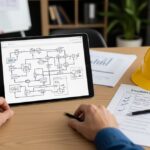
Mechanical Completion (MC) is the formal handover from the construction team to the commissioning team. It is verified through joint “Walkdowns” where engineers inspect the installation against P&IDs (Piping and Instrumentation Diagrams). Any defects found are logged in the Commissioning Punch List, which categorizes items as “A” (must be fixed before start-up) or “B” (can be fixed later).
Hot Commissioning in Oil and Gas Operations
Often called “Hot Commissioning,” this stage involves the functional testing of systems using live power or inert media. This is where Process Safety systems, such as Emergency Shutdown (ESD) valves and Fire & Gas (F&G) detectors, are live-tested to API 14C standards. Rotating equipment like pumps and compressors undergo “uncoupled” and “coupled” runs to verify vibration and temperature limits.
Start-up and Performance Testing Protocols
This is the most critical phase where hydrocarbons are first introduced into the system (Initial Start-up). Once the plant is stabilized, Performance Testing begins to prove that the facility meets its nameplate capacity and efficiency targets. For a refinery, this might involve a 72-hour continuous run at full throughput to satisfy contractual performance guarantees.
System Handover and Final Documentation
The final milestone of Commissioning in Oil and Gas is the Transfer of Care, Custody, and Control (TCCC). All red-line markups, material test reports (MTRs), and commissioning records are compiled into a Final Commissioning Dossier, signaling the facility is ready for the operations team to take full ownership.
Don’t miss this video related to Commissioning in Oil and Gas
Summary: Master Piping Engineering with our complete 125+ hour Certification Course: ……
Industrial Examples of Commissioning in Oil and Gas Projects
The practical execution of Commissioning in Oil and Gas varies significantly depending on the asset class. Whether it is a subsea development or a land-based processing plant, the technical requirements for operational readiness must be tailored to the specific process hazards and mechanical complexities involved.
Offshore Platform and FPSO Commissioning
Offshore Commissioning in Oil and Gas is uniquely challenging due to limited space and the logistical constraints of marine environments. On a Floating Production Storage and Offloading (FPSO) vessel, commissioning involves the integration of the “Hull” (marine systems) with the “Topside” (oil processing systems). Critical activities include verifying subsea umbilical connectivity, testing chemical injection skids for hydrate inhibition, and ensuring the firewater deluge system meets NFPA 15 requirements for offshore safety.
Complex Refinery and Petrochemical Commissioning
Refinery Commissioning in Oil and Gas is characterized by large-scale catalyst loading and complex thermal management. For units like Fluid Catalytic Crackers (FCC) or Hydrocrackers, commissioning teams must perform rigorous steam blowing to clean high-pressure steam headers and conduct “leak tests” using helium-nitrogen mixtures to detect microscopic paths for hydrogen escape at high temperatures.
Cross-Country Pipeline Commissioning (Pigging & Purging)
For midstream assets, Commissioning in Oil and Gas focuses on pipeline integrity. This involves “Pigging” operations where internal tools (pigs) are launched to clean, gauge, and inspect the pipe wall. After hydrotesting to ASME B31.4/B31.8, the pipeline must be dewatered and dried to a specific dew point (often -40°C) before being purged with nitrogen to prevent internal corrosion during the introduction of hydrocarbons.
| Asset Type | Primary Commissioning Focus | Key Testing Media | Critical Standard |
|---|---|---|---|
| Offshore Rig | Subsea tie-backs & Emergency Shutdown (ESD) | Seawater, Hydraulic Fluid | API RP 14C |
| LNG Terminal | Cryogenic cooling & MCHE integrity | Nitrogen, LNG | NFPA 59A |
| Oil Refinery | Catalyst activation & Thermal expansion | Steam, Hydrogen, N2 | API RP 520/521 |
The Strategic Importance of Commissioning in Oil and Gas
Effective Commissioning in Oil and Gas is the primary safeguard against “Startup Failures,” which historically account for a significant percentage of major process safety incidents. In 2026, the strategic importance of this phase extends beyond safety into financial performance. A delayed commissioning schedule on a 200,000 bpd refinery can result in millions of dollars in lost revenue per day.
- Risk Mitigation: Identifying flawed designs or construction defects before the introduction of hazardous materials.
- Environmental Compliance: Verifying that flare systems, wastewater treatment, and emission controls operate within EPA or local regulatory limits.
- Insurance Readiness: Providing the “Dossier of Completeness” required by insurers to activate coverage for live operations.
Specialized Types of Commissioning in Oil and Gas
Commissioning is not only for new “Greenfield” projects. Various methodologies are applied depending on the maturity and history of the industrial asset.
Initial Commissioning (Greenfield)
The standard process for new facilities where Commissioning in Oil and Gas follows a linear path from construction to handover. Every piece of equipment is verified from a “zero-hour” state.
Re-Commissioning (Post-Turnaround)
Performed after a major maintenance shutdown or turnaround. The focus is on verifying that existing systems, once modified or cleaned, still perform to original design specifications. This often involves re-calibrating instrumentation that may have been disturbed during maintenance.
Retro-Commissioning for Legacy Assets
Applied to older facilities that were never formally commissioned or have undergone significant performance degradation. Commissioning in Oil and Gas in this context focuses on optimizing current operations to improve energy efficiency and safety margins in line with 2026 standards.
Continuous Commissioning and Asset Monitoring
A modern approach utilizing Industrial IoT (IIoT) and digital twins. Instead of a one-time event, Commissioning in Oil and Gas becomes a permanent process where software continuously monitors system performance against the “original commissioning baseline” to identify drift and maintenance needs.
Commissioning in Oil and Gas Calculator
Estimate the Facility Readiness Index (FRI) by inputting the completion percentages of the core stages of Commissioning in Oil and Gas.
Project Readiness Score
Disclaimer: This tool provides a high-level estimate for 2026 project planning. Actual Commissioning in Oil and Gas progress must be verified using an approved Commissioning Management System (CMS) with detailed checksheet counts.
Commissioning in Oil and Gas Case Study: Deepwater FPSO Integration

Project Overview
- Asset: 150,000 bpd Floating Production Storage and Offloading (FPSO) Vessel
- Location: Santos Basin, Deepwater Offshore
- Scope: Integration of 14 process modules (Topside) with the Suezmax Hull
- Complexity: 42,000 Engineering Tags; 12,000 Commissioning Checksheets
The Challenges
The primary challenge in this 2026 Commissioning in Oil and Gas project was the asynchronous completion of modules across three different global shipyards. Traditional paper-based tracking led to “data silos,” where Mechanical Completion (MC) certificates for the power generation module did not align with the instrumentation status of the control room. This threatened a 4-month delay in the “First Oil” milestone.
Engineering Strategy
The project team pivoted to a Digital Commissioning Management System (CMS) integrated with a 3D Digital Twin. The strategy included:
- Real-time Punch Listing: Inspectors used ruggedized tablets to log defects directly into the 3D model, allowing shore-based engineers to approve fixes instantly.
- Remote FAT (Factory Acceptance Testing): Using AR headsets, the commissioning team verified the ESD system logic from the corporate HQ, reducing offshore POB (Personnel on Board) requirements.
- Dynamic Systemization: Re-grouping subsystems based on “Ready for Commissioning” priority rather than construction sequence.
Outcome & Lessons
The facility achieved Operational Readiness 14 days ahead of schedule. The use of a digital punch list reduced “Category A” carry-over work by 65%. The key lesson: Commissioning in Oil and Gas must be integrated into the 3D design phase to enable seamless data handover from construction to operations.
Frequently Asked Questions about Commissioning in Oil and Gas
What is the primary difference between pre-commissioning and commissioning in oil and gas?
What defines ‘Mechanical Completion’ in a commissioning project?
How is a commissioning punch list categorized for safety?
What is the importance of a Commissioning Management System (CMS)?
Conclusion: Engineering Excellence in 2026
As global energy demands continue to evolve, the rigor of Commissioning in Oil and Gas remains the ultimate safeguard for project success. By transitioning from a construction-focused mindset to a system-focused operational readiness strategy, EPC contractors and operators can ensure that assets are not just built, but are fully capable of safe, reliable, and efficient production.
In 2026, the integration of digital twins, real-time punch listing, and automated CMS platforms has transformed commissioning from a reactive phase into a proactive engineering discipline. Mastering the nuances of Commissioning in Oil and Gas is no longer optional—it is the hallmark of world-class engineering excellence.
Adhering to API RP 1FSC and ISO 19901 standards for 2026 operational readiness and facility handover.
📚 Recommended Resources: Commissioning in Oil and Gas
Read these Guides
🎓 Advanced Training



Related posts:
![High-grade industrial Wing Nut Types and Applications for mechanical assemblies.]()
Wing Nut Types and Applications: The 2026 Engineering Guide
![Industrial Monorail Crane Systems installed in a modern manufacturing plant 2026.]()
Monorail Crane Systems: Design, Types & 2026 Standards Guide
![Lead engineer performing a Factory Acceptance Test FAT on an industrial skid system 2026]()
Factory Acceptance Test FAT: The 2026 Engineering Guide to Zero-Defect Delivery
![Professional engineering workspace showing a Basis of Design document layout for a 2026 project.]()
Basis of Design: How to Write a BOD for Engineering Projects in 2026
![Industrial Flare Knockout Drum Sizing and installation in a refinery relief system.]()
Flare Knockout Drum Sizing: Design & API 521 Standards (2026 Guide)
![Advanced Reboiler Control Systems in a modern petrochemical refinery 2026.]()
Reboiler Control Systems: Engineering Guide to Precision Control 2026