Comprehensive Guide to the CNG Process: Properties, Engineering, and Global Standards (2026)

Imagine a high-pressure mother station where a sudden drop in ambient temperature causes a total system shutdown. The culprit? Not a mechanical failure, but a microscopic trace of water vapor that bypassed the dehydration unit, forming solid hydrates that choked the CNG Process. In the 2026 energy landscape, understanding the precision engineering behind gas compression isn’t just about efficiency—it is about preventing catastrophic downtime. Whether you are an EPC contractor or a site engineer, this guide breaks down the thermodynamic journey of natural gas into its compressed state.
Key Engineering Takeaways
- Thermodynamic Precision: The CNG Process requires multi-stage compression with inter-stage cooling to manage the heat of compression.
- Material Integrity: Compliance with ASME B31.3 and ISO 11439 is mandatory for high-pressure storage and transport.
- Operational Purity: Effective dehydration (GDU) is the most critical step to prevent hydrate formation and internal corrosion.
What is the CNG Process?
The CNG Process involves the filtration, dehydration, and multi-stage compression of natural gas (primarily methane) to a pressure typically between 200 and 250 bar (2,900 to 3,600 psi). This reduces the gas volume to less than 1% of its standard atmospheric volume, enabling efficient storage and transportation for vehicular and industrial use.
“In over two decades of oil and gas consultancy, I’ve seen that the CNG Process is often misunderstood as ‘just compression.’ In reality, it is a sophisticated separation and thermal management dance. If your gas isn’t dried to a dew point 10 degrees below your lowest ambient temperature, your process is a ticking time bomb.”
— Atul Singla, Founder of Epcland
Complete Course on
Piping Engineering
Check Now
Key Features
- 125+ Hours Content
- 500+ Recorded Lectures
- 20+ Years Exp.
- Lifetime Access
Coverage
- Codes & Standards
- Layouts & Design
- Material Eng.
- Stress Analysis
Technical Proficiency Check: The CNG Process
Question 1 of 5
What is CNG? Defining the Compressed Natural Gas State
Compressed Natural Gas (CNG) is a fuel gas made of natural gas, which is mainly composed of methane (CH4), compressed to less than 1% of the volume it occupies at standard atmospheric pressure. In the 2026 industrial landscape, the CNG Process serves as a critical bridge for decarbonization, providing a cleaner alternative to heavy fuel oils and diesel. Unlike Liquefied Natural Gas (LNG), which requires cryogenic temperatures of -162 degrees Celsius, CNG is stored at ambient temperatures using high-pressure containment systems.
The physics of the CNG Process relies on the Ideal Gas Law (PV=nRT), though at the high pressures of 200-250 bar, engineers must account for the compressibility factor (Z). This deviation from ideal behavior is vital when calculating the actual mass of gas stored within a cascade system.
The Origins and Evolution of the CNG Process
The CNG Process originated in the late 19th century but saw its first major industrial surge during World War II due to gasoline shortages. Today, the process has evolved from simple single-stage pumps to sophisticated Mother-Daughter station networks. In 2026, the integration of IoT-enabled sensors allows for real-time monitoring of the CNG Process, optimizing compressor run-times and predicting valve fatigue before failure occurs.
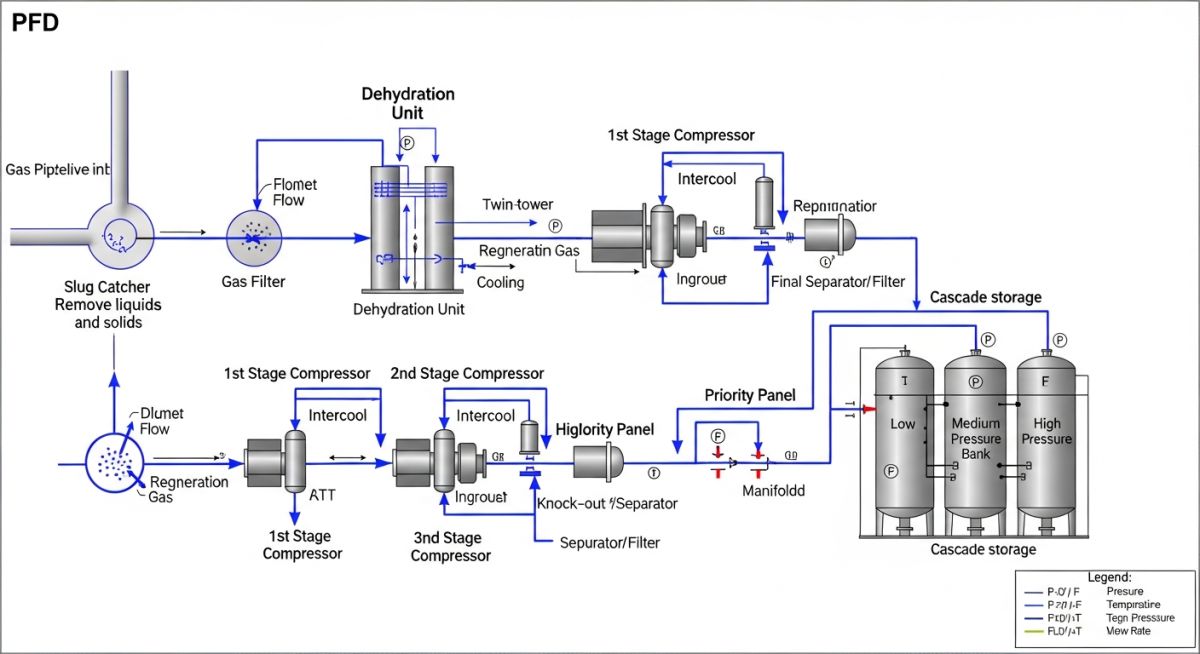
Figure 1: Typical Process Flow Diagram (PFD) for a 2026 Standard CNG Mother Station.
Technical Properties of CNG in Industrial Applications
The CNG Process results in a fuel with unique technical characteristics that dictate how it is handled in an engineering environment:
- Energy Density: While the CNG Process significantly increases volumetric energy density compared to raw natural gas, it remains lower than liquid fuels, requiring larger storage volumes for equivalent range.
- Auto-ignition Temperature: CNG has a high auto-ignition temperature (approx. 540 degrees Celsius), making it safer and less likely to ignite on hot surfaces than gasoline.
- Flammability Range: Natural gas has a narrow flammability range (5% to 15% in air), which reduces the risk of accidental combustion during the CNG Process.
Chemical Composition: What the CNG Process Refines
The input for the CNG Process is pipeline-quality natural gas. However, the compression process amplifies the concentration of impurities per unit volume. The primary components include:
| Component | Chemical Formula | Typical Percentage |
|---|---|---|
| Methane | CH4 | 80% – 98% |
| Ethane | C2H6 | 1% – 5% |
| Nitrogen/CO2 | N2 / CO2 | < 3% |
The Four-Phase CNG Process Engineering
Engineering a reliable CNG Process requires a sequential approach to thermodynamics and fluid mechanics. In 2026, stations are increasingly utilizing automated PLC (Programmable Logic Controller) systems to manage these four distinct phases.
Phase 1: Production and Gas Pre-treatment
The CNG Process begins with raw gas extraction or pipeline tapping. The most critical engineering sub-step here is Dehydration. Using Molecular Sieve desiccant or Glycol units, water content must be reduced to less than 7 lbs/MMSCF to prevent the formation of methane hydrates at high pressures. Filtration is also performed to remove particulates that could erode compressor valves.
Phase 2: Compression and Transportation Logistics
This is the heart of the CNG Process. Reciprocating compressors, typically 3 or 4 stages, raise the pressure from 15-20 bar (pipeline) to 250 bar. Inter-stage cooling is mandatory to keep the gas temperature within the ASME B31.3 allowable stress limits for the piping. Once compressed, the gas is loaded into LCVs (Light Commercial Vehicles) or heavy-duty tube trailers.
Phase 3: Receiving and Pressure Reduction
At “Daughter Stations,” the CNG Process involves the safe decanting of gas. Because pressure reduction causes a drop in temperature (the Joule-Thomson Effect), heat exchangers (Pre-heaters) are often used to prevent freezing of the regulator seals and downstream components.
Phase 4: Cascade Storage and Dispensing
Storage is managed through a Priority Panel which fills cylinders in a three-bank “Cascade” (Low, Medium, and High pressure). This maximizes the efficiency of the CNG Process during vehicle refueling by using differential pressure rather than continuous compressor operation.
Engineering Standards and Material Comparison
Adherence to international standards ensures the safety of the CNG Process. The following table compares the primary materials used in high-pressure CNG storage as per ISO 11439 and NZS 5454.
| Cylinder Type | Material Construction | Weight-to-Volume Ratio | Common Application |
|---|---|---|---|
| Type 1 | All Steel (Chromium Molybdenum) | High (Heaviest) | Stationary Cascade Storage |
| Type 2 | Steel Liner + Glass Fiber Hoop Wrap | Medium | Heavy Duty Trucks |
| Type 4 | Plastic Liner + Carbon Fiber Full Wrap | Low (Lightest) | Passenger Vehicles (2026 Models) |
Engineering Evaluation: Advantages & Disadvantages
Technical Advantages
- Lower Emissions: Reduces CO2 by 20-30% compared to diesel.
- No Lead or Benzene: Eliminates lead fouling of spark plugs.
- Safety: Being lighter than air, it dissipates quickly in case of a leak.
Technical Disadvantages
- Space Constraint: Low volumetric energy density requires bulky tanks.
- Compression Cost: High electricity consumption for the CNG Process stages.
- Refueling Time: Slow-fill systems can take several hours for full saturation.
Don’t miss this video related to CNG Process
Summary: Master Piping Engineering with our complete 125+ hour Certification Course: ……
CNG Process: Storage Capacity & Mass Calculator
Estimate the mass of Compressed Natural Gas stored in your cascade system. This calculator uses a simplified compressibility factor (Z ≈ 0.85) for standard 2026 industrial estimations at 15°C.
*Note: Calculation based on 85% Methane composition and Z-factor of 0.85 at 250 bar. For precise CNG Process modeling, use AGA-8 real-gas equations.*
CNG Process Failure Case Study: Hydrate Blockage at a 250-Bar Mother Station

The Incident
In early 2026, a major CNG mother station experienced a total throughput failure during a peak winter demand cycle. The CNG Process was halted when the third-stage discharge valve of the primary reciprocating compressor seized. Initial diagnostics suggested mechanical fatigue, but subsequent teardown revealed a different culprit.
Engineering Analysis
The root cause was traced to the Gas Dehydration Unit (GDU). The molecular sieve desiccant had reached “breakthrough” due to saturation, allowing water vapor to carry over into the high-pressure compression stages. Under the 250-bar pressure environment, the water combined with methane molecules to form clathrate hydrates—solid, ice-like crystals that exist far above the freezing point of water.
Corrective Action & Lesson
The station was retrofitted with an online Chilled Mirror Hygrometer to monitor the water dew point in real-time. This case study highlights that the CNG Process is highly sensitive to upstream purity; without stringent moisture control, high-pressure equipment is susceptible to catastrophic “slugging” and internal corrosion.
Expert Insights: Lessons from 20 years in the field
Refining the CNG Process requires more than just meeting pressure targets. Based on two decades of EPC experience, here are the critical operational nuances for 2026:
- Lube Oil Carryover: Excessive oil from compressor cylinders can coat the internal lining of Type 4 cylinders, reducing their lifespan. Always use high-efficiency coalescing filters after the final compression stage.
- The 10% Rule: Always size your CNG Process dehydration unit for 110% of peak flow. Seasonal fluctuations in pipeline gas moisture can easily overwhelm an undersized GDU.
- Vibration Management: High-pressure pulses in the CNG Process lead to fatigue in small-bore piping. Ensure all gauge lines and bypasses are supported according to ASME B31.3 standards to prevent “shaker” failures.
Frequently Asked Questions: The CNG Process
Why is my CNG dispenser showing a “Low Flow” error despite high bank pressure? ▼
What is the standard pressure for the CNG Process in 2026? ▼
Is CNG safer than Liquid Petroleum Gas (LPG)? ▼
How does the CNG Process handle the Joule-Thomson effect? ▼
What is the shelf life of Compressed Natural Gas? ▼
Do I need to odorize gas during the CNG Process? ▼
References & Standards
📚 Recommended Resources: CNG
Read these Guides


Related posts:
![High-grade industrial Wing Nut Types and Applications for mechanical assemblies.]()
Wing Nut Types and Applications: The 2026 Engineering Guide
![Industrial Monorail Crane Systems installed in a modern manufacturing plant 2026.]()
Monorail Crane Systems: Design, Types & 2026 Standards Guide
![Lead engineer performing a Factory Acceptance Test FAT on an industrial skid system 2026]()
Factory Acceptance Test FAT: The 2026 Engineering Guide to Zero-Defect Delivery
![Professional engineering workspace showing a Basis of Design document layout for a 2026 project.]()
Basis of Design: How to Write a BOD for Engineering Projects in 2026
![Industrial Flare Knockout Drum Sizing and installation in a refinery relief system.]()
Flare Knockout Drum Sizing: Design & API 521 Standards (2026 Guide)
![Advanced Reboiler Control Systems in a modern petrochemical refinery 2026.]()
Reboiler Control Systems: Engineering Guide to Precision Control 2026