What is ASTM A182? Applications and Benefits of ASTM A182 Material
ASTM A182 is the globally recognized standard specification for forged or rolled alloy and stainless steel pipe flanges, forged fittings, and valves and parts designed specifically for high-temperature service. As a cornerstone of the piping industry, this specification ensures that pressure-containing components can withstand the rigorous demands of chemical plants, refineries, and power generation facilities where safety and material integrity are paramount.
What is ASTM A182?
ASTM A182 is a technical standard covering forged alloy and stainless steel components for high-pressure systems. It governs the chemical, mechanical, and heat-treatment requirements for various grades such as F304, F316L, and F22, ensuring structural reliability in critical industrial piping, valves, and flange connections for 2026 engineering projects.

Table of Contents
Technical Knowledge Check: ASTM A182
Question 1 of 5What type of manufacturing process does ASTM A182 primarily cover?
Complete Course on
Piping Engineering
Check Now
Key Features
- 125+ Hours Content
- 500+ Recorded Lectures
- 20+ Years Exp.
- Lifetime Access
Coverage
- Codes & Standards
- Layouts & Design
- Material Eng.
- Stress Analysis
Comprehensive Guide to ASTM A182 Grades and Material Specifications
The ASTM A182 specification is diverse, categorizing materials into three primary metallurgical groups: low-alloy steels, martensitic/ferritic stainless steels, and austenitic stainless steels. Each grade is identified by a prefix “F” (signifying “Forging”), followed by a number or alphanumeric code that designates its specific chemical and mechanical properties.
In 2026, the selection of an ASTM A182 grade depends heavily on the operating environment. For instance, alloy steels like F11 and F22 are widely used in power piping due to their creep resistance, while austenitic grades like F304L and F316L are preferred in chemical processing for their superior corrosion resistance.
Detailed Chemical Composition of ASTM A182 Forged Materials
The reliability of ASTM A182 components is rooted in precise chemical control. Elements such as Chromium (Cr) provide oxidation resistance, Nickel (Ni) enhances toughness, and Molybdenum (Mo) significantly improves pitting resistance in chloride environments.
| Grade (ASTM A182) | Carbon (C) % | Chromium (Cr) % | Nickel (Ni) % | Molybdenum (Mo) % |
|---|---|---|---|---|
| F11 (Class 2) | 0.10–0.20 | 1.00–1.50 | — | 0.44–0.65 |
| F304 | 0.08 max | 18.0–20.0 | 8.0–11.0 | — |
| F316L | 0.030 max | 16.0–18.0 | 10.0–14.0 | 2.00–3.00 |
Mechanical Properties and Tensile Strength of ASTM A182
To meet the ASTM A182 standard, every forging must undergo rigorous mechanical testing. This includes tension tests to determine Tensile Strength and Yield Strength, as well as Brinell Hardness (HB) testing to ensure the material isn’t too brittle for high-stress applications.
- Tensile Strength: The maximum stress the material can withstand while being stretched. For F316L, this is typically a minimum of 485 MPa (70 ksi).
- Yield Strength: The stress level at which plastic deformation begins. F316L requires a minimum of 170 MPa (25 ksi).
- Elongation: A measure of ductility, ensuring the ASTM A182 fitting can deform without fracturing.
- Heat Treatment: Most grades require Solution Annealing (for stainless) or Quenching and Tempering (for alloy steels) to achieve these properties.
Engineering Standards for ASTM A182 Flanges (ASME B16.5)
When designing piping systems, ASTM A182 material specifications work in tandem with dimensional standards like ASME B16.5 (for Pipe Flanges and Flanged Fittings up to NPS 24) and ASME B16.47 (for Large Diameter Flanges).
Key Design Considerations for Flanges:
The pressure-temperature ratings defined in ASME B16.5 are directly influenced by the ASTM A182 grade. A Class 300 flange made of F316L will have a different maximum allowable working pressure (MAWP) at 400°C compared to one made of F11. Engineers must consult the Material Group tables in ASME B16.5 to ensure the selected forging meets the system’s design pressure.
Forged Steel Fittings and ASTM A182 Material Specifications
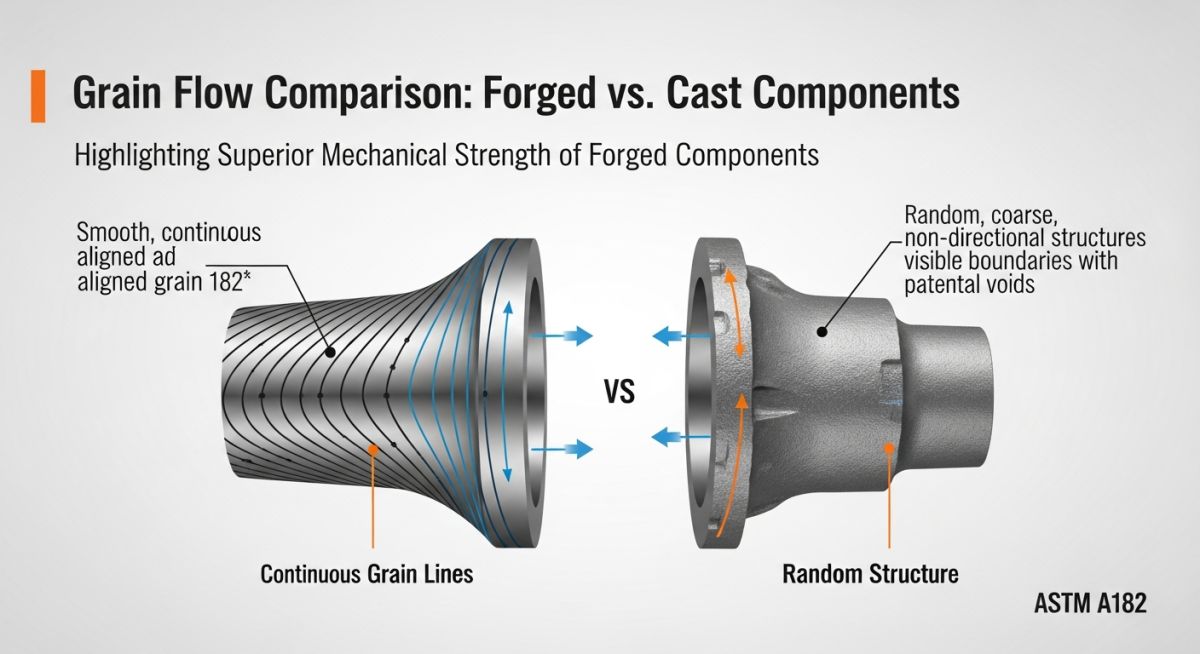
Beyond flanges, ASTM A182 is the primary material choice for high-pressure forged fittings. These components are typically manufactured in accordance with ASME B16.11, which covers both socket-weld and threaded end connections. Because the forging process eliminates internal porosity and optimizes grain structure, ASTM A182 fittings provide a higher safety factor than cast alternatives in 2026 piping designs.
Socket-Weld Fittings
Commonly used for small-bore piping (typically up to NPS 2). ASTM A182 grades like F304L ensure high weldability and structural integrity at the joint.
Threaded Fittings
Used in low-pressure or non-critical systems where welding is not feasible. The hardness requirements of ASTM A182 ensure threads remain durable under torque.
Design and Use of ASTM A182 Valves in Pressure Piping
Valve bodies, bonnets, and trim parts are frequently specified as ASTM A182 to match the piping material. Forged gate, globe, and check valves—often following API 602 standards—rely on the superior mechanical properties of A182 to handle rapid pressure fluctuations and thermal cycling.
Engineering Calculation: Wall Thickness for ASTM A182 Components
Under ASME B31.3, the required wall thickness (t) for a pipe or fitting made from ASTM A182 is calculated as:
t = (P * D) / (2 * (S*E*W + P*Y))
Where:
P = Internal design gage pressure.
D = Outside diameter.
S = Allowable stress value for the specific ASTM A182 grade at design temperature.
E = Quality factor.
W = Weld joint strength reduction factor.
Y = Coefficient from Table 304.1.1.
Core Industrial Applications and Benefits of ASTM A182
The universal adoption of ASTM A182 in the EPC (Engineering, Procurement, and Construction) sector is due to its reliability in extreme environments.
Superior Strength and Durability of Forged Steel
The forging process used for ASTM A182 materials compresses the metal and aligns the grain flow. This results in superior impact resistance and fatigue life compared to cast parts which may contain blowholes or inclusions.
Corrosion Resistance in High-Pressure Environments
By utilizing high-chromium and molybdenum content in grades like F316, ASTM A182 components resist pitting and crevice corrosion, making them essential for seawater cooling systems and chemical reactors.
Performance Across Wide Temperature Ranges
From cryogenic service (using austenitic grades) to high-temperature steam headers exceeding 500°C (using F22 or F91 alloy steels), ASTM A182 provides a solution for every thermal gradient in a modern refinery.
Deep Dive: ASTM A182 F316L Properties and Applications
Among all stainless steel forgings, ASTM A182 F316L is arguably the most versatile. The “L” stands for “Low Carbon” (max 0.030%), which prevents “sensitization”—the precipitation of chromium carbides at the grain boundaries during welding.
| Feature | ASTM A182 F316L Value / Capability |
|---|---|
| Primary Advantage | Excellent resistance to chloride-induced stress corrosion cracking. |
| Max Temp (Non-Pressure) | Up to 870°C (1600°F) for intermittent service. |
| Typical Application | Pharmaceutical equipment, marine piping, and food processing. |
| Weldability | Excellent; does not require post-weld heat treatment (PWHT). |
Don’t miss this video related to ASTM A182
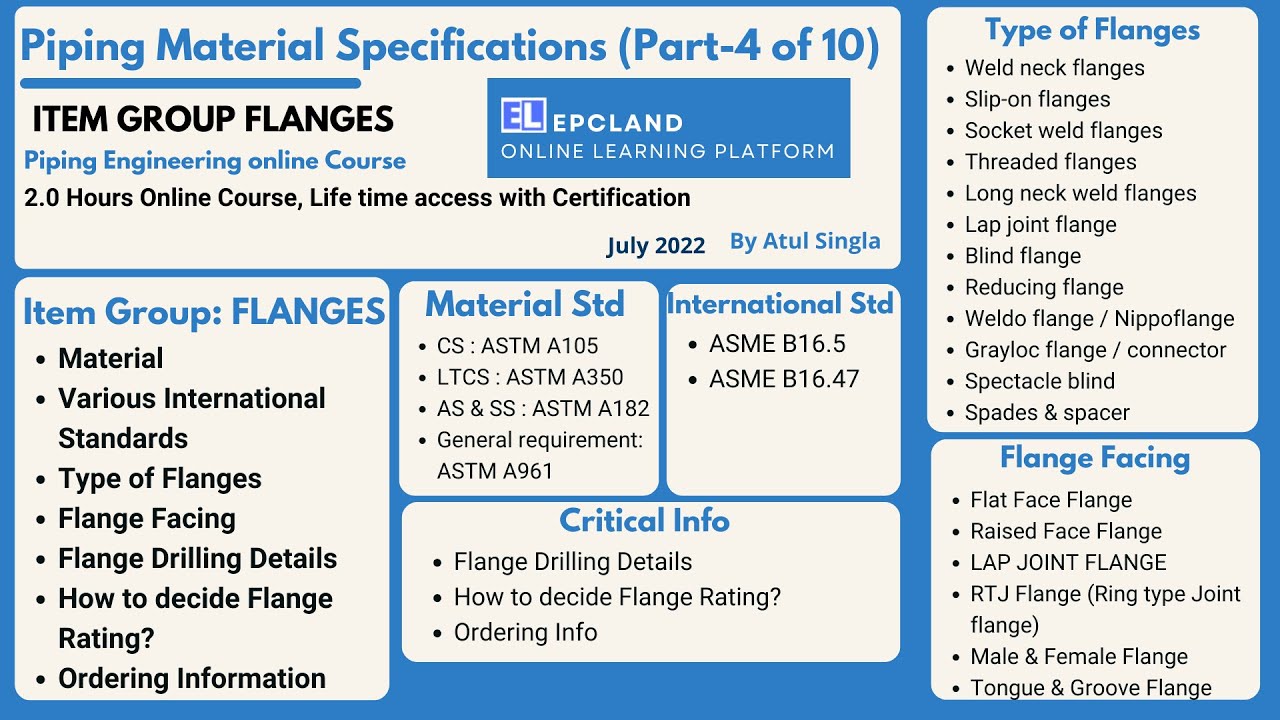
Summary: Master Piping Engineering with our complete 125+ hour Certification Course: ……
ASTM A182 Pitting Resistance (PREN) Calculator
Calculate the Pitting Resistance Equivalent Number (PREN) for your ASTM A182 stainless steel grade to determine its suitability for corrosive 2026 industrial environments.
Calculated PREN Value
Note: The calculator provides a theoretical comparison based on chemical composition. Always verify specific project requirements against the full ASTM A182 material test report (MTR).
ASTM A182 Failure Case Study: Upgrading Offshore Reverse Osmosis Systems

Project Data
- Facility: Subsea Desalination & High-Pressure SWRO Unit
- Operating Pressure: 4,500 PSI (310 Bar)
- Media: Raw Seawater / High Salinity Brine
- Initial Material: Standard Carbon Steel with Internal Coating
Failure Analysis
In early 2025, the facility experienced severe leakage at several flange faces. Investigation revealed that the internal protective coating had failed due to high-velocity turbulence. This exposed the underlying carbon steel to rapid crevice corrosion and pitting. The metallurgical report indicated that the material lacked sufficient ASTM A182 alloying elements (specifically Chromium and Molybdenum) to resist the chloride-rich environment.
Engineering Fix
The engineering team mandated a complete replacement of the manifold using ASTM A182 F316L forged steel. This specific grade was chosen for:
- Low Carbon Content: Preventing sensitization during field welding.
- Forged Integrity: Eliminating the risk of casting-related porosity in high-pressure service.
- PREN Value: Ensuring a Pitting Resistance Equivalent Number (PREN) > 24 for seawater durability.
Lessons Learned
The total lifecycle cost of the ASTM A182 upgrade was 40% lower than the cost of frequent maintenance and downtime associated with inferior materials. For 2026 projects, selecting the correct ASTM A182 grade at the FEED stage is critical for offshore reliability.
Frequently Asked Questions about ASTM A182 Specifications
What is the difference between ASTM A182 F304 and F304L for forged fittings?
Can ASTM A182 material be used for cryogenic applications?
What are the heat treatment requirements for ASTM A182 alloy steel?
How do I verify the authenticity of an ASTM A182 flange?
Conclusion: The Engineering Standard in 2026
As we navigate the complexities of modern industrial infrastructure in 2026, the ASTM A182 specification remains an indispensable pillar for safety and performance. Its comprehensive requirements for chemical composition, mechanical properties, and heat treatment provide the necessary framework for engineers to select materials that can endure the world’s most demanding environments.
Whether you are specifying F316L flanges for a pharmaceutical cleanroom or F22 alloy fittings for a supercritical power plant, understanding the nuances of ASTM A182 ensures your piping system is built for longevity, reliability, and ultimate structural integrity.
Designed to meet international compliance standards for Pressure Equipment Directive (PED) and ASME Boiler & Pressure Vessel Code (BPVC).
📚 Recommended Resources: ASTM A182
Read these Guides
🎓 Advanced Training



Related posts:
![Advanced Industrial Dryers installation in a modern chemical processing plant 2026.]()
Industrial Dryers: Selection Guide & Technology Trends 2026
![Industrial Air Relief Valve installed on municipal water transmission pipeline for surge protection.]()
Air Relief Valve: Engineering Guide to Surge Protection 2026
![Hydrogen Induced Cracking (HIC) damage in industrial pressure vessel steel.]()
Hydrogen Induced Cracking (HIC) Mechanism & Prevention Guide 2026
![Macro view of Stress Corrosion Cracking (SCC) in industrial stainless steel piping.]()
Stress Corrosion Cracking (SCC): Mechanism and Prevention Guide 2026
![Professional 3D CAD model demonstrating advanced Pipe Routing Concepts in a refinery.]()
Pipe Routing Concepts: Engineering Layout Guide 2026
![Industrial Slurry Piping System Design installation for heavy mining operations.]()
Slurry Piping System Design: Engineering Guide & Standards 2026