Chemical Injection: Engineering Systems, Equipment, and Industrial Standards

The process of Chemical Injection is a critical operation in modern industrial plants, designed to deliver precise volumes of specialty chemicals into a process stream. From inhibiting corrosion in subsea pipelines to ensuring water purity in municipal systems, the mechanical integrity of the injection system is paramount. Engineers must balance pump hydraulics, material compatibility, and delivery mechanisms like quills to ensure effective treatment and equipment protection.
What is Chemical Injection in Process Engineering?
Chemical Injection involves the controlled dosing of chemicals (inhibitors, coagulants, or biocides) into a process line to modify its properties or protect infrastructure. These systems typically utilize high-precision metering pumps, often governed by API 675 standards, and modular skids that integrate storage, filtration, and instrumentation for automated dosing control.
Table of Contents
Quiz: Industrial Chemical Injection Fundamentals
Complete Course on
Piping Engineering
Check Now
Key Features
- 125+ Hours Content
- 500+ Recorded Lectures
- 20+ Years Exp.
- Lifetime Access
Coverage
- Codes & Standards
- Layouts & Design
- Material Eng.
- Stress Analysis
Industrial Applications of Chemical Injection Systems
The tactical deployment of Chemical Injection systems is essential for maintaining the operational life of high-value assets in volatile environments. By introducing specific reagents at the molecular level, engineers can neutralize corrosive agents, prevent mineral buildup, and ensure that fluid properties remain within design parameters. In 2026, the shift toward real-time “Smart Dosing” has further increased the reliance on these automated systems.
Corrosion and Scale Inhibition for Chemical Injection in Oil and Gas
In the upstream sector, Chemical Injection serves as the primary defense against internal pipeline degradation. Sour gas containing hydrogen sulfide (H2S) and carbon dioxide (CO2) creates a highly acidic environment that can lead to rapid pitting and stress corrosion cracking. To combat this, corrosion inhibitors (CIs) are injected at precise concentrations (often in parts per million) to form a protective film on the internal pipe wall.
Similarly, scale inhibitors are required to prevent the precipitation of carbonates and sulfates, which can restrict flow and damage expensive downhole equipment. In deepwater subsea completions, Chemical Injection of Monoethylene Glycol (MEG) or Methanol is critical for hydrate inhibition, ensuring that gas lines do not plug during thermal transients.
Water Treatment and Pharmaceutical Chemical Injection Processes
In municipal and industrial water treatment, Chemical Injection is used for disinfection and pH stabilization. Automated skids deliver sodium hypochlorite for chlorination or ferric chloride for coagulation. The accuracy of the injection system is vital here; under-dosing leads to biological contamination, while over-dosing can result in toxic byproduct formation.
The pharmaceutical industry utilizes Chemical Injection for high-purity batching and catalytic additions. These systems must comply with sanitary standards, often requiring 316L stainless steel construction and high-polishing of internal surfaces to prevent bacterial growth and ensure cross-contamination is eliminated.
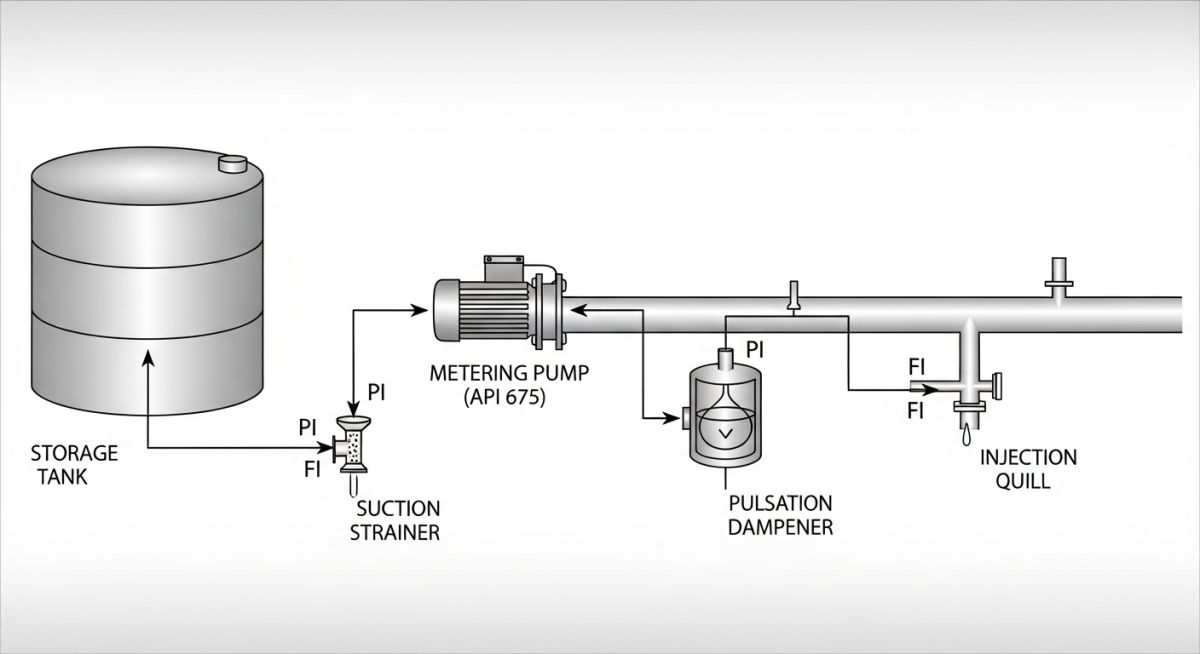
Technical Architecture: The Chemical Injection Skid
A Chemical Injection skid is a modular, self-contained unit that houses all components necessary for fluid storage, filtration, and pressurized delivery. Modern skids are designed for “Plug-and-Play” installation, minimizing field labor and ensuring that the entire hydraulic circuit is tested and certified prior to site arrival.
Chemical Injection Pump Technology (API 675 vs API 674)
The heart of any Chemical Injection system is the pump. Two primary standards govern these units:
- API 675 (Positive Displacement – Metering): These are the most common pumps for Chemical Injection. They utilize a controlled-volume plunger or diaphragm to deliver precise dosing with an accuracy of plus or minus 1 percent. They are ideal for applications requiring variable flow rates at constant pressures.
- API 674 (Positive Displacement – Reciprocating): These are generally used for higher-volume Chemical Injection tasks, such as large-scale MEG injection. While highly robust, they lack the fine-tuned volumetric control provided by API 675 metering pumps.
Chemical Injection Quill and Atomization Nozzle Design
The point of delivery—the Chemical Injection quill—is often overlooked but is structurally critical. A quill is an extension of the injection line that protrudes into the process pipe, typically ending at the center one-third of the pipe diameter.
By delivering the chemical to the high-velocity center of the flow, the quill ensures rapid mixing and prevents “wall-streaming,” where high concentrations of raw chemicals cling to the pipe wall, causing localized corrosion or “chemical burns.” High-pressure systems may utilize atomization nozzles to break the chemical into a fine mist, further accelerating the reaction or inhibition process.
Strategic Advantages of Precision Chemical Injection Systems
Implementing a high-fidelity Chemical Injection system provides more than just technical protection; it directly impacts the plant’s bottom line. In 2026, where environmental regulations are tightening, the ability to prove precise dosing via automated logs is a requirement for many industrial operating permits.
Operational Cost Efficiency
Chemicals such as biocide and specialized corrosion inhibitors are expensive. By using Chemical Injection metering pumps with high turndown ratios, operators can match the dose exactly to the process flow, potentially saving hundreds of thousands of USD in chemical waste annually.
Environmental Stewardship
Over-dosing chemicals can lead to toxic discharge into wastewater systems. Precision Chemical Injection ensures that the minimum effective dose is used, reducing the environmental footprint and minimizing the risk of regulatory fines related to chemical leaching.
Engineering Selection Criteria for a Chemical Injection Kit
When specifying a Chemical Injection kit or skid, engineers must perform a rigorous hydraulic analysis. A common mistake is focusing solely on the discharge pressure without considering the Net Positive Suction Head (NPSH) available, which can lead to pump cavitation and premature failure.
Material Selection and Compatibility for Harsh Environments
Materials for Chemical Injection systems must be resistant to both the injected chemical and the external environment. For highly corrosive service, such as injecting concentrated sulfuric acid, standard 316 stainless steel may be insufficient. In these cases, exotic alloys like Hastelloy C-276 or Titanium are specified for the pump heads and injection quills.
| Feature | Plunger Injection Pump | Hydraulic Diaphragm Pump |
|---|---|---|
| Pressure Capability | Very High (Up to 15,000 PSI+) | Moderate to High (Up to 5,000 PSI) |
| Leak Resistance | Low (Potential for packing leaks) | High (Hermetically sealed) |
| Maintenance | Simple, frequent seal changes | Complex, but long intervals |
| Best Chemical Service | Non-toxic, lubricating fluids | Hazardous, toxic, or abrasive fluids |
Advanced Calculation: Calculating Dosage in PPM
In Chemical Injection engineering, the required flow rate of the chemical is often derived from the desired concentration in Parts Per Million (PPM) within the process stream. The basic calculation used for sizing the metering pump is:
- Qchem: Required Chemical Flow Rate (Liters/Hour)
- Cppm: Desired Concentration (Parts Per Million)
- Qprocess: Main Process Flow Rate (Liters/Hour)
- SGp / SGc: Specific Gravity of Process and Chemical fluids
Chemical Injection Calculator
Calculate the required Chemical Injection pump flow rate based on the target concentration in Parts Per Million (PPM) for your process stream.
Water = 1.0
Typical range: 0.8 to 1.5
Note: Result accounts for specific gravity differences between chemical and process fluids.
Don’t miss this video related to Chemical Injection
Summary: Master Piping Engineering with our complete 125+ hour Certification Course: ……
Case Study: Preventing Pipeline Failure via Chemical Injection Optimization

1. Project Data and Background
In early 2026, an offshore operator in the North Sea faced significant integrity challenges with a 40-kilometer subsea pipeline transporting sour gas (high H2S and CO2 content). The pipeline was protected by a manual batch-based Chemical Injection program. However, ultrasonic wall-thickness inspections revealed a localized 30 percent wall loss in low-elevation segments where water and corrosive fluids tended to accumulate.
2. Failure Analysis
The engineering audit determined that the manual batch treatment was insufficient for the fluctuating flow velocities of the pipeline. During periods of high production, the inhibitor film was being stripped away faster than it was being replenished. The lack of precision in the Chemical Injection dosage meant that “slugs” of uninhibited corrosive fluid were reaching the pipe wall, leading to rapid pitting corrosion and threatening a catastrophic containment loss.
3. Engineering Fix and System Redesign
The operator replaced the manual system with a fully automated, modular Chemical Injection skid. The redesign included:
- Continuous Injection: Implementation of API 675 hydraulic diaphragm pumps to deliver a constant, precisely metered stream of inhibitor.
- Real-time Feedback: Integration of electromagnetic corrosion probes linked to the skid’s PLC, allowing for “Smart Dosing” where the injection rate automatically adjusted based on real-time corrosion data.
- Quill Optimization: Installation of specialized atomization quills to ensure the inhibitor reached the center of the gas flow for maximum dispersion.
Lessons Learned for Asset Integrity
For high-risk sour service, a reactive Chemical Injection strategy is inadequate. Moving to a continuous, automated dosing system significantly reduced the corrosion rate from 1.5 mm/year to less than 0.1 mm/year. The investment in automated skids and API-compliant pumps was recouped within 12 months through the reduction in chemical waste and the extension of the pipeline’s remaining useful life.
Frequently Asked Questions about Chemical Injection
What are the key maintenance requirements for an API 675 chemical injection pump?
How do you prevent clogging in a high-pressure chemical injection quill?
What materials are best for handling corrosive chemicals in injection skids?
Why is a pulsation dampener critical for chemical injection systems?
Summary of Chemical Injection Engineering
Effective Chemical Injection is much more than simply adding a reagent to a pipe; it is a sophisticated engineering discipline that requires a deep understanding of pump hydraulics, material science, and process automation. By utilizing API-compliant metering pumps, modular skids, and optimized delivery quills, industrial facilities can protect their multibillion-USD infrastructure from corrosion and scaling. As we move through 2026, the integration of smart sensors and real-time dosing control will continue to redefine the efficiency and safety of these essential systems.