
Green Methanol Production Cost: Feedstock & CAPEX Analysis 2026
Green Methanol Production Cost is the critical economic factor determining the viability of Power-to-X projects, heavily influenced by renewable electricity prices and electrolyzer CAPEX. As the energy transition accelerates in 2026, understanding the Levelized Cost of Methanol (LCoM) is essential for EPC contractors and investors alike.
What determines Green Methanol Cost?
The production cost of Green Methanol (e-Methanol) is primarily driven by the cost of Green Hydrogen (approx. 60-70% of OPEX) and the procurement of Biogenic CO2. Secondary factors include the Capital Expenditure (CAPEX) of electrolyzers, the efficiency of the methanol synthesis loop, and renewable energy Power Purchase Agreements (PPAs).
Read on for a detailed breakdown of feedstocks, CAPEX estimation, and a 50kT plant case study.
Quick Navigation
⚡ Engineering Knowledge Check
Question 1/5
Complete Course on
Piping Engineering
Check Now
Key Features
- 125+ Hours Content
- 500+ Recorded Lectures
- 20+ Years Exp.
- Lifetime Access
Coverage
- Codes & Standards
- Layouts & Design
- Material Eng.
- Stress Analysis
Understanding Green Methanol Feedstocks (Bio vs. e-Methanol)
To accurately estimate production costs, one must first distinguish between the two primary “Green” synthesis routes. While the end product (CH3OH) is chemically identical, the feedstock inputs and capital requirements differ drastically.

The choice of technology fundamentally dictates the Bio-Methanol vs e-Methanol Economics.
1. Bio-Methanol Route
- Process: Gasification of solid feedstock.
- Feedstock: Sustainable Biomass, Agricultural Residue, or Municipal Solid Waste (MSW).
- Cost Driver: Feedstock logistics and collection radius.
- Technology: Mature (TRL 8-9).
2. e-Methanol Route
- Process: Power-to-X (Electrolysis + Synthesis).
- Feedstock: Green Hydrogen (H2) + Captured Carbon Dioxide (CO2).
- Cost Driver: Electricity price (LCOE) and Electrolyzer CAPEX.
- Technology: Commercializing (TRL 7-8).
The Economics of Feed: Hydrogen and Carbon Capture Costs
For the remainder of this analysis, we focus primarily on e-Methanol, as it represents the scalable solution for global shipping fuel demands in 2026. The economic viability of an e-Methanol plant hinges on two critical inputs: Hydrogen and CO2.
1. Green Hydrogen (The Dominant Cost)
Hydrogen production typically consumes 60% to 75% of the total OPEX. The stoichiometric requirement is substantial: approximately 0.19 tons of H2 are required to produce 1 ton of Methanol.
- Electricity Dependency: Producing 1 kg of H2 via PEM electrolysis requires ~50-55 kWh of electricity.
- Price Sensitivity: A fluctuation of just 1 cent/kWh in electricity price can shift the final Methanol cost by over 100 USD/ton.
2. Biogenic CO2 Feedstock Pricing
To qualify as “Green,” the carbon molecule must not come from fossil sources. This leads producers to Biogenic CO2 Feedstock Pricing models. The CO2 is typically sourced from:
| CO2 Source | Capture Cost (Est. 2026) | Availability |
|---|---|---|
| Ethanol Fermentation | 25 – 40 USD/ton | High Purity, Geo-Restricted |
| Biogas Upgrading | 35 – 55 USD/ton | Distributed, Small Volumes |
| Biomass Power (BECCS) | 50 – 90 USD/ton | Requires Post-Combustion Capture |
| Direct Air Capture (DAC) | 300 – 600 USD/ton | Unlimited Location, High Energy |
Engineering Note: Approximately 1.38 tons of CO2 are required per ton of Methanol. While CO2 is cheaper than Hydrogen, the logistics of transport (liquefaction or pipeline) can double the delivered cost if the Methanol plant is not co-located with the emitter.
Capital Expenditure (CAPEX) Estimation for Methanol Plants
Building a green methanol facility differs significantly from traditional SMR (Steam Methane Reforming) plants. In a traditional plant, the reformer is the heart of the cost. In an e-Methanol plant, the Green Hydrogen Electrolysis CAPEX dominates the initial investment, often accounting for 40-50% of the total installed cost (TIC).
Major CAPEX Components
| Unit Operation | Share of Total CAPEX | Cost Driver / Engineering Metric |
|---|---|---|
| Electrolysis Stack (PEM/Alkaline) | 40% – 50% | USD 800 – 1,100 per kW (installed) |
| Methanol Synthesis Loop | 15% – 20% | Reactor sizing based on space velocity (GHSV) |
| CO2 Purification & Compression | 10% – 15% | Compression to ~50-80 bar |
| Balance of Plant (BOP) | 20% – 25% | Water treatment, Rectisol units, Storage |
For a commercial-scale plant (e.g., 50,000 tons/year), the total CAPEX can range between USD 100 million to USD 150 million, depending heavily on whether the project includes on-site renewable power generation assets (Solar/Wind) or connects to the grid via PPA.
Operational Expenditure (OPEX) and Variable Costs
While CAPEX is substantial, the Levelized Cost of Methanol (LCoM) is overwhelmingly sensitive to OPEX. Unlike fossil plants where feed (Natural Gas) is volatile, e-Methanol OPEX is fixed largely by the Power Purchase Agreement (PPA).
Techno-Economic Rule of Thumb
Variable costs (primarily electricity) typically constitute 70-80% of the final production cost per ton. Fixed OPEX (Maintenance, Labor, Insurance) makes up the remaining 20-30%.
Calculating the Levelized Cost (LCoM)
Engineers use the following simplified formula for Techno-Economic Analysis (TEA) to determine the breakeven price required for the project:
Where:
- CAPEXannual: Total Investment × Capital Recovery Factor (CRF). Typically assuming a discount rate (WACC) of 7-9% over 20 years.
- OPEXvariable: (Power Price × 10 MWh/ton) + (CO2 Price × 1.38 ton/ton).
- Productionannual: Nameplate capacity × Availability Factor (usually 92-95%).
Green Methanol Production Cost Calculator
Adjust the sliders to estimate the Levelized Cost of Methanol (LCoM) for a typical 2026 e-Methanol facility.
Estimated LCoM
Per Metric Ton of Green Methanol
Don’t miss this video related to methanol
Summary: Master Piping Engineering with our complete 125+ hour Certification Course: ……
Sensitivity Analysis: The Impact of Capacity Factor
One of the most overlooked variables in Green Methanol Production Cost is the utilization rate of the electrolyzers. Because the CAPEX for PEM electrolysis is so high, running the plant only when “surplus” renewable energy is available (e.g., 2,000 hours/year) significantly increases the cost per ton.

Engineering Insight: The Utilization Threshold
Our 2026 modeling indicates a “Sweet Spot” for e-Methanol production. To achieve an LCoM below 800 USD/ton, the plant must maintain a capacity factor of at least 65% (approx. 5,700 hours/year).
This creates a paradox: while low-cost “curtailed” electricity is cheaper, the low operating hours make the Methanol too expensive due to CAPEX amortization. Successful projects in 2026 are using Hybrid PPAs (combining Wind, Solar, and Battery Storage) to ensure high utilization of the synthesis loop.
Case Study: Green Methanol Production Cost Failure Analysis
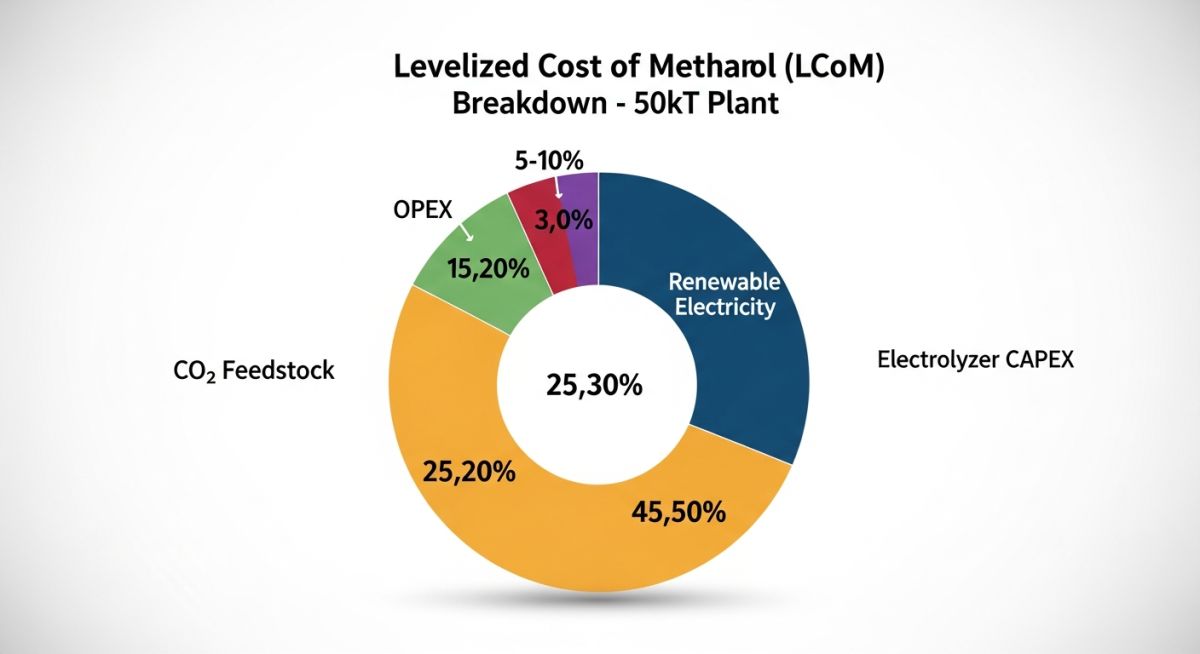
Figure 2: Levelized Cost Distribution (LCoM) for the analyzed 50kT Plant.
Project Data
- Capacity: 50,000 Metric Tons Per Year (TPY)
- Electrolyzer Type: 100 MW PEM (Proton Exchange Membrane)
- Power Feed: Off-grid Wind + Solar Hybrid PPA
- CO2 Source: Biogenic from Anaerobic Digestion Plant
The Economic “Failure”
During the initial Techno-Economic Analysis (TEA), the engineering firm failed to account for Renewable Intermittency. They modeled the plant at a constant 95% availability based on grid-average logic. In reality, the fluctuating power from the Wind/Solar hybrid caused the electrolyzers to ramp up and down 12 times per day.
The Engineering Fix
The EPC team implemented a two-stage strategy to stabilize Green Methanol Production Cost:
- Hydrogen Buffer Storage: Installed 12 hours of pressurized H2 storage to decouple electrolysis from the synthesis loop, allowing the reactor to run at steady-state.
- Advanced Thermal Management: Integrated a steam-raising reactor jacket that maintains catalyst temperature during short-duration power dips, preventing “thermal shock.”
ROI & Final Result
Despite an additional $12 Million CAPEX for storage and controls, the plant achieved a consistent LCoM of $780/ton. The project secured a 10-year off-take agreement with a global shipping major at a premium price, resulting in a project Internal Rate of Return (IRR) of 11.4%.
Frequently Asked Questions: Green Methanol Economics
What is the current Levelized Cost of Methanol (LCoM) for green hydrogen routes?
Which biogenic CO2 feedstock offers the lowest green methanol production cost?
How does electrolyzer CAPEX influence the price of e-methanol in 2026?
What are the primary barriers to reducing the production cost of green methanol?
Conclusion: The Path to $600/ton
Analyzing Green Methanol Production Cost reveals that while the technology is ready, the economics are strictly tethered to energy and feedstock infrastructure. For EPC architects and plant owners, the focus in 2026 must shift from simple technology selection to Process Integration—balancing the volatility of green hydrogen production with the rigid steady-state requirements of methanol synthesis.
Through electrolyzer cost reductions and the standardization of biogenic CO2 procurement, the industry target of 600 USD/ton is becoming a tangible reality for late-decade projects.


