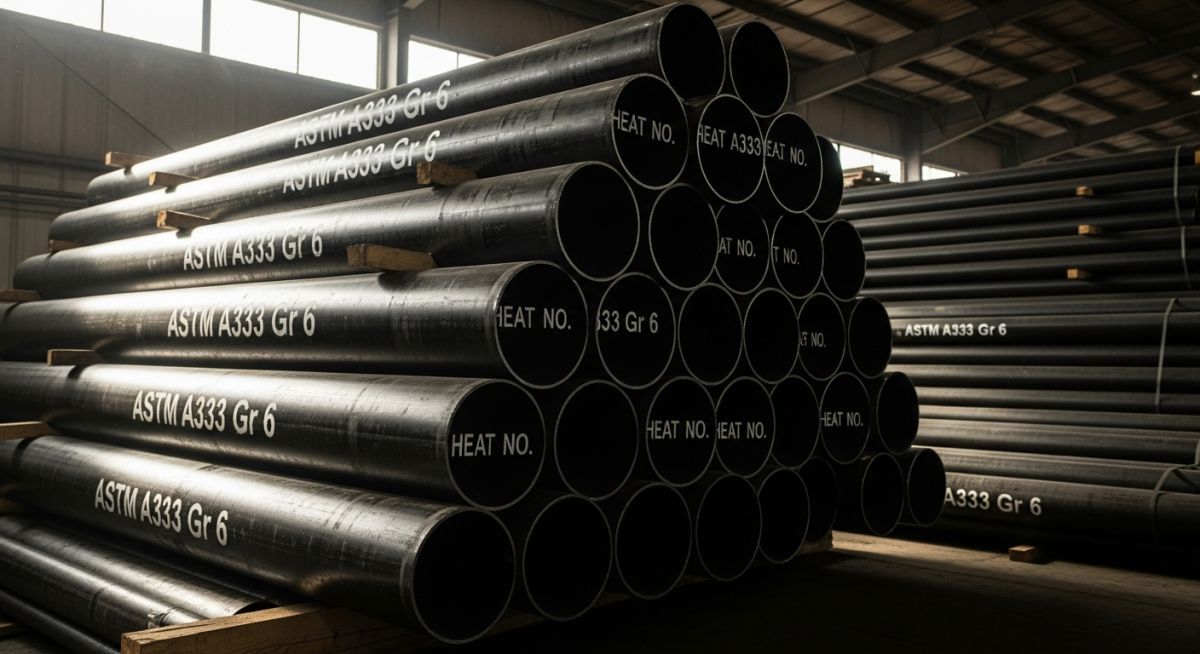
Focus Keyword: ASTM A333 Gr 6 SEO Title: ASTM A333 Gr 6 Guide: Properties, Comparison vs A106 & Specs Slug: astm-a333-gr-6-low-temperature-pipe Meta Description: Master ASTM A333 Gr 6 engineering specs. Learn chemical composition, mechanical properties, and critical differences between ASTM A333 Gr 6 and A106 Gr B. Tags: ASTM A333 Gr 6, LTCS Pipe, Low Temperature Carbon Steel, ASME B31.3, Charpy Impact Test VERIFIED ENGINEERING CONTENT Updated: 2026 Ultimate Guide to ASTM A333 Gr 6: Properties, Applications, and A106 Gr B Comparisons ASTM A333 Gr 6 is the industry standard for seamless and welded carbon steel pipe intended for use at low temperatures, specifically designed to maintain notch toughness in sub-zero environments. Unlike standard carbon steel, this material undergoes rigorous impact testing to ensure structural integrity in critical process piping applications. What is ASTM A333 Gr 6? ASTM A333 Gr 6 is a Low-Temperature Carbon Steel (LTCS) used in piping systems where temperatures may drop as low as -45 degrees Celsius (-50 degrees Fahrenheit). It is characterized by its fine-grain structure, achieved through normalization, and mandatory Charpy V-notch impact testing to prevent brittle fracture. In This Technical Guide What is ASTM A333 Gr 6 Carbon Steel? Critical Information Required to Purchase ASTM A333 Gr 6 Pipe Chemical Composition Requirements for ASTM A333 Gr 6 Mechanical Properties and Tensile Strength Technical Differences: ASTM A106 Gr B vs. ASTM A333 Gr 6 Low-Temperature Impact Testing Standards ASME B31.3 and ASTM A333 Gr 6 Compliance Sourcing and Manufacturers Technical Competency Quiz: LTCS Materials Question 1 of 5 Next Question Restart Quiz What is ASTM A333 Gr 6 Carbon Steel for Low-Temperature Service? The ASTM A333 Gr 6 specification covers seamless and welded nominal wall carbon and alloy steel pipe intended for use at low temperatures. In the hierarchy of industrial piping, this grade is classified as a Low-Temperature Carbon Steel (LTCS). Unlike standard A106 materials, Grade 6 is specifically engineered to resist brittle fracture, a phenomenon where steel loses ductility and fails suddenly when exposed to sub-zero conditions. According to ASME B31.3 (Process Piping) and ASME Section VIII, materials used in refrigerated or cryogenic environments must demonstrate specific notch toughness. ASTM A333 Gr 6 meets these requirements through a controlled manufacturing process that emphasizes a fine-grain crystalline structure, typically achieved via normalizing heat treatments. Critical Information Required to Purchase ASTM A333 Gr 6 Pipe When procurement teams or piping engineers issue a purchase order for ASTM A333 Gr 6, specific technical parameters must be defined to ensure compliance with project specifications. Missing data can lead to the delivery of material that fails to meet safety codes for low-temperature service. Quantity and Dimensions: Total length (meters/feet), Nominal Pipe Size (NPS), and Schedule (e.g., SCH 40, SCH 80). Manufacturing Method: Specify "Seamless" or "Welded." For critical high-pressure lines, seamless is often preferred. Heat Treatment: Ensure the Material Test Report (MTR) confirms the pipe was normalized or quenched and tempered. Impact Test Temperature: The standard temperature is -45 degrees C (-50 degrees F). If the project requires lower temperatures, additional testing may be needed. Supplementary Requirements: Mention any additional tests like Product Analysis or NACE MR0175 compliance for sour service. Chemical Composition Requirements for ASTM A333 Gr 6 Material The chemistry of ASTM A333 Gr 6 is meticulously balanced to provide a blend of strength and weldability while maintaining toughness. The inclusion of Manganese (Mn) is critical as it refines the grain size and improves the impact properties of the carbon steel. Element Composition Limit (Percentage) Carbon (C) max 0.30 Manganese (Mn) 0.29 to 1.06 Phosphorus (P) max 0.025 Sulfur (S) max 0.025 Silicon (Si) min 0.10 Note: For each reduction of 0.01 percentage point below the specified carbon maximum, an increase of 0.05 percentage point manganese above the specified maximum is permitted up to a maximum of 1.35 percentage point manganese. Mechanical Properties and Tensile Strength of A333 Gr 6 Pipe Material The mechanical properties of ASTM A333 Gr 6 are designed to ensure that the piping can withstand both internal pressure and external mechanical loads at reduced temperatures. These properties are verified through tensile testing and elongation measurements as per ASTM A370 standards. Property Value (Imperial) Value (Metric) Tensile Strength, min 60,000 psi 415 MPa Yield Strength, min 35,000 psi 240 MPa Elongation in 2 in (50mm) 30 percent 30 percent Technical Differences: ASTM A106 Gr B vs. ASTM A333 Gr 6 Pipe Material A common question in piping engineering is whether ASTM A106 Gr B can be substituted for ASTM A333 Gr 6. While their tensile strengths are nearly identical, their performance in cold climates is vastly different. Feature ASTM A106 Grade B ASTM A333 Grade 6 Primary Service High-Temperature Service Low-Temperature Service (LTCS) Impact Testing Not Required Mandatory (Charpy V-Notch) Min. Temp Rating -29 degrees C (-20 degrees F) -45 degrees C (-50 degrees F) Heat Treatment Hot Finished / Annealed Normalized (Grain Controlled) Calculations and Impact Energy for ASTM A333 Gr 6 For engineering design, the impact energy absorbed by the material is calculated using Charpy V-notch tests. The impact energy requirement is a function of the specimen size. If sub-size specimens are used due to wall thickness limitations, the energy requirements are adjusted proportionally. Notch Toughness Requirement (Full Size: 10mm x 10mm) Minimum Average of 3 Specimens: 18 Joules (13 ft-lb) Minimum for 1 Individual Specimen: 14 Joules (10 ft-lb) Impact Energy Correction for Sub-size Specimens: Energyrequired = Energyfull × (Actual Width / 10mm) Engineers must verify that the ASTM A333 Gr 6 pipe supplied has been tested at the correct temperature specified in the design. If the project operating temperature is lower than -45 degrees C, the pipe may require re-testing or an upgrade to A333 Grade 8 (liquid nitrogen service). ASTM A333 Gr 6 Impact Energy Calculator Use this tool to calculate the required Charpy V-notch impact energy values for sub-size specimens. As per ASTM A333, when pipe wall thickness prevents the use of full-size (10mm x 10mm) specimens, the required energy values must be reduced proportionally. Specimen Width (mm) 10mm (Full Size) 7.5mm (3/4 Size) 6.7mm (2/3 Size) 5mm (1/2 Size) 3.3mm (1/3 Size) 2.5mm (1/4 Size) Required Full-Size Energy (Joules) Calculate Values Reset Adjusted Requirements: Minimum Average (3 Specimens): -- Joules Minimum for 1 Individual Specimen: -- Joules Calculation based on linear reduction ratio: (Sub-size Width / 10mm) as specified in ASTM A333 / A370. Don't miss this video related to ASTM A333 Summary: Understand Tensile Requirements (Section 7) and Mechanical Testing (Section 12) for ASTM A333 pipes. Learn about yield ...... ✅ 2500+ VIDEOS View Playlists → JOIN EXCLUSIVE EDUCATION SUBSCRIBE Welding Metallurgy and Heat Affected Zone (HAZ) in ASTM A333 Gr 6 The primary challenge when welding ASTM A333 Gr 6 is not just joining the metal, but preserving the low-temperature notch toughness within the Heat Affected Zone (HAZ). During welding, the high heat input can cause grain coarsening, which significantly raises the Ductile-to-Brittle Transition Temperature (DBTT), potentially making the weld area susceptible to brittle failure at -45 degrees Celsius. Managing Heat Input for ASTM A333 Gr 6 To maintain a fine-grain structure, engineers must strictly control the Heat Input (HI). High heat input leads to slow cooling rates, which promotes the growth of large grains. The heat input is calculated using the following formula: HI = (Voltage × Amperage × 60) / (Travel Speed × 1000) Units: HI in kJ/mm; Voltage in Volts; Amperage in Amps; Travel Speed in mm/min. Essential Welding Procedures According to ASME Section IX, the Welding Procedure Specification (WPS) for LTCS materials must be qualified with impact testing of both the weld metal and the HAZ. Key technical requirements include: Requirement Engineering Guideline Preheat Temperature Typically 100 to 150 degrees C to remove moisture and prevent hydrogen cracking. Interpass Temperature Maximum 250 degrees C recommended to prevent excessive grain growth in ASTM A333 Gr 6. Filler Metal Class AWS A5.1 E7018-1 (SMAW) or AWS A5.18 ER70S-2 (GTAW). Post-Weld Heat Treatment (PWHT) Required for heavy wall thicknesses (typically > 19mm) per ASME B31.3 to relieve residual stresses. Failure to control these variables can result in "local brittle zones" where the absorbed impact energy falls below the mandatory 18 Joules, necessitating costly cut-outs and re-welding. Always ensure that the ASTM A333 Gr 6 base metal chemistry, specifically the Carbon Equivalent (CE), is compatible with the intended welding heat input. Case Study: ASTM A333 Gr 6 Implementation in Arctic LPG Storage Project Data Location: Prudhoe Bay, Alaska Application: Liquid Petroleum Gas (LPG) Transfer Lines Design Temperature: -40 degrees Celsius Material: ASTM A333 Gr 6 Seamless Pipe Failure Analysis (Hypothetical) Prior to the 2026 upgrade, the facility utilized standard A106 Grade B piping. During a record cold snap, a thermal shock event led to a brittle fracture near a flange weld. The absence of verified impact toughness in the A106 material allowed a micro-crack to propagate at sonic speeds, resulting in a total containment loss. Engineering Fix & Lessons Learned The entire piping circuit was replaced with ASTM A333 Gr 6. The engineering team enforced 100 percent Charpy V-notch testing at -45 degrees Celsius to ensure a safety margin against the design temperature of -40 degrees Celsius. Normalized heat treatment is non-negotiable for sub-zero weld integrity. Manganese-to-Carbon ratios must be strictly audited in Material Test Reports (MTRs). Welding procedures (WPS) must utilize low-hydrogen electrodes (e.g., E7018-1) to match the base metal toughness. Frequently Asked Questions: ASTM A333 Gr 6 Can ASTM A333 Gr 6 be used for sour service (NACE MR0175)? Yes, ASTM A333 Gr 6 is often supplied for sour service. However, it must also meet the requirements of NACE MR0175 / ISO 15156, which typically includes a maximum hardness limit of 22 HRC (Hardness Rockwell C) and specific restrictions on sulfur content and HIC (Hydrogen Induced Cracking) testing. What is the difference between ASTM A333 Grade 6 and Grade 3? The primary difference lies in the alloy content and temperature rating. Grade 6 is a nickel-free carbon steel rated for -45 degrees C, while Grade 3 contains 3.5 percent Nickel and is rated for lower temperatures, typically reaching -101 degrees C (-150 degrees F). Is Charpy V-notch testing required for every heat of ASTM A333 Gr 6? Yes. Per the ASTM A333 specification, impact tests shall be made for each heat of steel used and for each heat-treatment lot. This ensures that every pipe section maintains the mandatory 18 Joules average energy absorption at -45 degrees C. What welding filler metal is recommended for A333 Gr 6 pipe? For manual welding (SMAW), E7018-1 electrodes are typically used because they provide enhanced low-temperature toughness. For GTAW (TIG) welding, ER70S-2 or ER70S-6 filler wires are common, provided the welding procedure qualification (PQR) includes impact testing. Conclusion Understanding the technical nuances of ASTM A333 Gr 6 is vital for any engineer working in the midstream, downstream, or cryogenic sectors. By prioritizing notch toughness and adhering to ASME B31.3 standards, facilities can mitigate the risks of brittle fracture in sub-zero environments. Whether you are comparing Grade 6 to A106 or calculating sub-size impact energy, this material remains the cornerstone of safe, low-temperature piping design in 2026. This concludes the technical documentation for ASTM A333 Gr 6. All data points are cross-referenced with current ASME/ASTM standards. 📚 Recommended Resources: ASTM A333 Read these Guides 📄 How to Select Piping Materials Based on ASTM and API Standards | EPCLAND 📄 ASTM vs API Piping Standards: Key Differences Explained 📄 Complete Guide to Epoxy Pipe Coating: Types, Applications, Pros and Cons 📄 Carbon Steel vs LTCS Pipe: Engineering Guide to Material Substitution 2026 🎓 Advanced Training 🏆 ASTM A333 – Complete Guide to Low-Temperature Carbon Steel Pipe Standards 🏆 Piping Engineering Fundamentals Series- Part-3 🎥 Watch Tutorials ASTM A106 vs. ASTM A333: Selecting the Right Carbon Steel Pipe | Comprehensive Comparison (Part 1/6) Mastering ASTM A333: Scope, Grades & Ordering Explained | Piping Engineering Basics (Part 3/6)ASTM A333 Mechanical Testing: Tensile Strength & Elongation Requirements | Piping